

How Long Do Motor Mounts Last? (Real Mileage & Signs)
Motor mounts typically last 5-7 years or 60,000-100,000 miles - but oil leaks and cheap parts can kill one in months. Here's the real data on lifespan, what wears them out, and when to replace.
Motor mounts (also called engine mounts) are the rubber-and-metal brackets that bolt your engine to the frame. They hold the engine in place and soak up its vibration so you don't feel every combustion pulse in the steering wheel. Simple parts. Which is exactly why nobody thinks about them until one fails.
The Short Answer
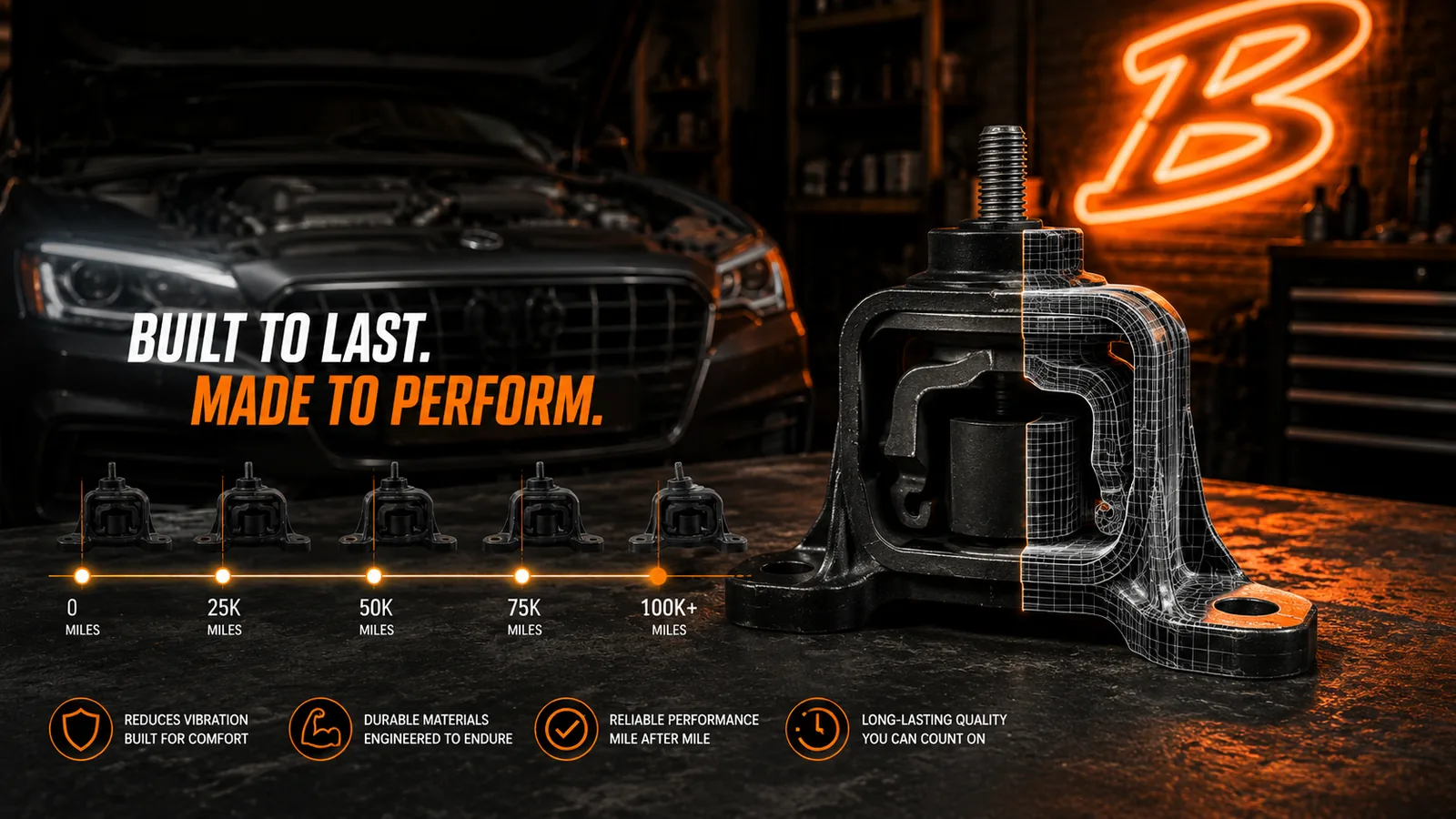
Motor mounts typically last 5-7 years, or roughly 60,000-100,000 miles, and many survive the life of the car. The rubber slowly hardens and cracks somewhere between 80,000 and 150,000 miles. But an oil leak, constant heat, or a cheap replacement mount can destroy one far sooner, sometimes in as little as 3,000-5,000 miles.
There's no single expiration date, because a mount's life depends on how it's built, what's dripping on it, and how you drive. Let's break down the real numbers.
Find the Right Motor Mount for Your Vehicle
Enter your year, make, and model - we'll show only the mounts that fit
How Long Do Engine Mounts Actually Last?
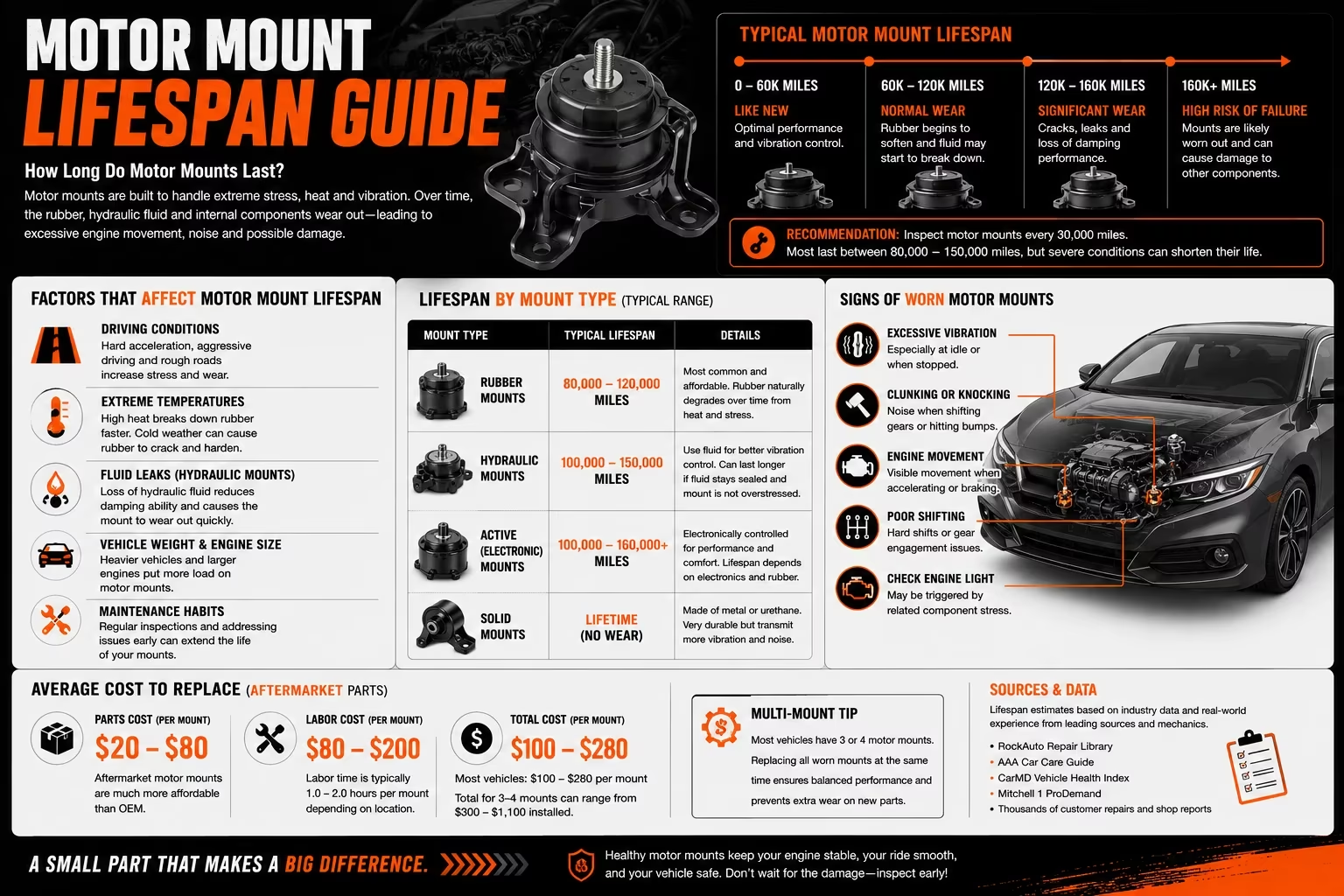
Most factory motor mounts are designed to last the warranty period and then some. In normal driving, the rubber does its job quietly for the first 60,000-80,000 miles. After that, heat cycling and age start to catch up with it. By 100,000-150,000 miles, it's common to have at least one mount that's cracked, sagging, or torn.
The mount's construction matters more than any other single factor. Here's how the common types compare:
| Mount Type | Typical Lifespan | Common Failure Mode |
|---|---|---|
| Solid rubber | 60,000-100,000 mi / 5-7 yr | Rubber hardens, cracks, separates from the metal core |
| Hydraulic (fluid-filled) | 50,000-90,000 mi / 5-7 yr | Fluid chamber leaks, mount collapses and loses damping |
| Polyurethane (performance) | 100,000+ mi | Rarely fails; trade-off is more vibration in the cabin |
| Bargain-bin replacement | 3,000-30,000 mi | Thin or over-hard rubber tears early |
Hydraulic mounts deserve a note. They're filled with fluid to damp vibration better than plain rubber, which is why a lot of modern cars use them. The downside is a second way to fail. Once that fluid chamber springs a leak, the mount goes soft fast and you'll feel it. A leaking hydraulic mount often shows an oily film on the outside.
What Causes Motor Mounts to Go Bad?
Mounts almost never wear out on a clean odometer schedule. Something usually pushes them there early. These are the real killers:
| Cause | What's Happening | How Fast It Kills a Mount |
|---|---|---|
| Oil or fluid leak | Petroleum chemically eats and softens rubber | Weeks to months |
| Heat cycling | Repeated hot/cold cycles harden and crack rubber | Gradual, over years |
| Hard launches / aggressive driving | Big torque spikes load-cycle the rubber harder | Accelerates normal wear |
| Cheap replacement part | Thin or over-hard rubber can't take the load | 3,000-5,000 miles |
| Age & high mileage | Normal rubber fatigue | 80,000-150,000 mi |
Oil is the big one. Rubber and petroleum don't mix. If you have a leaking valve cover gasket or an oil pan seep dripping straight down onto a mount, the rubber will swell, soften, and disintegrate long before its time. If you're replacing a mount, fix the leak above it first, otherwise the new one is on the same countdown.
Heat is the slow, unavoidable one. The engine bay runs hot, and every heat cycle stiffens the rubber a little more. That's why age matters even on a low-mileage car. A 12-year-old mount with 40,000 miles can still be cracked and brittle.
Does Aggressive Driving Wear Mounts Faster?
Yes. Every hard launch, every aggressive shift, every time the engine snaps against its mounts under full torque, you're load-cycling the rubber. Cars that get driven hard, tow heavy, or run more powerful engines chew through mounts faster than a commuter that never sees wide-open throttle. It won't halve the lifespan overnight, but a spirited driver will typically be replacing mounts at the earlier end of every range above.
When to Replace Motor Mounts
The honest rule: replace a motor mount at the first confirmed symptom, not on a fixed mileage. A mount doesn't get better once it starts to go. It gets worse, and a fully failed mount lets the engine shift enough to stress hoses, the exhaust, and even the transmission mount.
Watch for these signs (covered in depth in our Bad Motor Mount Symptoms guide):
- A clunk or thud when you shift into Drive or Reverse
- Excess vibration at idle that smooths out as RPM climbs
- The engine visibly jumping or rocking when you blip the throttle
- Vibration through the steering wheel or seat that wasn't there before
One thing that trips people up: a bad motor mount never triggers a check-engine light. There's no sensor on a mount. The car's computer has no idea the rubber is torn. Diagnosis is physical, a visual inspection and a torque test in the bay, not a scan tool.
If you're already in there replacing one worn mount on a high-mileage car, it's often smart to do the set. The others are the same age and have seen the same heat, so they're usually not far behind.
How Long Does It Take to Replace Motor Mounts?
For a straightforward mount on an accessible engine, a shop typically books 1 to 2 hours per mount. Real-world time depends heavily on location and layout:
- Easy, top-accessible mount: 45 minutes to 1.5 hours
- Mount buried behind accessories or subframe: 2-4 hours
- Full set on a transverse (sideways) engine: 3-5+ hours, since the engine has to be supported and lifted to swing the mounts out
The labor, not the part, is what drives the bill on tucked-away mounts. For a full cost breakdown by mount type and vehicle, see our Motor Mount Replacement Cost guide.
Cheap Mounts vs. Quality Mounts
This is where a lot of people get burned. A bargain-bin mount can look identical to a good one in the box, but the rubber is thinner and harder, and it's often not bonded to the metal core properly. Those are the mounts that fail in 3,000-5,000 miles, and now you're paying the labor a second time.
A quality specialist mount is a different part. Westar, a U.S. manufacturer that's specialized in engine and transmission mounts since 1986, engineers the rubber compound and bonding for the load. That's the whole reason a good mount lasts 5-7 years instead of one summer. When the labor to install costs more than the part, buying the mount that actually lasts is the cheaper decision.
Bottom Line
Expect 5-7 years or 60,000-100,000 miles from a healthy set of motor mounts, with rubber breaking down between 80,000 and 150,000 miles. Keep oil off them, don't ignore the first clunk, and don't cheap out on the replacement. The labor is the expensive half, and a quality mount is what keeps you from doing this job twice.
Get the Exact Mount That Fits
Search by year, make, and model and order in minutes
Shop: Motor Mounts · Westar Mounts
FAQ / People Also Ask
Motor mounts typically last 5-7 years or about 60,000-100,000 miles, and many last the life of the vehicle. The rubber usually starts cracking and hardening between 80,000 and 150,000 miles. Oil contamination, heat, aggressive driving, or a cheap replacement part can cut that lifespan dramatically, sometimes to just a few thousand miles.

Comments
Loading comments...
Comments are moderated by the AutoBuffy team.