

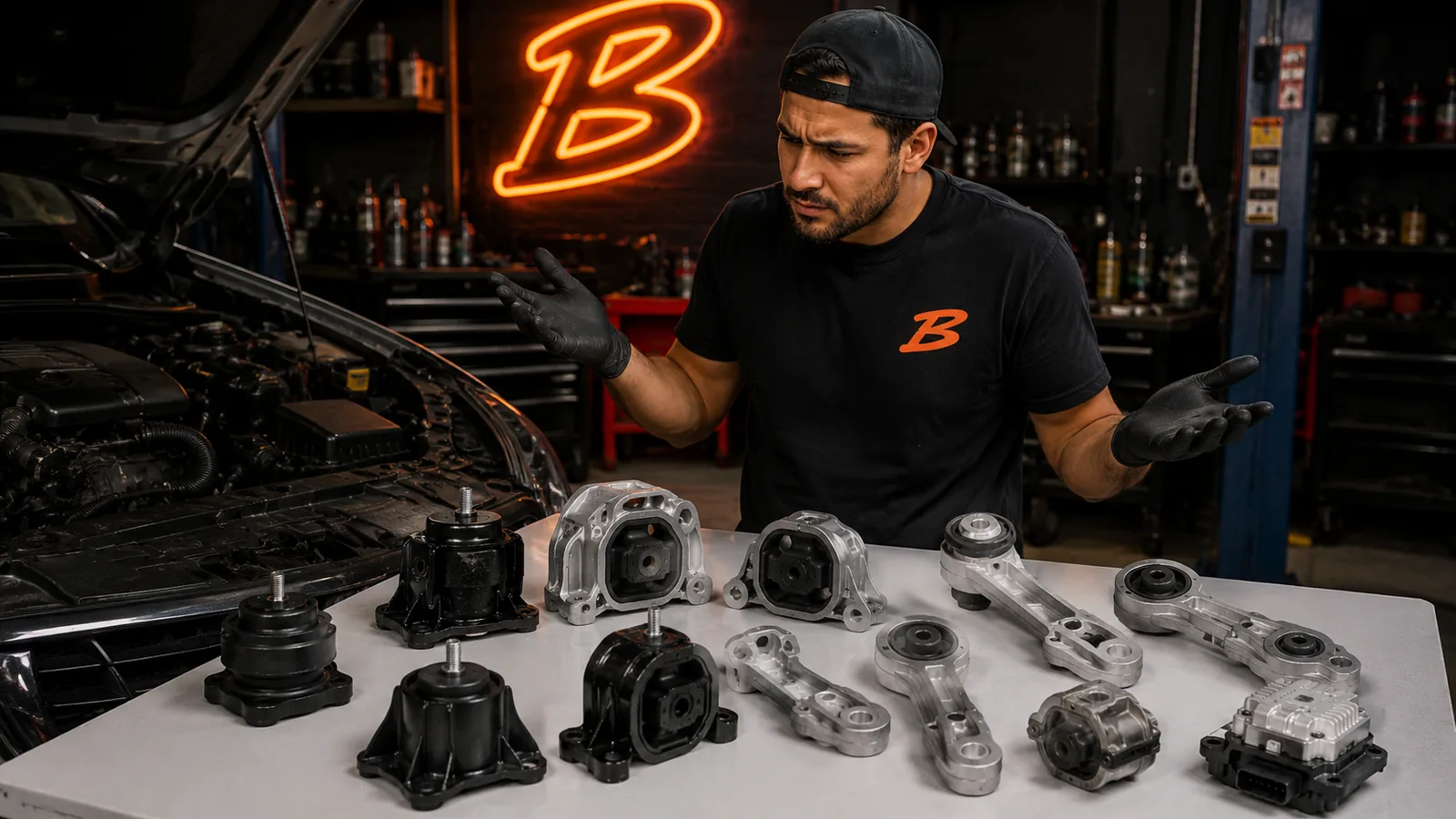
How to Tell Which Motor Mount Is Bad: A Diagnostic Guide
A manufacturer's step-by-step method to pinpoint the exact failed motor mount — the brake-torque test, throttle-blip test, and visual check — plus how many mounts your car actually has.
Most guides tell you a motor mount is "bad" and stop there. That doesn't help when your car has three or four of them and you only want to replace the one that failed. As a mount manufacturer, we build these parts and we test them, so here's the honest, no-BS way to find the *specific* mount that's gone, without a shop diagnostic fee.
The Short Answer
Most front-wheel-drive cars have 3 to 4 motor mounts, two main load-bearing mounts plus one or two torque (dogbone) mounts. To find the bad one, do the brake-torque load test: set the parking brake, chock the wheels, then have a helper shift P→R→D while holding the brake as you watch the engine from the front. It lurches *toward* the failed mount. Confirm with a flashlight. Cracked rubber or oily fluid means that mount is done.
Find the Exact Mount for Your Vehicle
Enter your year, make and model — we'll show only the mounts that fit
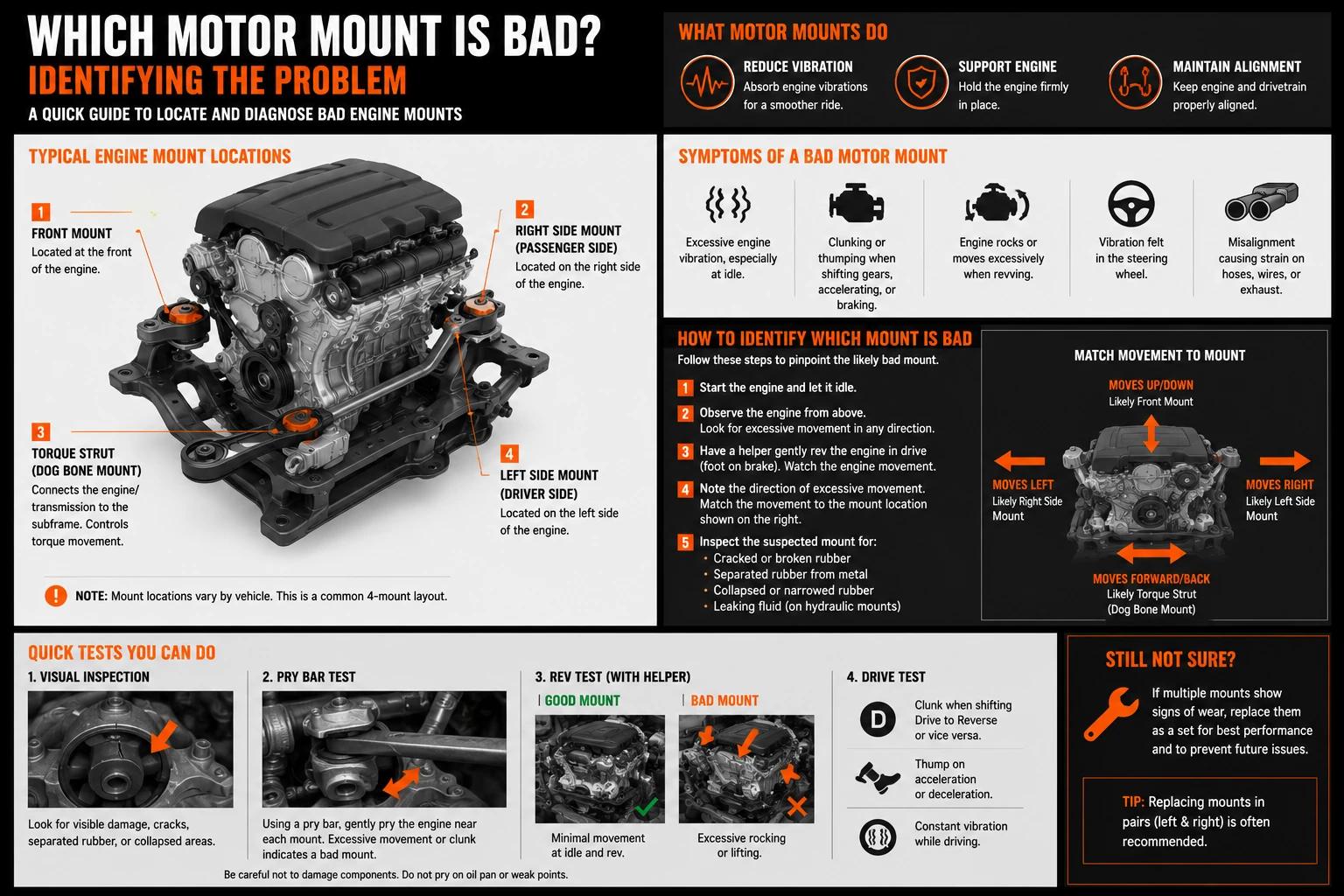
How Many Motor Mounts Does a Car Have?
This is the first thing to nail down, because you can't diagnose "which one" until you know how many there are. It depends almost entirely on drivetrain layout.
| Drivetrain / Layout | Typical Mount Count | What's There |
|---|---|---|
| FWD (transverse engine) | 3–4 | 2 main load-bearing (left/passenger + right/driver or front/rear) + 1–2 torque/dogbone mounts |
| RWD (longitudinal engine) | 3 | 2 engine mounts (driver + passenger side) + 1 separate transmission mount |
| AWD / 4WD | 3–4 | Same as RWD base plus extra bracing depending on transfer case |
| Transverse V6 (e.g. Honda) | 4 | Often includes a hydraulic (fluid-filled) mount to kill idle vibration |
On a transverse FWD car, the engine hangs *sideways* and wants to rock forward and back as you accelerate and brake. That's why it needs those torque mounts (often called a dogbone or torque strut) up top or down low to stop the rocking. RWD cars mount the engine front-to-back, so two side mounts plus a transmission mount at the tail of the gearbox handle it.
The short version: if you're not sure, count on four for a modern FWD car and inspect every one. A failed mount rarely happens in isolation. When one lets go, the others have been carrying extra load and are often next.
Signs of Bad Motor Mounts (Before You Test)
Before you crawl under the car, these symptoms tell you a mount is failing somewhere:
- Clunk or thud when shifting from Park to Drive or Reverse
- Heavy vibration at idle that smooths out as RPM climbs
- A jolt or "chassis shake" on hard acceleration or when letting off the gas
- Engine movement you can see when you blip the throttle
- Clunking over bumps or when turning into a driveway
One important fact: a bad motor mount will never throw a check-engine code. Mounts aren't monitored by the ECU. There's no sensor on them. So don't wait for a dash light. If you feel these symptoms, the diagnosis is on you, and the tests below are how you do it. For the full symptom breakdown, see Bad Motor Mount Symptoms.
The Diagnostic Table: Symptom → Which Mount → Test
This is the map. Match what your car is doing to the mount that's likely responsible, then run the matching test to confirm.
| Symptom | Likely Mount | Confirm With |
|---|---|---|
| Engine lurches forward on hard acceleration | Front / lower mount | Brake-torque test in Drive |
| Clunk on deceleration + when shifting into Reverse | Rear / torque (dogbone) mount | Brake-torque test in Reverse; visual for cracked rubber |
| Vibration at idle + oily film on the mount | Passenger-side hydraulic mount (common on Honda/Acura V6) | Visual for weeping fluid; throttle-blip test |
| Engine rocks side-to-side, thumps on gear change | Upper torque strut | Throttle-blip; pry-bar test |
| Excessive engine "jump" on throttle blip in Park | Weakest mount overall | Watch direction of movement — engine drifts toward the weak side |
| Clunk only over bumps, no drivetrain shake | Worn mount rubber (any) | Pry-bar test on each mount |
The Four Tests, Step by Step
1. The Load / Brake-Torque Test (the money test)
This is the single most reliable way to find the bad mount. Safety first: automatic transmission only, on level ground.
- Set the parking brake firmly and chock the wheels front and back.
- Open the hood. Stand to the front of the engine bay, off to the side, never directly in line with a spinning belt or fan.
- Have a helper start the engine, hold the brake pedal down hard, and shift P → R (pause), then P → D (pause). Keep it brief, a second or two per gear, no revving.
- Watch the engine. A healthy mount holds it nearly still. The engine will lurch toward the side of the failed mount. If it jumps hard toward the passenger side going into Drive, your passenger mount is weak. A hard rock backward on Reverse points to the rear/torque mount.
The engine "loads" against the mounts in each gear, so this test isolates the weak one by direction of movement.
2. The Throttle-Blip Test
In Park, engine running, give the throttle a quick blip (a light tap, you're not redlining it). A good mount system barely moves. If the engine twists or jumps hard, a mount is weak, and it'll drift toward the failing side. Great for spotting a bad upper torque strut.
3. The Visual Inspection
With the engine off, take a flashlight to each mount:
- Rubber mounts: Look for cracked, split, or separated rubber, or a mount where the metal top has visibly dropped closer to the metal base.
- Hydraulic mounts: Look for oily fluid weeping from the mount body. A hydraulic mount is fluid-filled to dampen vibration. Once it leaks, it's dead, and you'll feel it as idle vibration. This is the classic Honda/Acura V6 passenger-mount failure.
4. The Pry-Bar Test
Engine off. Gently lever a pry bar or long screwdriver against each mount and watch the gap. A good mount barely moves. A failed one shifts freely or the rubber pulls away from the metal. Go easy. You're checking for play, not trying to break anything.
Ready to Replace the Bad Mount?
We'll match the exact front, rear, or torque mount to your vehicle
Once You've Found It
When you've isolated the bad mount, replace it, and inspect the rest while you're in there, because a car that's been running on one failed mount has been overworking the others. On many FWD engines the mounts are accessible with hand tools and a floor jack supporting the engine. The torque/dogbone mount is usually the easiest, the hydraulic mount often the most involved.
We're Westar, a US manufacturer building engine and transmission mounts since 1986. Mounts are what we do, which is why we'd rather teach you to diagnose the right one than sell you four. For what the job runs, see Motor Mount Replacement Cost.
Shop the parts: Motor Mounts · Westar Mounts.
Bottom line: count your mounts (3–4 on most FWD cars), match the symptom to the mount in the table above, then confirm with the brake-torque test and a flashlight. No code, no guesswork, no shop fee. Just the failed mount, found.
FAQ / People Also Ask
Use the brake-torque load test: set the parking brake, chock the wheels, and have a helper shift P→R→D while holding the brake as you watch the engine from the front. The engine lurches toward the side of the failed mount. Confirm with a flashlight; cracked rubber or oily fluid weeping from a hydraulic mount identifies the exact bad one.

Comments
Loading comments...
Comments are moderated by the AutoBuffy team.