

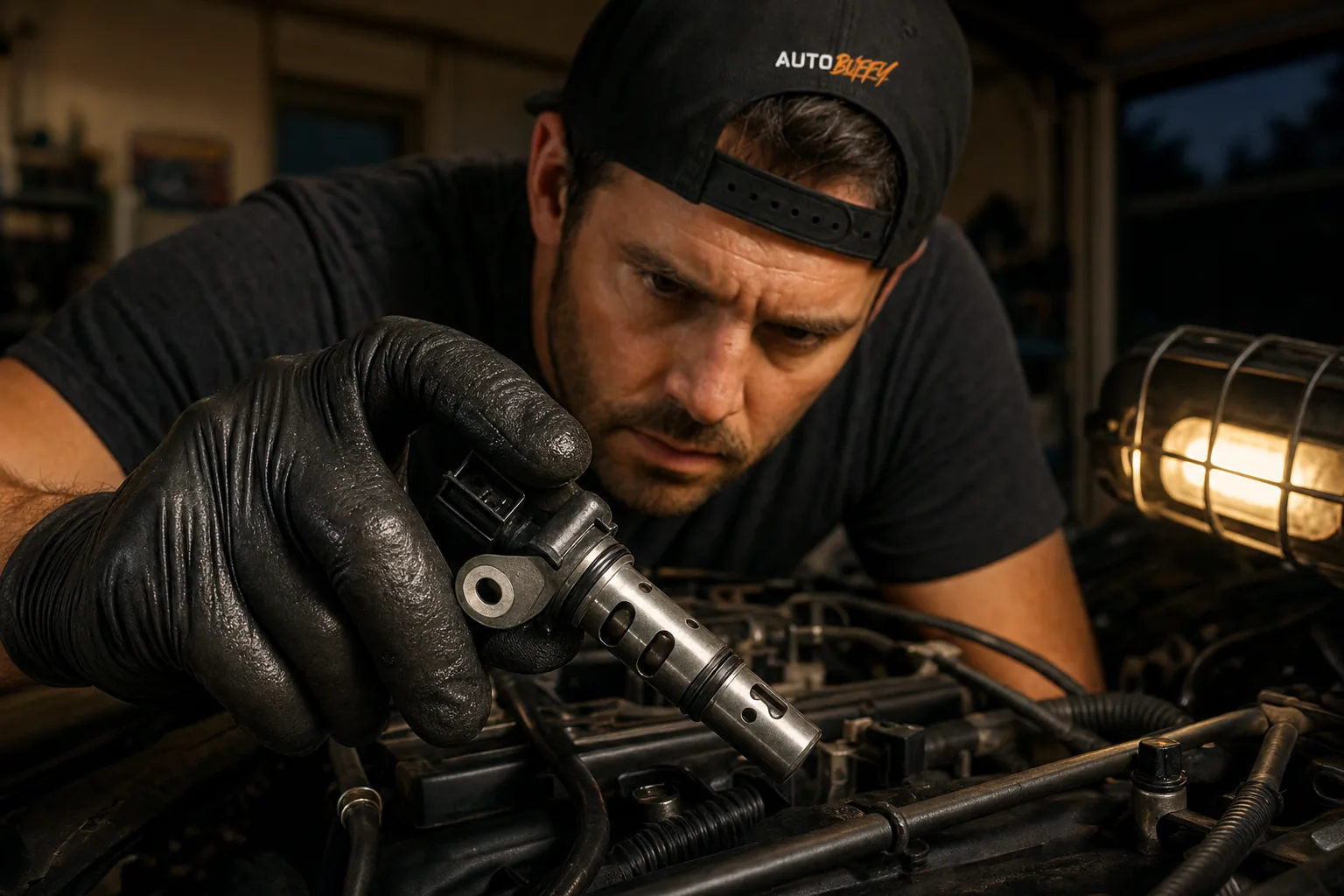
P0014 Code: Camshaft Position Timing Over-Advanced (Bank 1 Exhaust) — Causes and Cost
P0014 means your Bank 1 exhaust cam is stuck over-advanced. Learn the exact fault signature, what sets it apart from P0011/P0012, and how to fix it.
The Short Answer
P0014 means your Bank 1 exhaust camshaft is over-advanced — it's moved beyond its target position and the engine's variable valve timing system can't pull it back, so the ECM logs the fault and lights up your Check Engine light.
| Factor | Details |
|---|---|
| Code definition | Camshaft Position B – Timing Over-Advanced or System Performance (Bank 1) |
| Affected component | Exhaust camshaft, engine side containing cylinder #1 |
| Most common cause | Failed VVT solenoid or dirty/low engine oil |
| DIY solenoid fix | ~$60–$100 in parts |
| Shop OCV replacement | ~$300–$400 |
| Worst-case (timing chain) | $1,000 or more |
| Applies to | All OBD-II vehicles (1996 model year and newer) with VVT |
P0014 vs P0011 / P0012: How to Tell Them Apart
These three codes live close together in the OBD-II index and share some surface-level causes, but the PCM is describing three completely different conditions. Treating them as interchangeable is a reliable way to waste money on parts that won't fix your car.
| Code | What the PCM Actually Saw | Most Likely Cause | First Test |
|---|---|---|---|
| P0011 | Intake cam (Bank 1) over-advanced | Stuck-open intake VVT solenoid | Command solenoid off; watch if intake cam retards |
| P0012 | Intake cam (Bank 1) over-retarded | Stuck-closed intake VVT solenoid, low oil pressure | Command solenoid on; watch if intake cam advances |
| P0014 | Exhaust cam (Bank 1) over-advanced | Stuck-open exhaust VVT solenoid | Command exhaust solenoid off; watch if exhaust cam retards |
The critical difference: P0011 and P0014 both describe an over-advanced condition, but on different camshafts. P0011 is the intake cam; P0014 is the exhaust cam. On engines with dual VVT, there are separate solenoids for each — replacing the wrong one fixes nothing. P0012 is a retarded (not advanced) intake cam fault, which is essentially the opposite direction of error.
If you're staring at P0014, the cam that's misbehaving is exhaust-side, Bank 1. That distinction matters for both the test procedure and the part you need.
The Exact Fault Signature for P0014
Here's what's actually happening inside the PCM when it logs this code — and why it's not a generic "sensor problem."
The PCM sends a duty-cycle command to the exhaust camshaft oil control valve (OCV), telling it how far to advance or retard the exhaust cam. Simultaneously, the camshaft position sensor reports actual cam position back to the PCM as a voltage signal tied to reluctor ring teeth passing the sensor. The PCM compares those two numbers continuously.
P0014 sets when:
- The actual exhaust cam position exceeds the commanded target by more than a calibrated threshold — typically around 10–15 degrees of crankshaft rotation, though the exact value is manufacturer-specific.
- That over-advanced error persists for a continuous dwell period, commonly 5–10 seconds, within the monitor's enable window.
- The cam appears stuck in an advanced state regardless of what the PCM commands.
Enable criteria the PCM needs before it can run this monitor:
- Coolant temperature at or above the closed-loop threshold (usually 140–170°F)
- Engine speed within a normal operating band — generally above idle, often 500–3,000 RPM
- The VVT solenoid actively commanded to a position other than full advance
In plain English: the engine has to be warm and running before the PCM even evaluates cam timing. That's why P0014 sometimes doesn't set on a cold start — the monitor isn't awake yet.
What makes P0014 different from a sensor code is that this is a rationality fault. The PCM isn't just seeing a bad voltage; it's comparing commanded vs. actual position and finding a persistent mismatch in one direction. A fully dead sensor would set a circuit code (P0340 or P0341). P0014 means the sensor is reporting something, and what it's reporting is that the exhaust cam is further advanced than it should be.
Ranked Probable Causes — With a "How Common" Note
1. Failed or Clogged Exhaust VVT Solenoid (Very Common)
This is where most P0014 cases land. The exhaust OCV controls hydraulic pressure to the exhaust cam phaser. When it sticks open — electrically or mechanically due to oil sludge — the cam advances and won't retract regardless of what the PCM commands. On engines with two VVT solenoids, confirm you're testing the exhaust-side one. They're often similar-looking parts in close proximity.
2. Low or Degraded Engine Oil (Common — and Cheap to Rule Out)
The VVT system is hydraulic. No proper oil pressure, no cam control. If your oil is low, well past its change interval, or the wrong viscosity for your engine, the phaser can't generate enough force to retard the cam. Check this before touching any parts. A fresh oil change with the correct viscosity spec fixes the problem outright more often than people expect.
3. Faulty Camshaft Position Sensor (Moderately Common)
A deteriorating sensor can report erratic or offset cam position data, making the PCM calculate an over-advanced position even when the hardware is functioning normally. Look for companion codes P0340 or P0341 — if either appears alongside P0014, the sensor and its circuit should come before the solenoid in your diagnostic sequence.
4. Worn Timing Chain or Stretched Chain (Less Common, Most Expensive)
A stretched chain introduces real mechanical cam timing error — the cam is genuinely in the wrong position, not just being misread. A new solenoid won't fix this. Watch for P0016 (crankshaft/camshaft correlation) alongside P0014, and listen for chain rattle on cold starts. If both are present, the timing chain kit is the likely answer.
5. Wiring or Connector Faults (Less Common, Easy to Miss)
Corrosion at the exhaust VVT solenoid connector, a chafed wire, or a poor ground can cause intermittent or persistent P0014 without any mechanical failure at all. Always inspect the connector and test resistance before condemning the solenoid.
Diagnostic Sequence — Starting From P0014's Signature
This sequence follows the fault logic, not a generic parts-replacement script:
- Scan and record everything. Note all codes present — not just P0014. Companion codes like P0340, P0016, or P0013 fundamentally change the diagnostic path.
- Check oil level and condition first. If it's low or overdue, change it with the correct viscosity and clear the code. Drive for a full day. If P0014 doesn't return, you're done.
- Inspect the exhaust VVT solenoid connector. Look for corrosion, bent pins, or moisture intrusion. Clean with electrical contact cleaner and reseat firmly.
- Test solenoid resistance. With a multimeter across the solenoid terminals, compare resistance to your service manual spec. An open or shorted winding means the solenoid needs replacement.
- Use live scan data to command the solenoid. With a capable scan tool, command the exhaust VVT solenoid to 0% duty cycle (fully retarded) and watch the actual cam position value. If the cam doesn't move toward retard, the solenoid or its hydraulic circuit is the problem.
- Check for P0016 and listen for cold-start rattle. If cam timing moves but correlation remains off, or if you hear a rattle that quiets after a few seconds of running, suspect chain wear. That's the expensive path.
Symptoms You'll Notice
- Rough idle, especially when the engine is cold
- Hesitation or stumble on acceleration
- Reduced fuel economy — sometimes noticeably
- Hard starting in cold weather
- Check Engine light — solid, or flashing in severe cases
- Rattling on startup — a red flag for chain issues or oil starvation
Some drivers feel almost nothing until the problem compounds. A mild symptom doesn't mean a mild problem.
Can P0014 Damage My Engine?
Yes, over time. An exhaust cam stuck over-advanced puts extra mechanical stress on the timing chain, phaser, and valvetrain. It also disrupts exhaust valve timing, which affects combustion efficiency and can accelerate carbon buildup. The longer P0014 stays active, the more likely a straightforward solenoid fix turns into a timing chain replacement. Fix it promptly.
Related Codes to Know
- P0010 — Intake camshaft actuator circuit, Bank 1 (circuit fault, not rationality)
- P0013 — Exhaust camshaft position actuator circuit, Bank 1 (wiring/circuit)
- P0016 — Crankshaft/camshaft correlation fault (chain wear signal)
- P0340 / P0341 — Camshaft position sensor circuit, Bank 1
If P0016 appears with P0014, take the timing chain possibility seriously before spending money on solenoids.
Sources
- SAE J2012 OBD-II DTC Definitions
- OBD-II Powertrain Diagnostic Trouble Codes, generic B-camshaft rationality monitor specifications
- Engine manufacturer VVT system service documentation (consult your vehicle-specific service manual for exact degree thresholds and enable criteria)
Find the right VVT solenoid for your vehicle
Guaranteed fit, ships free
FAQ / People Also Ask
P0014 is defined as 'Camshaft Position B – Timing Over-Advanced or System Performance (Bank 1).' The 'B' camshaft is the exhaust cam. The PCM is telling you that on the engine side containing cylinder #1, the exhaust cam has moved beyond its commanded target and stayed there — the VVT system can't pull it back into spec.
Comments
Loading comments...
Comments are moderated by the AutoBuffy team.