

P0087: Fuel Rail/System Pressure Too Low — Causes & Fix Cost
P0087 means fuel pressure dropped below spec. Here's every cause, real fix costs, and how to avoid a $5,000+ pump disaster.
The Short Answer
P0087 means your PCM detected that fuel rail pressure dropped below the minimum threshold your engine needs to run correctly, and you need to find and fix that pressure loss before it causes lean-condition damage or leaves you stranded.
| Likely Cause | DIY Difficulty | Typical Part Cost | Typical Labor Cost |
|---|---|---|---|
| Low fuel level | None | $0 | $0 |
| Clogged fuel filter | Easy | $20–$80 | $50–$120 |
| Fuel pressure regulator | Moderate | $30–$150 | $80–$200 |
| Weak in-tank fuel pump | Moderate | $150–$450 | $150–$400 |
| Fuel Pump Driver Module (FPDM) | Moderate | $80–$300 | $80–$200 |
| Clogged fuel injectors | Moderate | $15–$80 (cleaning) | $100–$250 |
| CP4 diesel pump failure | Professional only | $5,000+ total | Included |
What Does P0087 Actually Mean?
P0087 is a generic OBD-II powertrain code — officially defined as "Fuel Rail/System Pressure – Too Low." It applies to every vehicle with electronic fuel injection, regardless of make or model. When your PCM sees actual fuel rail pressure running consistently below its programmed target (the threshold varies by engine), it logs P0087 and usually trips the check engine light.
The PCM isn't just being paranoid. Modern engines need tightly controlled fuel pressure to calculate accurate injector pulse widths. Too little pressure means too little fuel, which means a lean air/fuel mixture — and lean combustion runs hot and can damage pistons, O2 sensors, and catalytic converters over time.
Symptoms You'll Notice
P0087 doesn't always announce itself dramatically. Sometimes it's subtle, sometimes it's impossible to miss.
- Hard starts — especially hot starts after the engine has been sitting a short time
- Hesitation or stumble during acceleration, particularly under load
- Power loss at highway speeds when fuel demand peaks
- Engine stalling, often at idle or low RPM
- Rough idle that smooths out above 1,500 RPM
- In bad cases, no-start conditions
If the symptoms show up mainly under load — climbing a hill, towing, accelerating onto a highway — that's a strong hint the fuel pump is wearing out. It can hold pressure at idle but can't keep up when demand spikes.
Start With the Free Stuff
Before you order any parts, do these two things:
- Check your fuel level. Running on fumes lets the pump suck air. It sounds obvious, but a near-empty tank causes enough pressure drop to trigger P0087. Fill up, clear the code, and see if it returns.
- Check for a TSB or recall. Certain 2017–2024 Subaru, 2018–2022 Honda, and 2017–2019 Nissan models have manufacturer technical service bulletins covering P0087 — sometimes an ECM software update or a free fuel pump replacement fully resolves it. Search your VIN on NHTSA.gov before spending a dime on parts.
The Real Causes, In Order of Likelihood
Clogged Fuel Filter
This is where most P0087 diagnoses should start. A plugged filter restricts flow enough to starve the rail even when the pump itself is healthy. Filter replacement is cheap and quick — typically under $80 in parts. On many modern vehicles the filter is integrated into the fuel pump module inside the tank, so this repair merges with the pump replacement, but on older platforms it's a standalone job.
Weak or Failing Fuel Pump
The in-tank pump is the most common hardware culprit, especially on higher-mileage vehicles. Pumps wear gradually — they'll hold pressure at idle but can't maintain spec under load. A fuel pressure gauge test (done at the Schrader valve on the fuel rail) will confirm it. If you see pressure that's low across the board or that collapses during a snap-throttle test, the pump is your answer.
In my experience, a pump that's been starved by low fuel repeatedly — those people who habitually run below a quarter tank — often fails at 80,000–100,000 miles instead of lasting to 150,000 or beyond.
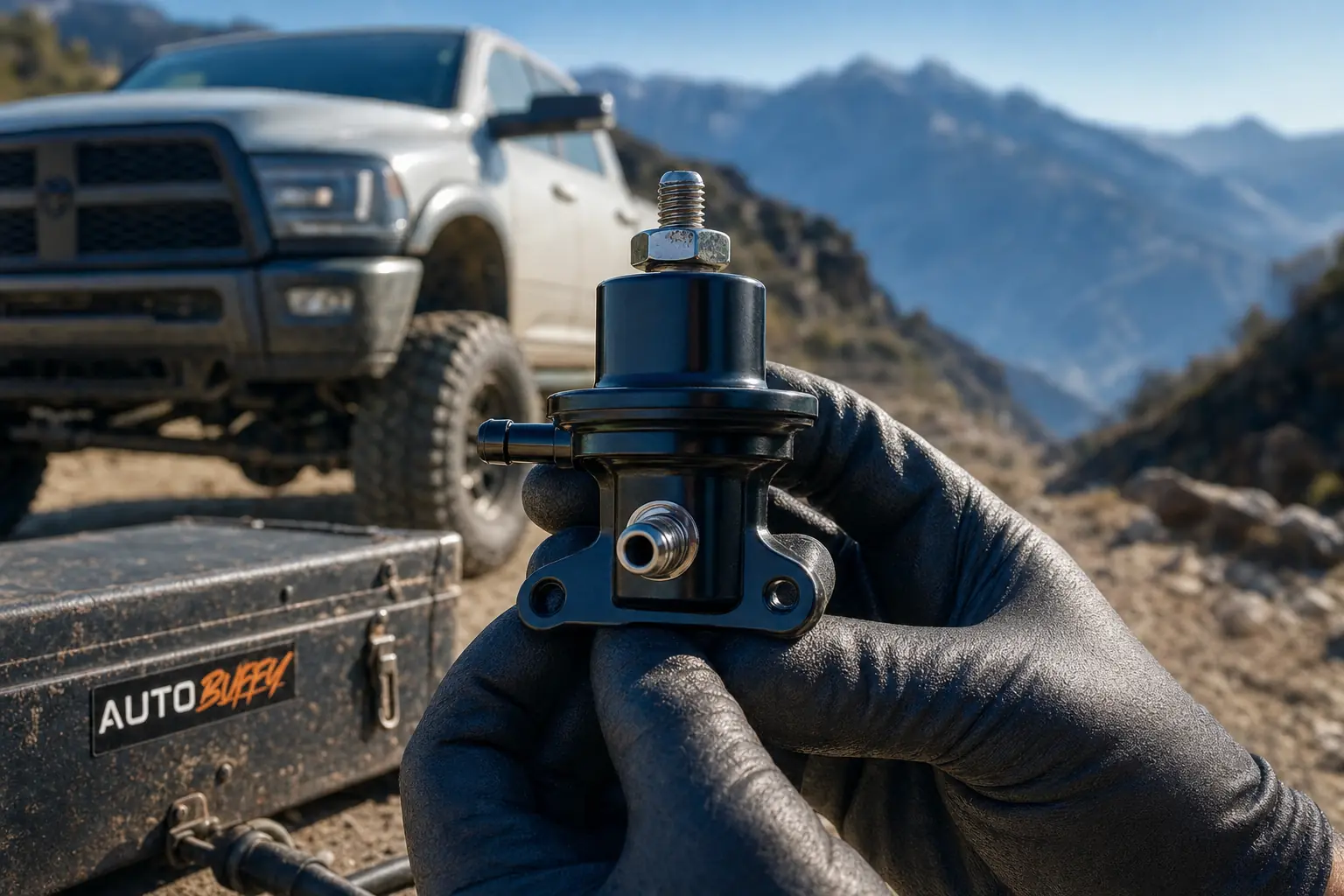
Fuel Pressure Regulator
On older returnless fuel systems, a mechanical pressure regulator controls rail pressure directly. When it fails — either sticking open or losing its ability to maintain pressure — rail pressure drops and P0087 follows. You can sometimes diagnose this by watching pressure bleed-off after shutdown: if pressure drops rapidly to zero within a minute or two of the engine stopping, the regulator isn't holding.
It's worth noting that newer vehicles don't use a traditional pressure regulator in the same way. Instead, they rely on a Fuel Pump Driver Module (FPDM) that electronically varies pump speed and therefore rail pressure. A failing FPDM can cause identical symptoms and the same P0087 code — but replacing a pressure regulator won't fix it. Know which system your vehicle uses before buying parts.
Clogged Fuel Injectors
Restricted injectors increase backpressure in the system and reduce actual fuel delivery, which can pull rail pressure down. This is more common on high-mileage engines that've run a lot of low-quality fuel. Injector cleaning service ($50–$200 at a shop) is worth trying if the pump and regulator check out.
The Diesel CP4 Pump Problem — Don't Ignore This
If you're driving a 2011–2016 Ford or GM diesel truck and P0087 is paired with metal shavings in the fuel filter housing, stop driving immediately. This is a documented catastrophic failure pattern for the CP4 high-pressure fuel pump. Metal debris from the disintegrating pump circulates through the entire fuel system, contaminating injectors, lines, and the tank. The repair typically runs $5,000 or more for a full system overhaul. Catching it early — before the metal spreads — can sometimes reduce the scope of damage, but this is a shop job, not a DIY fix.
How to Diagnose It Yourself
A basic fuel pressure gauge (rents free at most auto parts stores) tells you most of what you need to know:
- Connect the gauge to the Schrader valve on the fuel rail — most EFI engines have one.
- Cycle the ignition to "on" without cranking. The pump should prime and build pressure. Note the reading and compare to your vehicle's spec.
- Start the engine and let it idle. Pressure should hold steady within spec.
- Have a helper snap the throttle while you watch the gauge. Pressure should drop momentarily but recover fast. If it drops and stays low, the pump can't keep up with demand.
- Shut the engine off and watch pressure over the next few minutes. A healthy system holds pressure for at least 20–30 minutes. Rapid bleed-off points to the regulator, a leaking injector, or a failing pump check valve.
Fix Cost Summary
Costs vary a lot by vehicle and labor market, but here's an honest range:
- Fuel filter only: $20–$80 parts, $50–$120 labor if shop-done
- Fuel pressure regulator: $30–$150 parts, $80–$200 labor
- In-tank fuel pump: $150–$450 parts, $150–$400 labor (more on trucks and AWD vehicles where tank drop is complex)
- FPDM replacement: $80–$300 parts, $80–$200 labor
- Diesel CP4 failure: $5,000+ all-in, no shortcuts
For your exact part fit and current pricing, use the finder below — it'll match to your specific year, make, engine, and trim.
Find the right part for your vehicle
Guaranteed fit, ships free
FAQ / People Also Ask
Not really. Low fuel pressure causes the engine to run lean, which can damage pistons and catalytic converters over time. Short trips to a shop are fine, but don't ignore it or drive at highway speeds for extended periods.
Comments
Loading comments...
Comments are moderated by the AutoBuffy team.