

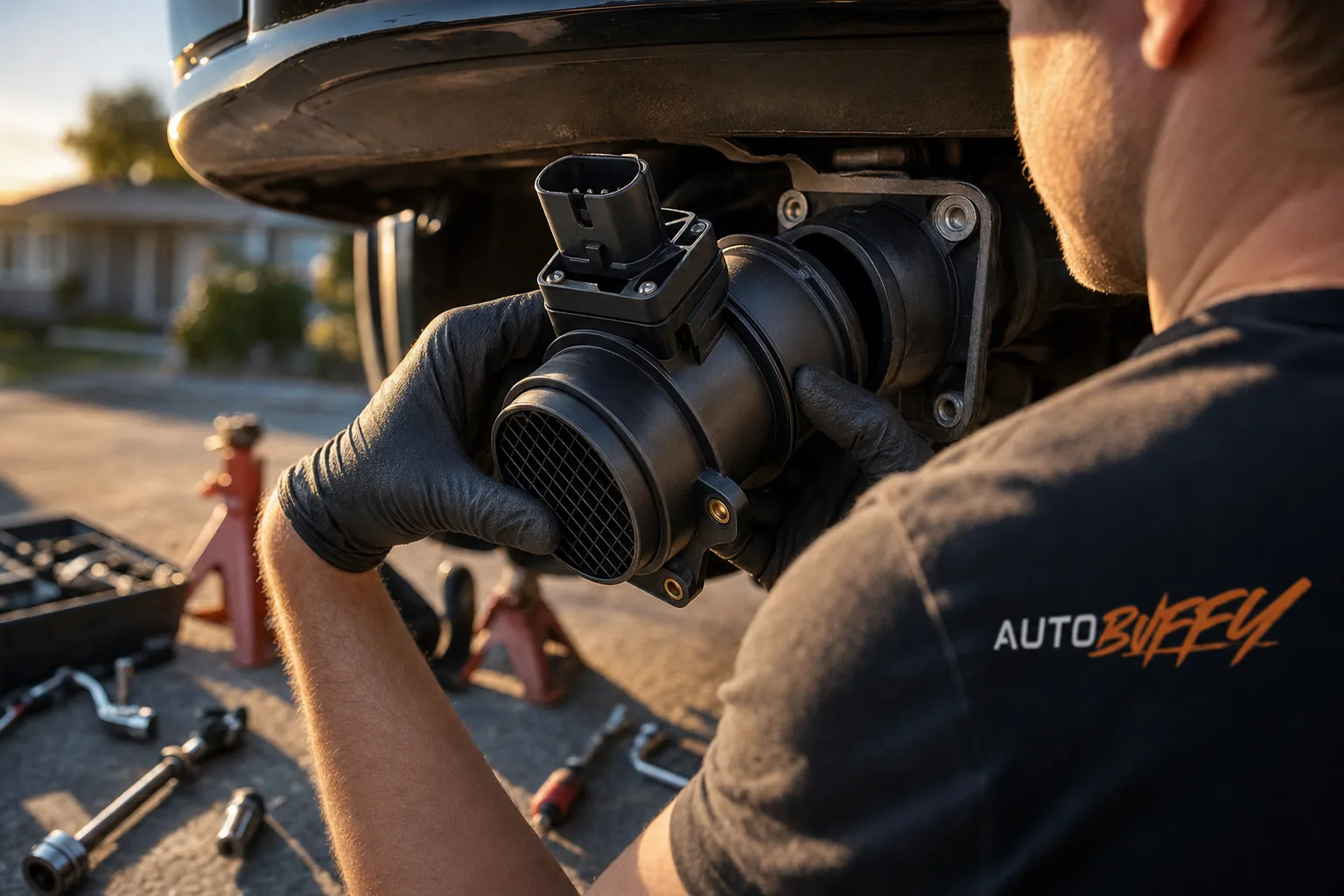
P0102 Code: Mass Air Flow Sensor Circuit Low Input — Causes, Fix, and Cost
P0102 means your ECM sees a low signal from the MAF circuit. Learn the real causes, DIY fixes, and what a repair costs before you replace anything.
The Short Answer
P0102 means your engine control module is detecting a lower-than-expected voltage or frequency signal from the Mass or Volume Air Flow "A" circuit — it's a circuit fault, not an automatic death sentence for the sensor itself.
| Factor | Detail |
|---|---|
| Official SAE Title | Mass or Volume Air Flow "A" Circuit Low Input |
| Code Type | Generic OBD-II (applies to most makes/models) |
| Sensor Location | Between air filter and throttle body |
| Most Common Cause | Dirty/contaminated MAF sensor hot wire |
| DIY Fix Cost | $8–$15 (MAF cleaner) |
| Sensor Replacement Cost | $150–$800+ (parts + labor, varies by vehicle) |
| Safe to Drive? | Short term only — catalytic converter risk if ignored |
| Repair Urgency | Moderate-high |
What Exactly Is the P0102 Code? The ECM monitors the MAF sensor's output signal constantly. That sensor sits between your air filter box and throttle body and measures exactly how much air is entering the engine on every intake stroke. Most modern vehicles use a **hot-wire MAF sensor** — a thin heated wire suspended in the airflow path whose electrical resistance changes as air cools it. The ECM uses that resistance change to calculate airflow in grams per second. When the signal falls below a calibrated minimum threshold, the ECM stores P0102 and lights the check engine lamp. It's worth repeating: P0102 flags the **circuit**, not just the sensor. That means wiring, connectors, and grounds are all fair game before you order parts. Don't confuse this with **P0101**, which flags a range or performance problem — signal is there, but doesn't match what other sensors expect. P0102 is specifically about a signal that's too *low*. ---
Symptoms to Watch For
You might not feel much at first, or the car might be barely drivable. Typical P0102 symptoms include:
- Check engine light (obviously)
- Hard start or stall at cold startup
- Rich-running condition — black smoke, fuel smell from exhaust
- Poor fuel economy
- Sluggish acceleration or hesitation
- Idle that hunts or surges
Some drivers report no noticeable drivability issues at all, especially if the code was triggered by a brief contamination event. Don't let that fool you — ignoring P0102 long-term can decrease fuel efficiency, increase emissions, and damage the catalytic converter over time. ---
The 6 Most Common Causes of P0102
1. Contaminated or Dirty MAF Sensor Wire
This is the number-one culprit. Oil mist from an over-oiled aftermarket air filter (like certain oiled-cotton gauze types), dust, or fine debris can coat the hot wire and reduce its ability to respond to airflow changes. The signal drops. P0102 sets. ### 2. Air Intake Leak Between MAF Sensor and Throttle Body
Any crack in an intake boot, loose hose clamp, or failed gasket lets unmetered air bypass the sensor entirely. The engine is getting more air than the MAF is reporting, but from the ECM's perspective the MAF output looks low relative to other data. ### 3. Damaged, Corroded, or Loose Wiring/Connector
The MAF sensor wiring harness runs in a warm, vibration-prone environment. Pins back out, connectors corrode, and wires chafe against brackets over years of use. A high-resistance connection in the signal wire will drag the voltage reading down — same effect as a bad sensor, different fix. ### 4. Failed MAF Sensor
Eventually sensors do fail outright. The hot wire can break, the circuit board inside the sensor housing can develop cracks, or the thermistor circuit can drift too far out of calibration. At that point cleaning won't help and replacement is the fix. ### 5. Weak or Missing Ground
The MAF sensor shares a ground circuit with other components. A corroded chassis ground, a loose ground strap at the battery or engine block, or high resistance in the sensor's dedicated ground wire can pull the signal voltage down enough to trigger P0102. ### 6. Failed or Incorrect Air Filter
A collapsed air filter element severely restricts airflow through the sensor. The sensor reads accurately — there genuinely isn't much air moving — but the ECM knows that can't be right at normal RPM and flags the low reading. ---
How to Diagnose P0102 — Step by Step
Don't throw a MAF sensor at this code without working through the basics first. Here's a logical sequence that saves money most of the time. 1. Scan and document — Pull the full freeze frame data. Note RPM, coolant temp, and engine load at the time of the fault. That context matters. 2. Check the air filter — Pull it and inspect. Collapsed, soaked in oil, or packed with debris? Replace it before anything else. 3. Inspect the intake tract — With the engine off, trace the intake tube from the airbox to the throttle body. Squeeze every hose, look for cracks, check every clamp. Any gap = unmetered air. 4. Inspect the MAF connector — Unplug it. Look for bent pins, green corrosion, or moisture inside the connector body. Use electrical contact cleaner and a small pick if needed. 5. Clean the MAF sensor — Use a dedicated MAF sensor cleaner (NOT generic parts cleaner or brake cleaner). Spray 10–12 short bursts directly on the wire element and let it air dry completely — at least 30 minutes. Reinstall, clear codes, test drive. 6. Check live MAF data — With an OBD-II scanner showing live data, watch grams-per-second at idle. Most naturally aspirated gas engines should read roughly 2–7 g/s at a warm idle. If it's near zero or flatlined, suspect a wiring or sensor fault. 7. Test wiring with a multimeter — With the sensor plugged in and key-on, check the signal wire voltage or frequency output per your vehicle's service data. Compare to spec. Then check ground resistance — it should be less than 0.5 ohms to chassis ground. 8. Replace the MAF sensor — If cleaning and wiring checks didn't resolve it, the sensor itself has failed. > One honest opinion: In 15 years of looking at MAF-related codes, the vast majority of P0102 cases on vehicles under 100,000 miles trace back to a dirty sensor from an over-oiled aftermarket filter. Clean the sensor and switch to a dry-element filter if you're using an oiled type. That combination fixes it about 60–65% of the time without any parts purchase at all. ---
What Brand MAF Sensor Should You Buy? Because P0102 is a generic code that affects virtually every OBD-II vehicle, the right answer depends entirely on your make and model. A few honest guidelines:
Bosch is the OE supplier for many European vehicles — Volkswagen, Audi, Porsche, BMW — and their sensors for those applications are as close to factory-spec as you'll find on the aftermarket. They also supply sensors for several Korean and domestic platforms. DENSO is the OE or OE-equivalent supplier for a wide range of Toyota, Volvo, and other Asian-market vehicles. If your vehicle originally had a DENSO sensor, staying with DENSO is the straightforward call. Motorcraft is Ford's OE parts brand. For Ford and Lincoln vehicles, Motorcraft MAF sensors are exactly what the factory specced. There's no reason to speculate about quality — it's the same sensor. VEMO specializes in European vehicle electrical and sensor components. For Mercedes-Benz, BMW, and other European applications, their sensors are a well-regarded choice. SKP offers broad coverage across multiple makes and is worth considering when OE-brand fitment isn't available or the budget is a genuine concern. The cleanest way to find the right sensor for your specific year, make, and model — and confirm fitment before you order — is the part finder below. ---
Repair Cost Breakdown
| Repair Step | Typical Cost |
|---|---|
| MAF sensor cleaner (DIY) | $8–$15 |
| MAF sensor replacement (part only) | $50–$750+ |
| Shop labor (diagnosis + replace) | $75–$200 |
| Total at independent shop | $150–$800+ |
European luxury vehicles (Porsche, Mercedes-Benz) sit at the higher end of that sensor cost range. Domestic and Japanese vehicles typically land in the middle. If you're paying dealer labor rates, add 20–40% to the labor estimate. ---
Can You Pass Emissions With P0102? No. An illuminated check engine light is an automatic emissions test failure in the vast majority of U.S. states. Beyond the light itself, P0102 indicates the air-fuel mixture is likely off, which means real emissions are probably elevated too. Fix the root cause, clear the code, and let the readiness monitors complete a drive cycle before heading to the testing station. ---
Find the right MAF sensor for your vehicle
Guaranteed fit, ships free
FAQ / People Also Ask
P0102 is officially titled 'Mass or Volume Air Flow A Circuit Low Input.' It means the ECM/PCM is receiving a signal from the MAF sensor circuit that is lower than the expected range — it flags a circuit problem, not necessarily a failed sensor outright.
Comments
Loading comments...
Comments are moderated by the AutoBuffy team.