

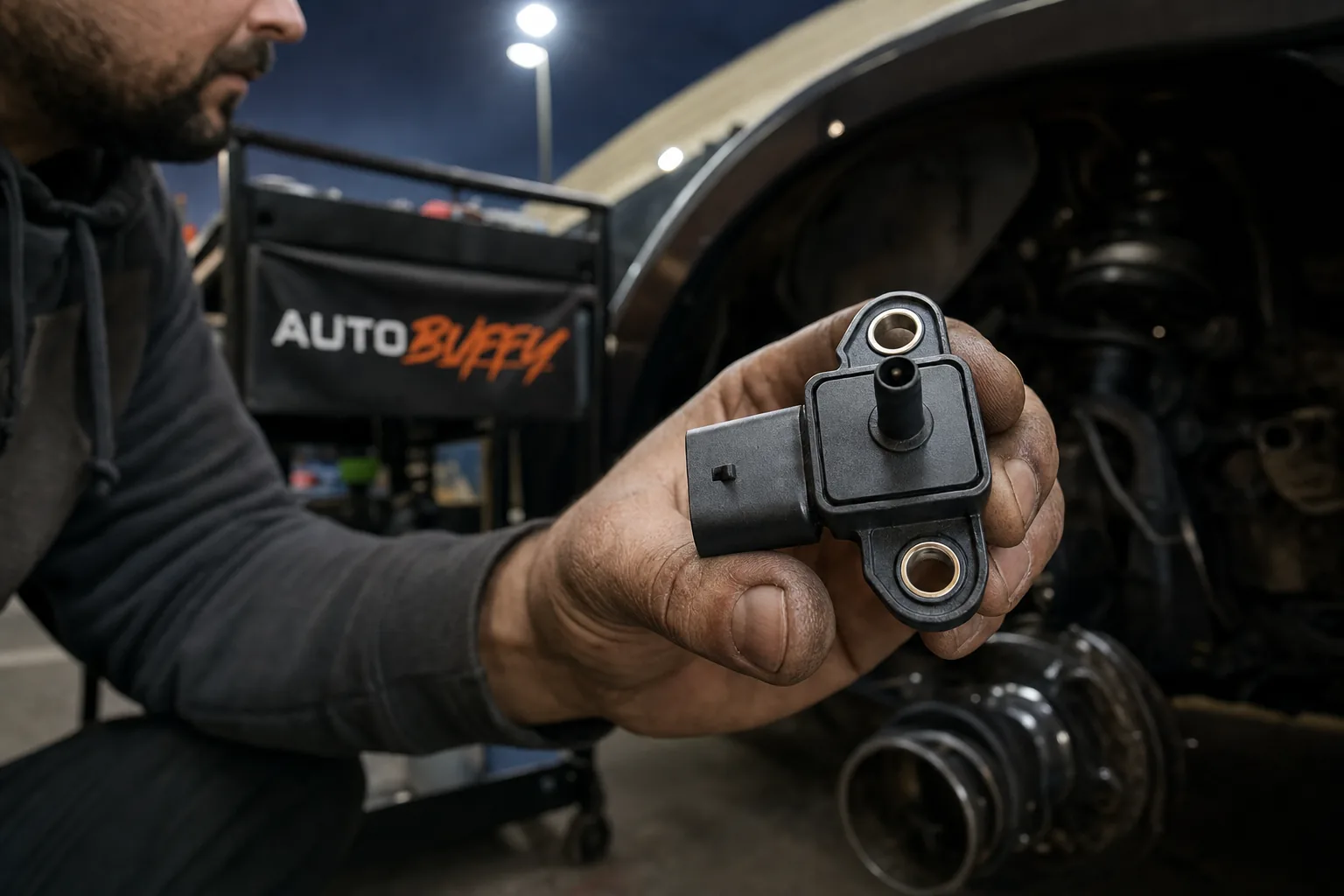
P0106: MAP Sensor Range/Performance — Symptoms, Causes, Cost
P0106 means your PCM is getting erratic MAP sensor readings. Here's what causes it, what it costs to fix, and how to clear it fast.
The Short Answer
P0106 means your powertrain control module (PCM) is receiving MAP or BARO sensor signals that fall outside the expected voltage range or behave erratically — and until you fix it, your engine can't meter fuel or manage timing accurately.
| Detail | Info |
|---|---|
| Full code name | Manifold Absolute Pressure/BARO Sensor Range/Performance |
| Code type | Generic SAE (applies to most OBD2 vehicles) |
| Normal MAP sensor voltage | 1–4.5V depending on engine load |
| Most common cause | Cracked/disconnected vacuum line |
| DIY difficulty | Easy to moderate |
| Typical repair cost | $80–$270 (parts + labor) |
| Can you drive with it? | Short term, cautiously — fix it soon |
What P0106 Actually Means
Your MAP sensor measures manifold absolute pressure — essentially, how hard the engine is working to pull in air. The PCM uses that pressure reading to calculate air density, then adjusts fuel delivery and ignition timing accordingly. It's a continuous loop happening hundreds of times per second.
When the PCM sees MAP sensor voltage that doesn't match what it expects for a given throttle position, RPM, and engine temperature, it logs P0106. "Range/performance" is OBD2 speak for "the signal isn't dead — it's just wrong."
A completely dead sensor (stuck at 0V or 5V) usually throws P0107 or P0108 instead. P0106 is sneakier: the sensor is alive, but what it's saying doesn't add up.
Common Symptoms of P0106
You might notice several of these, or just one. It varies a lot by how far off the readings are.
- Rough idle or stalling — the PCM can't maintain the right air-fuel ratio at low RPM
- Poor acceleration — hesitation or a flat spot when you press the throttle
- Check engine light — this is usually what sends people to the code reader
- Worse fuel economy — running rich on a fixed map burns more gas
- Failed emissions test — erratic fueling causes elevated hydrocarbon output
- Engine surging — RPMs hunt up and down at steady throttle
Not every car shows all of these. On some vehicles, especially newer ones with aggressive fail-safe modes, you might just get the light and a slight mpg hit.
What Causes P0106
Cracked or Loose Vacuum Line
This is the single most common cause, and it costs nothing to check. The MAP sensor connects to the intake manifold via a small rubber vacuum hose. Over time — especially with heat cycling — these hoses crack, split at the ends, or simply pop off their fittings. A leak there means manifold vacuum isn't reaching the sensor accurately.
Spend five minutes tracing the vacuum line before you buy anything.
Dirty or Contaminated MAP Sensor
Oil vapors from the PCV system and general engine gunk can coat the MAP sensor's pressure port and sensing element. A light cleaning with electrical contact cleaner sometimes fixes this without any parts.
Failed MAP Sensor
Sensors do wear out. The internal sensing element can degrade and produce erratic readings even when the wiring is perfect. If the vacuum line is intact and the connector is clean, sensor replacement is the likely fix.
Wiring or Connector Issues
Corrosion at the sensor's three-wire connector (reference voltage, ground, signal) is a real possibility, especially on older vehicles or in regions that use road salt heavily. Check for green corrosion, bent pins, or a connector that doesn't fully click.
Intake Manifold Vacuum Leaks
A cracked intake manifold gasket or a loose vacuum fitting anywhere downstream of the throttle body creates false pressure readings. These leaks can be harder to find — a propane enrichment test or smoke machine is useful here.
PCM Issues
Rare, but it happens. If you've verified the sensor, wiring, and vacuum system are all fine, a PCM fault is worth considering. Get the PCM tested before you replace it — it's an expensive part to guess on.
How to Diagnose P0106 Step by Step
- Pull the code and check for companion codes (P0107, P0108, fuel trim codes, misfires) — they help narrow down the direction.
- Inspect the vacuum line from the MAP sensor to the intake manifold. Look for cracks, splits, and loose connections. Replace if in doubt — a new hose is a few dollars.
- Check the connector for corrosion or damaged pins. Clean with electrical contact cleaner.
- Use a scan tool's live data to watch MAP sensor voltage at idle and under throttle. At idle you should see roughly 1–1.5V; snapping the throttle should push readings toward 4–4.5V. Erratic jumps or a value stuck at one point are red flags.
- Test reference voltage at the sensor connector with a multimeter. The supply wire should show 5V with the key on. If it doesn't, the problem is upstream in the wiring or PCM.
- Replace the sensor if steps 1–5 don't reveal another cause.
- Clear the code and test drive. If it returns, revisit the vacuum system more thoroughly.
What It Costs to Fix
Repair costs vary by vehicle, but here's a realistic picture for most domestic and Asian import platforms:
| Repair | DIY Cost | Shop Cost |
|---|---|---|
| Vacuum line replacement | $5–$20 | $30–$80 |
| MAP sensor cleaning | $5 (cleaner) | $40–$80 |
| MAP sensor replacement | $20–$120 (part) | $100–$270 all-in |
| Intake manifold vacuum leak repair | $15–$60 (gasket kit) | $150–$500+ |
European and luxury vehicles tend to run higher — MAP sensors for those platforms can push $150–$250 for the part alone. The labor time is typically under one hour for a straightforward sensor swap.
My honest opinion: if you haven't done a vacuum line inspection yet, do that before spending a dollar on parts. In my experience, a cracked $8 vacuum hose accounts for a disproportionate share of P0106 codes — probably 30–40% of the cases where people jump straight to a new sensor and it doesn't fix anything.
Choosing a Replacement MAP Sensor
Not all MAP sensors are created equal. OEM-grade sensors use the same pressure-sensing element specifications the manufacturer validated; cheaper no-name sensors sometimes have loose tolerances that cause the code to return within months.
Bosch is a well-known OEM MAP sensor supplier — the company is privately held, with roughly 94% of its share capital owned by the charitable foundation Robert Bosch Stiftung. Delphi Technologies is another recognized name in this space, now operating as a brand under PHINIA, which became a standalone public company in July 2023 after being spun off from BorgWarner.
For specific fit, coverage, and current pricing on your year, make, and model, use the part finder below — it'll pull the right sensor for your exact application.
Can You Clear P0106 Without Fixing It?
You can clear it with a scan tool, sure. It'll come right back, usually within one or two drive cycles, as soon as the PCM runs its MAP sensor rationality test. Some states will also flag your vehicle for an emissions test if you've recently cleared codes — the monitors need to complete a full drive cycle before an inspection will pass.
Fix first, clear second.
Find the right MAP sensor for your vehicle
Guaranteed fit, ships free
FAQ / People Also Ask
P0106 stands for 'Manifold Absolute Pressure/BARO Sensor Range/Performance.' It means the PCM is receiving MAP or BARO sensor voltage that falls outside the expected range or is behaving erratically under known operating conditions.
Comments
Loading comments...
Comments are moderated by the AutoBuffy team.