


P0131 Code: O2 Sensor Circuit Low Voltage (Bank 1 Sensor 1) — Causes, Symptoms & Fix Cost
P0131 means Bank 1 Sensor 1 oxygen sensor voltage stayed below ~0.1V for 2+ minutes. Learn the exact fault signature, causes, and how to diagnose it.
The Short Answer
P0131 means the upstream oxygen sensor on Bank 1 (Sensor 1) produced a circuit voltage below the PCM's acceptable threshold — stuck near or below 0.1V — continuously through its monitoring window, triggering the check engine light.
| At a Glance | Detail |
|---|---|
| Code definition | O2 Sensor Circuit Low Voltage — Bank 1 Sensor 1 |
| Code type | Generic OBD-II powertrain (same definition on all makes) |
| Fault signature | Signal voltage stuck ≤ ~0.1V during closed-loop, warmed-up operation |
| Enable window | Typically ~2 minutes sustained (varies by calibration) |
| Severity | Moderate — drivable short-term, not safe to ignore |
| Most common fix | Replace Bank 1 Sensor 1 oxygen sensor |
| DIY part cost (typical) | $30–$300+ depending on vehicle |
| Shop repair total (typical) | $80–$550 depending on root cause |
What Exactly Sets P0131 — The Fault Signature
This is where P0131 gets specific, and it matters for diagnosis.
The PCM runs its oxygen sensor monitor only when all enable criteria are met:
- Engine coolant temperature has reached full operating temp
- The fuel system is in closed-loop mode (actively trimming fuel based on O2 feedback)
- The sensor heater circuit has been confirmed working (no heater fault codes like P0135)
- Vehicle speed and load are within a normal driving range — not hard deceleration fuel cutoff
Once those boxes are checked, the PCM expects the upstream sensor to cycle actively between roughly 0.1V (lean) and 0.9V (rich) — typically several times per second on a healthy sensor. That cycling is the sensor "talking" to the PCM in real time.
P0131 sets when the signal stays pinned at or below ~0.1V through that entire monitoring window without executing the expected rich-lean cycles. The PCM interprets that as: "this sensor is stuck reporting maximum lean — or the circuit has gone open or short-to-ground."
The key distinction: this is not a slow-response code (that's P0133) and it's not a no-activity/dead-signal code (that's P0134). P0131 means the voltage is definitively low — not just slow or absent.
P0131 vs P0133 / P0134 / P0135: How to Tell Them Apart
These four codes share the same sensor and location but describe completely different fault conditions. Getting them confused leads to replacing parts you don't need.
| Code | What the PCM Actually Saw | Most Likely Cause | First Test |
|---|---|---|---|
| P0131 | Voltage stuck ≤ ~0.1V during closed-loop operation | Failed/contaminated sensor, wiring short to ground, exhaust leak, or lean fuel condition | Check live voltage: stuck low or cycling? |
| P0133 | Sensor is responding, but switching too slowly (response time > ~100ms) | Aging sensor element losing reaction speed | Check switching frequency on live data |
| P0134 | No voltage activity — sensor appears completely inactive | Broken heater circuit, open signal wire, dead sensor | Check heater circuit continuity first |
| P0135 | Heater circuit current out of spec | Failed heater element or wiring fault in heater circuit | Test heater resistance (typically 3–30Ω) |
If you have P0131 and P0135 together, fix P0135 first — a cold sensor can't generate accurate voltage and may cause a false P0131.
Ranked Probable Causes for P0131
1. Failed or Contaminated Oxygen Sensor — Very Common
The sensor element degrades over time and loses its ability to generate adequate voltage output. Contamination from burning oil, coolant entering the combustion chamber, or sustained rich-running conditions accelerates that deterioration. Most upstream sensors are rated for 60,000–100,000 miles. With the average U.S. light vehicle now over 12 years old, plenty of Bank 1 Sensor 1 units are well past that service life. If the live data shows voltage stuck low and the wiring checks out, this is your answer roughly 60–70% of the time.
2. Wiring Short to Ground or Corroded Connector — More Common Than Expected
The signal wire runs through a hot, vibration-heavy environment. A single chafed section grounding against an exhaust heat shield will pull the signal voltage to zero — indistinguishable from a dead sensor on a code reader alone. This is why you inspect the harness before ordering parts. Check for melted insulation, broken pins, and green corrosion inside the connector. A wiring fix is a fraction of the cost of a new sensor.
3. Exhaust Leak Near the Sensor — Moderately Common
A crack or loose joint at or just upstream of the sensor bung introduces outside air into the exhaust stream. The sensor reads that extra oxygen and reports a lean signal — low voltage. Look for black soot streaks around exhaust joints. Fix the leak first; you might not need a sensor at all.
4. Low Fuel Pressure / Lean Fuel Condition — Less Common, but Tricky
If the fuel system can't maintain adequate pressure, the engine genuinely runs lean. The exhaust really is oxygen-rich, so the sensor is reporting accurately — it's just reporting a real problem elsewhere. Tip-off: you'll typically also see P0171 (System Lean Bank 1) alongside P0131. Check fuel pressure before chasing the sensor.
5. PCM Input Circuit Fault — Rare
A damaged PCM input channel can misread a healthy sensor's output as stuck-low. Suspect this only after the sensor, wiring, exhaust, and fuel pressure all test clean.
Symptoms to Watch For
Some P0131 cases feel fine to drive at first. Others are obvious:
- Check engine light — sometimes flashing if misfires are also occurring
- Reduced fuel economy — open-loop fuel control wastes gas
- Rough idle or hesitation during acceleration
- Rich or lean exhaust smell
- Failed emissions test — a stuck-low upstream sensor almost guarantees a smog failure
Diagnostic Sequence Starting from P0131's Fault Signature
Start from what the code actually tells you — a stuck-low voltage signal — and work outward.
- Scan and record all codes. P0135 alongside P0131? Fix the heater circuit first. P0171 alongside P0131? Prioritize fuel pressure testing. P0131 alone? Proceed to step 2.
- Pull live O2 sensor data. Connect a scan tool and watch the Bank 1 Sensor 1 voltage at operating temperature. A healthy sensor cycles rapidly between ~0.1V and ~0.9V. A voltage stuck at 0.1V (or lower) with no cycling confirms the "low" condition. A sensor cycling normally but slowly points you toward P0133, not P0131.
- Inspect the wiring harness and connector. Trace the signal wire from the sensor back to the PCM connector. Look for chafing against heat shields, melted sections, broken pins, or corrosion in the connector cavity. A signal wire shorted to ground produces a reading identical to a failed sensor.
- Check for exhaust leaks. Look for soot streaks around the exhaust manifold and downpipe joints, especially near the sensor bung. Start the engine cold and listen for ticking or hissing near the exhaust.
- Test fuel pressure if you also have lean system codes. A fuel delivery fault causes a genuine lean exhaust — the sensor is doing its job.
- Replace the sensor once wiring, exhaust integrity, and fuel pressure all check out clean. Stuck-low voltage with a clean circuit is a clear sensor failure.
"Always pull live sensor data before you order parts. A sensor stuck at 0.1V with clean wiring and no exhaust leaks is a clear replace — but a 'dead' sensor with a chafed ground wire is a $5 fix, not a $200 one." — General mechanic guidance
What Does It Cost to Fix P0131?
| Repair Scenario | Typical Part Cost | Typical Labor | Total Estimate |
|---|---|---|---|
| Replace O2 sensor (DIY) | $30–$300+ | $0 | $30–$300+ |
| Replace O2 sensor (shop) | $30–$300+ | $50–$150 | $80–$450 |
| Exhaust leak repair | $50–$250 | $100–$300 | $150–$550 |
| Wiring/connector repair | $10–$50 | $75–$200 | $85–$250 |
| Fuel pressure/pump issue | $80–$400 | $100–$400 | $180–$800 |
*Ranges are market estimates. Use the part finder below for your vehicle's exact sensor price.*
Can You Fix P0131 Yourself?
On most four-cylinder vehicles, yes — the Bank 1 Sensor 1 location is typically accessible without a lift. You'll want an O2 sensor socket (22mm slotted), penetrating oil for rusty threads, and a torque wrench. On V6 and V8 engines where Bank 1 is tucked between the manifold and firewall, it can get tight, and a lift helps significantly.
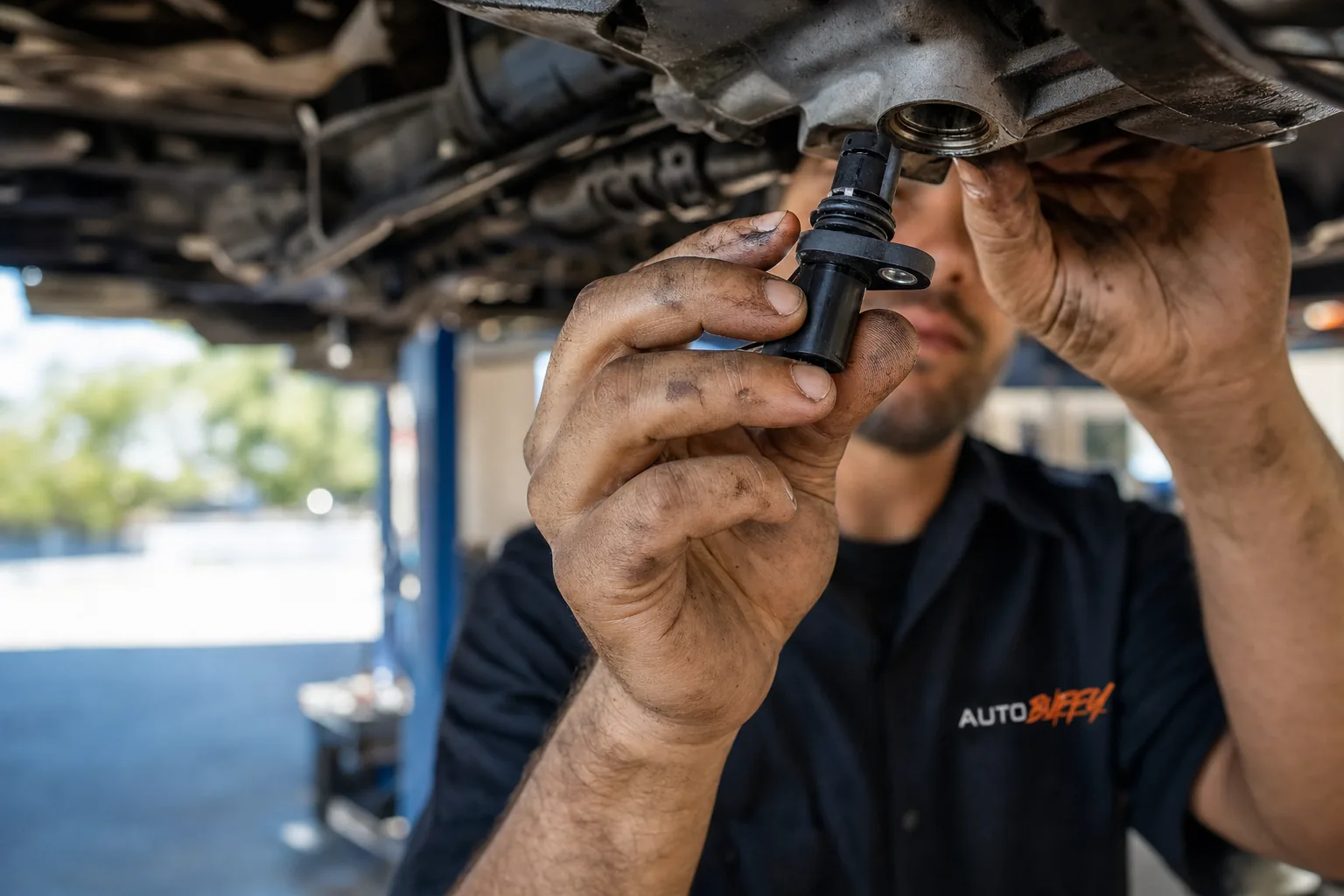
The job itself: disconnect the harness, unthread the old sensor, apply anti-seize to the threads if it isn't pre-applied on the new unit, torque to spec, reconnect the harness, and clear the code. Most experienced DIYers finish in 30–45 minutes. First-timers should budget an hour or two — and use penetrating oil the night before if there's any rust present.
Sources
- SAE J2012 OBD-II Diagnostic Trouble Code Definitions
- U.S. Auto Care Association — Average Vehicle Age Data (2025)
- OBD-II Generic Powertrain Standards — ISO 15031-6
Find the right O2 sensor for your vehicle
Guaranteed fit, ships free
FAQ / People Also Ask
P0131 is defined as 'O2 Sensor Circuit Low Voltage — Bank 1 Sensor 1.' It means the PCM measured the upstream oxygen sensor's output voltage below approximately 0.1V continuously for longer than its enable-threshold window (typically around 2 minutes at closed-loop, fully warmed-up conditions). That sustained low reading tells the PCM the sensor is stuck reporting an extremely lean signal — or that the circuit itself has failed low.
Comments
Loading comments...
Comments are moderated by the AutoBuffy team.