

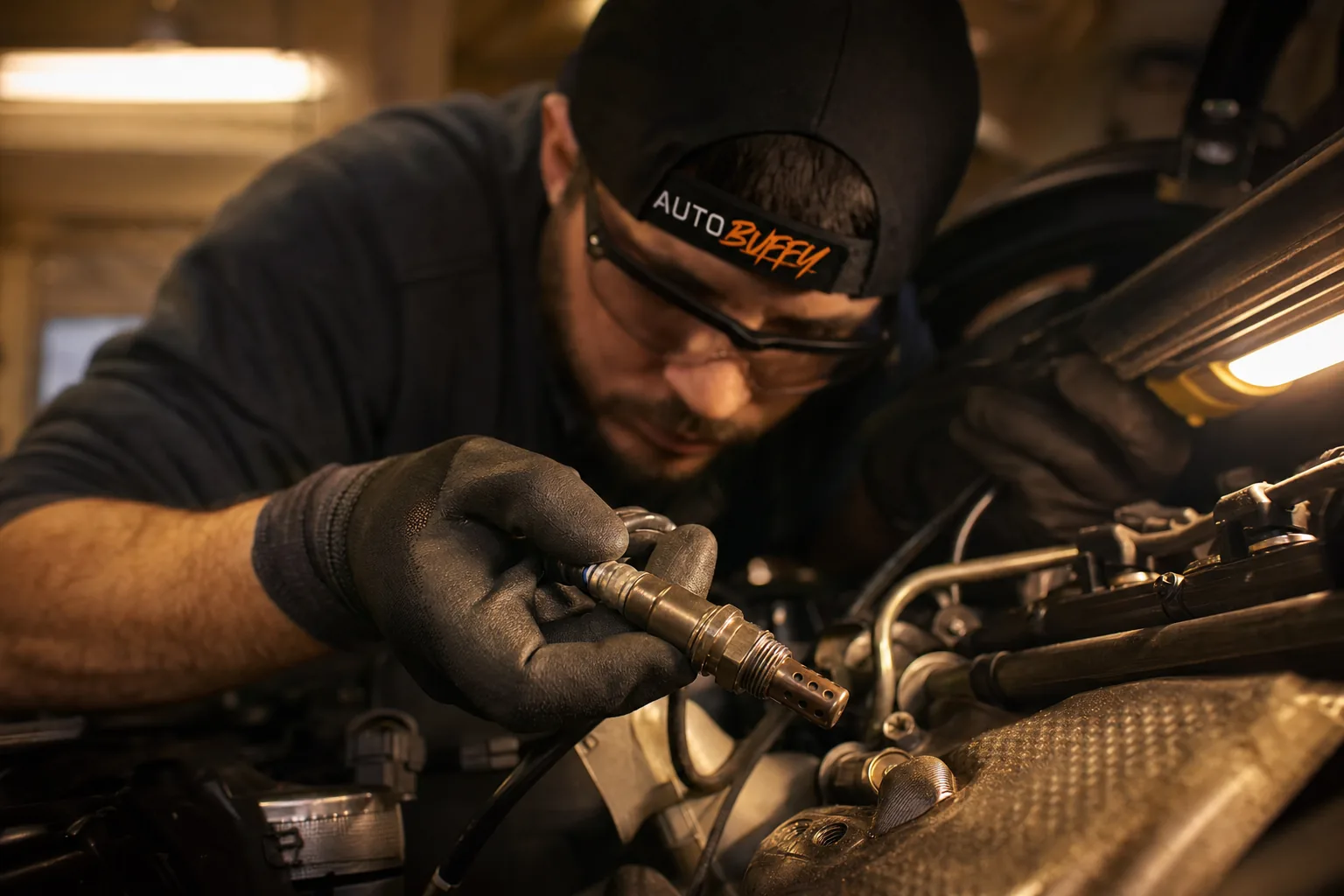
P0161: O2 Sensor Heater Circuit (Bank 2 Sensor 2) — Diagnosis & Cost
P0161 means your downstream O2 sensor on Bank 2 has a heater circuit fault. Here's how to diagnose it and what repairs cost.
The Short Answer
P0161 means the ECM has detected a malfunction in the heater circuit of the oxygen sensor located downstream of the catalytic converter on Bank 2 (the engine bank that does not contain cylinder #1).
| Detail | Spec |
|---|---|
| Official definition | O2 Sensor Heater Circuit Malfunction (Bank 2, Sensor 2) |
| Code type | Generic OBD-II — applies to all makes/models |
| Sensor location | After catalytic converter, Bank 2 (opposite cylinder #1) |
| Typical repair cost | $100–$350 (sensor + labor) |
| DIY difficulty | Beginner–Intermediate |
| Drive OK? | Short term only — fix promptly |
What Is the Bank 2 Sensor 2 O2 Sensor Actually Doing?
Your engine has a network of oxygen sensors managing both fuel delivery and emissions compliance. Bank 2 Sensor 2 is the *downstream* sensor — sitting after the catalytic converter on the side of the engine away from cylinder #1.
Unlike the upstream sensor (Sensor 1), which actively helps the ECM tune the air-fuel ratio, the downstream sensor's main job is comparing exhaust oxygen content before and after the cat. That comparison is how your PCM knows whether the catalytic converter is still doing its job.
Because it lives in cooler exhaust after the cat, this sensor relies heavily on its built-in *heater element* to reach operating temperature fast enough to generate a useful signal. Without that heater working, the sensor just sits there producing useless data — or none at all.
Why P0161 Gets Set
The PCM monitors the heater circuit by tracking current flow and how quickly the sensor warms up. P0161 triggers when it detects:
- An open circuit in the heater wiring (broken wire, corroded connector)
- A short circuit to ground or power
- Abnormal heater resistance — meaning the element inside the sensor has degraded or failed outright
- An incorrect warm-up response — the sensor takes too long to reach operating temperature
The heater circuit itself is straightforward: battery voltage flows through a fuse, through the heater element inside the sensor, and back to a PCM-controlled ground. Any break in that loop and P0161 follows.
Common Causes (Ranked by Likelihood)
- Failed O2 sensor heater element — the most common culprit by far. The internal heater wire burns out, especially on high-mileage vehicles.
- Corroded or damaged wiring harness — the exhaust environment is brutal. Heat, vibration, and road debris crack insulation and corrode terminals.
- Blown heater circuit fuse — often overlooked. Check this first; it costs nothing.
- Poor connector contact — a connector that's not fully seated or has a pushed-back pin can mimic a failed sensor.
- PCM failure — rare, but the PCM controls the ground side of the heater circuit. If everything else checks out, the PCM is worth testing.
Symptoms to Watch For
Honestly, P0161 is one of those codes that can be nearly invisible until you plug in a scan tool. That said, you might notice:
- Check Engine Light (the most reliable symptom)
- Slightly reduced fuel economy over time
- Failed emissions test — many states check for active OBD-II codes
- In some cases, rough idle or poor throttle response if the ECM enters a degraded feedback mode
The absence of dramatic symptoms is exactly why people ignore this code. Don't. Catalyst monitoring failure means you could be running a damaged cat for thousands of miles without knowing it.
How to Diagnose P0161 Step by Step
Step 1: Check the Fuse First
Pull up your owner's manual or the fuse box diagram and find the heated oxygen sensor fuse (sometimes labeled HO2S or O2 HTR). A blown fuse is a $2 fix. Replace it and see if the code returns.
Step 2: Inspect the Wiring Harness
Trace the wiring from the Bank 2 Sensor 2 connector back toward the firewall. Look for:
- Melted or cracked insulation from exhaust heat
- Corrosion at the connector pins
- Chafing against the exhaust pipe or chassis
Repair any damaged wiring before condemning the sensor.
Step 3: Test Heater Resistance
With the sensor unplugged and key off, use a digital multimeter set to ohms. Probe the two heater terminals (check a wiring diagram for your vehicle to identify them — they're usually the two wires not connected to the signal or ground circuits).
- Healthy reading: Typically 2–30 ohms, depending on make/model
- Infinite resistance (OL): Open circuit — sensor is faulty
- 0 ohms: Short circuit — sensor or wiring is shorted
Step 4: Verify Supply Voltage and Ground
If resistance tests normal, check that battery voltage is actually reaching the heater circuit at the connector with the key on, and that the PCM-side ground is functioning. No voltage? Trace back to the fuse and relay. No ground? The PCM may be at fault.
Step 5: Replace the Sensor if Needed
If the sensor fails the resistance test and wiring checks out, replace the downstream Bank 2 oxygen sensor. Clear the code, run two full drive cycles, and confirm it doesn't return.
What Does This Repair Actually Cost?
Typical total repair cost lands between $100 and $350. Here's where that range comes from:
| Component | Typical Cost Range |
|---|---|
| Downstream O2 sensor (part) | $40–$120 |
| Shop labor (sensor replacement) | $60–$200 |
| Fuse replacement (if applicable) | $2–$10 |
| Wiring repair (if needed) | $80–$200+ |
DIY-ers can often handle this for well under $100 in parts. The job requires an O2 sensor socket, some penetrating oil if the sensor threads are corroded, and patience. Shops typically charge 0.5–1.5 hours of labor.
My honest take: if you've already got 100,000+ miles on the vehicle and you're replacing the Bank 2 Sensor 2, spend a little extra and get a quality, emissions-focused sensor rather than the cheapest generic unit. On a heater-circuit code, sensor quality directly affects how long the fix holds — a good sensor on a high-mileage vehicle is money well spent versus chasing the same code again in 18 months. Use the part finder below to see the sensors that actually fit your vehicle and compare them.
Can You Fix P0161 Yourself?
Yes — this is one of the more DIY-friendly sensor jobs on a vehicle. The downstream sensor is usually more accessible than the upstream one (no manifold in the way), though tight spaces and rust can complicate things on older vehicles.
You'll need:
- OBD-II scan tool to read and clear codes
- Digital multimeter
- O2 sensor socket (7/8" or 22mm with a slot for the wire)
- Penetrating oil (apply the night before if the vehicle has rust)
- Basic hand tools
If wiring repair is needed beyond a connector cleanup, that's where most DIY-ers hit a wall and hand it off to a shop.
Find the right O2 sensor for your vehicle
Guaranteed fit, ships free
FAQ / People Also Ask
P0161 means 'Oxygen Sensor Heater Circuit Malfunction (Bank 2, Sensor 2).' The ECM detected a problem with the heater circuit inside the downstream O2 sensor on the side of the engine opposite cylinder #1.
Comments
Loading comments...
Comments are moderated by the AutoBuffy team.