

P0325: Knock Sensor Circuit Malfunction — Symptoms, Causes, Cost
P0325 means your PCM lost trust in the knock sensor signal. Here's what it costs, what breaks, and whether you can drive safely.
The Short Answer
P0325 — 'Knock Sensor 1 Circuit Malfunction (Bank 1 or Single Sensor)' — means your PCM has detected that the knock sensor's output voltage is outside its acceptable range, so the engine can no longer self-tune its ignition timing safely.
| Factor | Detail |
|---|---|
| Official definition | Knock Sensor 1 Circuit Malfunction (Bank 1 or Single Sensor) |
| Signal threshold | Below ~0.2V or above ~4.8V at operating RPM |
| Most affected brands | Honda, Acura, Nissan, Infiniti, Toyota |
| Repair cost range | ~$150 (accessible 4-cyl) to $1,200+ (V6/V8 with manifold removal) |
| Drive-safe? | Short trips only — up to 15% fuel economy loss, catalytic converter risk |
| Companion code | P0330 (Bank 2, second sensor — not the same fault) |
What Exactly Is P0325?
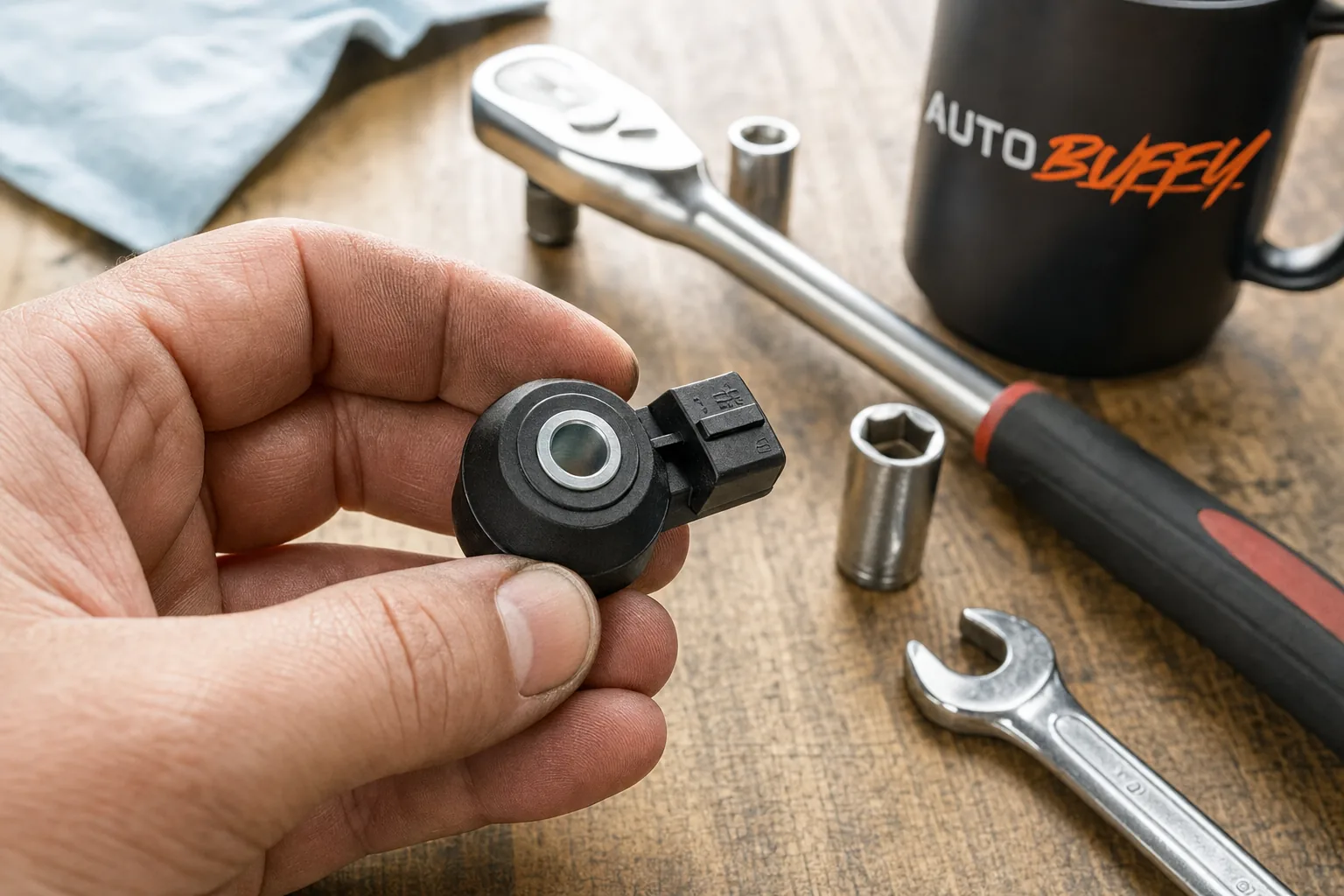
Every OBD-II vehicle built since 1996 has at least one knock sensor threaded into the engine block. Its job is simple but critical: it listens for the high-frequency vibration signature of detonation — the uncontrolled fuel ignition that causes engine knock — and sends a voltage signal back to the PCM so timing can be retarded before metal damage occurs.
When the PCM reads a signal that falls below roughly 0.2V or climbs above roughly 4.8V at operating speeds, it decides the circuit isn't trustworthy. It logs P0325, illuminates the check engine light, and defaults to a conservative timing map. That's the safety net. It's not ideal, but it keeps the engine alive while you sort out the real problem.
This is a generic powertrain code — it's not brand-specific and follows the SAE standard, so the diagnostic approach is the same whether you're looking at a Civic, a Frontier, or a Tacoma.
Common Symptoms of P0325
Some drivers catch this code during a routine scan and feel nothing odd. Others notice real drivability issues. Here's what to watch for:
- Check engine light — almost always the first sign
- Engine pinging or knocking, especially under load (acceleration, towing, climbing hills)
- Reduced fuel economy — the conservative timing map can drop efficiency by up to 15%
- Sluggish acceleration — timing retard costs horsepower
- Rough idle — less common, but it shows up on some platforms
The absence of obvious symptoms doesn't mean the code is harmless. Chronic timing retard stresses the catalytic converter, and if actual detonation events go undetected because the sensor is dead, piston and ring damage can follow.
What Causes P0325?
Failed Knock Sensor
The sensor itself is the most straightforward failure. Knock sensors are piezoelectric devices — they generate voltage from mechanical vibration. Heat cycling, age, and vibration fatigue eventually cause the crystal element inside to crack or the internal resistance to drift out of spec. When that happens, the signal falls outside the PCM's expected window and P0325 sets.
Wiring and Connector Problems
This is actually where I'd start looking before touching the sensor. The knock sensor sits low on the engine block, right in the path of heat, coolant, and road grime. Connector pins corrode. The harness can chafe against brackets. A single broken wire in the circuit mimics a dead sensor perfectly — and a lot of shops replace the sensor first, clear the code, and then watch it come back a week later because the real fault is a frayed wire six inches away.
Coolant Contamination
On several Honda and Nissan applications, coolant seeping past the intake manifold gasket can pool around the knock sensor connector. Moisture in the connector causes erratic voltage readings and is a known pattern failure on some higher-mileage V6 platforms.
PCM Fault
Rare, but possible. If you've verified the sensor and the full wiring harness check out, the PCM input circuit itself may be faulty. This is a diagnosis-of-exclusion — rule everything else out first.
How to Diagnose P0325 Step by Step
- Scan for all codes. If P0330 is also present, you may have a wiring issue that affects both sensors or a broader circuit problem. Don't chase P0325 in isolation if its Bank 2 sibling showed up too.
- Inspect the connector and harness visually. Look for corrosion, moisture, cracking insulation, or pinched wires before you pull anything.
- Test sensor resistance. Most flat-response knock sensors spec around 48–62 kΩ at room temperature — check your vehicle's service manual for the exact value. A reading far outside that range points to a dead sensor.
- Check circuit continuity. Use a multimeter in continuity mode along the full harness run from sensor to PCM connector. An open or short in the wiring is your answer if sensor resistance was fine.
- Verify ground integrity. A poor ground reference can throw the signal voltage out of range even with a perfect sensor.
- Replace the sensor if the circuit checks out. Clear the code, run the engine through a drive cycle that includes sustained RPM above 2,000, and see if P0325 returns.
Repair Cost: What You're Really Looking At
The part itself — a replacement knock sensor — typically runs $25–$80 depending on the vehicle. Labor is where the price can explode.
On a four-cylinder engine where the sensor is visible and accessible, total repair cost (parts and labor) is often in the $150–$300 range. That's a manageable job.
On many V6 and some V8 engines, the knock sensor lives under the intake manifold. Removing the manifold on a, say, Nissan VQ V6 or a Toyota 1GR-FE V6 is a multi-hour job on its own. That's where total costs can climb to $600, $900, even past $1,200 at dealer labor rates. It's genuinely one of the most labor-intensive "just a sensor" replacements in the business.
My honest take: the DIY window is real on accessible engines. If your sensor is exposed and the wiring harness is intact, this is a one-hour Saturday job for anyone comfortable with basic hand tools. For under-manifold applications, weigh the shop quote against your confidence level carefully — there are plenty of gaskets to disturb, and doing it once correctly beats doing it twice.
Which Knock Sensor Should You Buy?
For OEM-equivalent quality, the field is largely anchored by a handful of suppliers. Robert Bosch GmbH — a private company majority-owned by the non-profit Robert Bosch Stiftung GmbH — is one of the primary OEM knock sensor manufacturers globally. DENSO Corporation, a Toyota Group company publicly traded on the Tokyo Stock Exchange, is another leading OEM supplier, particularly strong on Japanese-nameplate applications.
A knock sensor's only job is to feed the PCM a clean signal so it pulls timing exactly when it needs to and no more, so an off-spec part quietly defeats the whole system. Choose a knock sensor built to OE spec and matched to your engine — use the part finder below to confirm fit, coverage, and current pricing; product lineups update, a printed list in an article doesn't.
Can You Drive with P0325 Active?
Short answer: for a short time, to get to a shop. Nothing more.
The PCM will retard timing to protect against undetected knock, so the car won't suddenly stop running. But that 15% fuel economy hit is real money over weeks of driving, and the catalytic converter wasn't designed to run with chronically retarded combustion. If genuine engine knock is occurring and the sensor isn't reporting it, you're also running without your early-warning system — that's the scenario where detonation actually damages pistons.
Don't let this one sit.
Find the right part for your vehicle
Guaranteed fit, ships free
FAQ / People Also Ask
P0325 is the SAE/OBD-II code for 'Knock Sensor 1 Circuit Malfunction (Bank 1 or Single Sensor).' It means the PCM detected that the knock sensor's signal voltage fell outside its expected range — either too low or too high — indicating a short, open circuit, or failed sensor.
Comments
Loading comments...
Comments are moderated by the AutoBuffy team.