

P0442: Small EVAP Leak — Start With the Gas Cap (Causes & Cost)
P0442 means a small EVAP leak. Here's why it triggers, what it costs to fix, and why the gas cap is always your first stop.
The Short Answer
P0442 means your vehicle's ECM detected a small leak in the EVAP (Evaporative Emission Control) system — and the gas cap is the first thing you should check, because it fixes the problem about a third of the time for under $30.
| Cause | Likelihood | Typical Repair Cost |
|---|---|---|
| Loose or faulty gas cap | Very common | $0 (tighten) – $29 (replace) |
| Cracked vapor hose or fitting | Common | $15–$60 parts + labor |
| Stuck/leaking purge valve | Common | $20–$80 parts + $50–$150 labor |
| Damaged vent valve | Moderate | $30–$100 parts + labor |
| Cracked charcoal canister | Less common | $150–$400 parts + labor |
What P0442 Actually Means
Your car's EVAP system is a sealed loop. Its whole job is to trap fuel vapors from the tank and route them into the engine to burn — rather than letting them vent into the atmosphere. The ECM runs a self-test on this system, pressurizing it and checking for pressure drop.
When the drop is consistent with a hole roughly 0.020 to 0.060 inches in diameter (sources vary slightly on the exact threshold, but it's genuinely tiny — think about the tip of a ballpoint pen), the computer throws P0442. It's a generic OBD-II code, meaning it applies to virtually every fuel-injected vehicle sold in the U.S., regardless of make or model.
P0442 sits between P0456 (very small leak) and P0455 (large leak, like a completely missing cap). It's not catastrophic, but it won't go away on its own.
Start Here: The Gas Cap
Seriously. Before you schedule a smoke test or start pulling hoses, take 30 seconds to check the gas cap.
- Remove it and inspect the rubber O-ring. It should be soft, continuous, and seated evenly in the groove. Cracks, flat spots, or debris on that seal = instant EVAP leak.
- Reinstall it and count the clicks. A cap that tightens but doesn't click, or one that feels loose after a few seconds, isn't sealing the system.
- If you're in doubt, replace it. Aftermarket gas caps run $9.99 to $28.99 at major retailers — that's the cheapest diagnostic step you'll ever take.
After tightening or replacing, drive normally for a few days. The ECM needs to complete the EVAP self-test, which typically happens once per drive cycle under the right conditions (fuel level between 1/4 and 3/4 tank helps). If the light clears, you're done.
Other Common Causes of P0442
If the cap checks out, the leak is somewhere else in the sealed system. Here's where to look next, roughly in order of how often each one causes P0442.
Cracked or Disconnected Vapor Hoses
The hoses that connect the fuel tank, charcoal canister, and purge valve are made of rubber or plastic. They get brittle over time — especially in climates with big temperature swings. A visual inspection under the hood and along the frame rail toward the tank can sometimes reveal a crack or a loose push-fit connection. These hoses are inexpensive; the labor is usually the bigger cost.
Vapor Canister Purge Valve
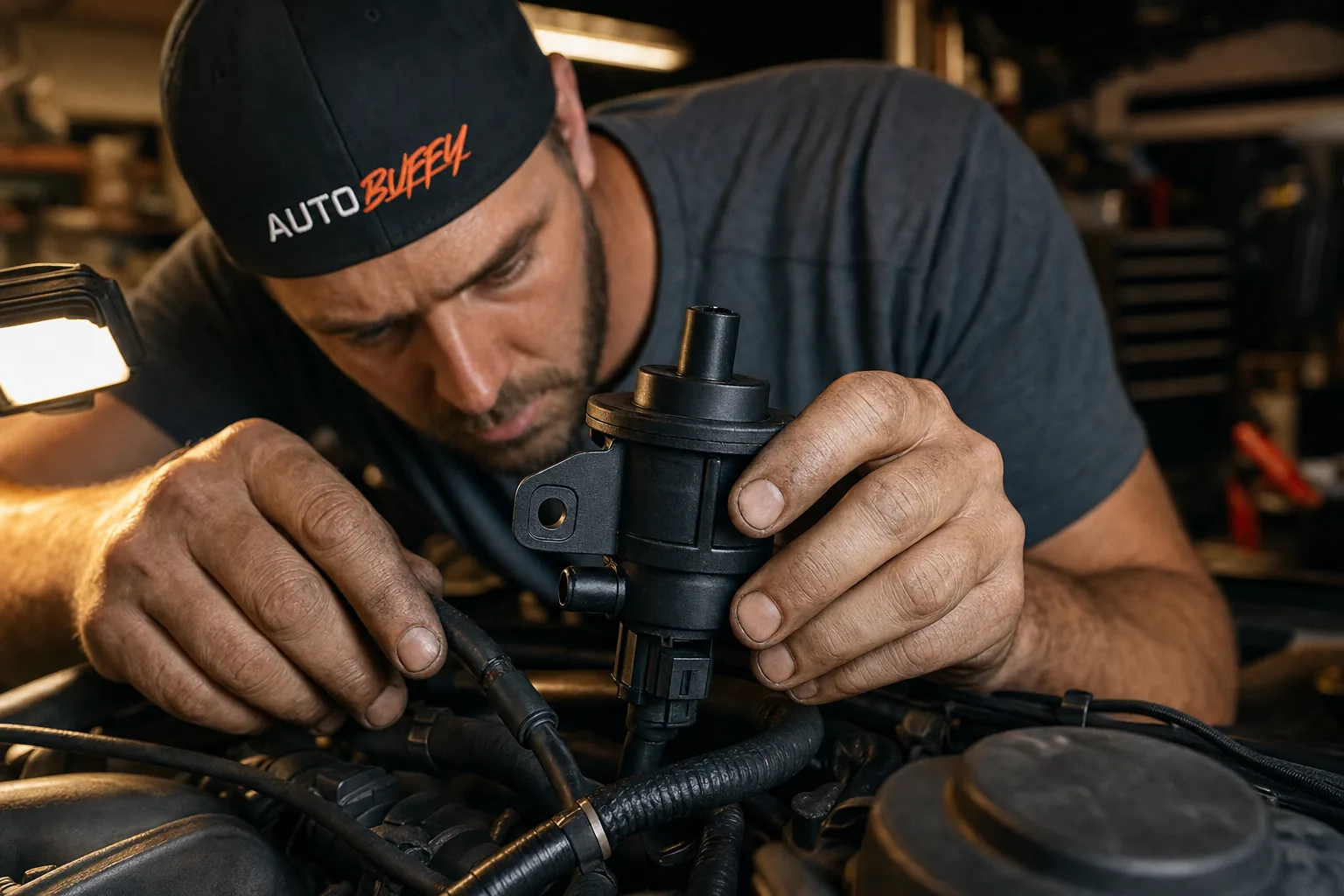
This is the component that opens on command to allow stored vapors to flow from the charcoal canister into the intake manifold. When it works correctly, it stays closed during the EVAP self-test. When it sticks open — due to a failed solenoid or debris — it bleeds pressure from the system continuously. The ECM reads that as a leak, even though there's no actual crack.
A purge valve that's stuck open can also cause a rough idle or a slightly rich condition at idle, which gives you an additional diagnostic clue. Replacement purge valves for most vehicles fall in the $20–$80 range for the part. Labor is usually straightforward — most are accessible with basic hand tools — but shop rates vary.
Use the part finder below to confirm the right purge valve for your vehicle before ordering.
Vent Valve (Canister Vent Solenoid)
The vent valve is the other end of the EVAP loop. It needs to close during the self-test to allow the system to hold pressure. A valve that won't fully close — or one with a failed solenoid — produces the same result as a leak. Replacement cost is similar to the purge valve.
Charcoal Canister
The charcoal canister is a plastic housing packed with activated charcoal that absorbs fuel vapors. Physical cracks from road debris, corrosion at fittings, or a canister saturated from repeated overfilling at the pump can all cause small leaks. This is a less frequent culprit, but it's worth knowing that replacement typically runs $150–$400 in total repair cost depending on location and labor rate — making it worth ruling out everything else first.
How Shops Diagnose P0442 Accurately
If you can't find the leak visually, a shop will use a smoke machine. They seal off the EVAP system, pump in inert smoke under low pressure, and watch for wisps escaping from hoses, fittings, the canister, or the purge/vent valves. It's fast, clean, and definitive. Smoke testing typically costs $75–$150 at an independent shop, and most will apply that toward the repair if you proceed.
Skipping this step and guessing at parts can get expensive quickly. My honest opinion: if tightening the gas cap doesn't clear it within a week, pay for the smoke test. It's cheaper than replacing two or three parts at random.
Will P0442 Fail an Emissions Test?
Yes. Any active check engine light triggers an automatic failure in states that conduct OBD-II emissions inspections — and P0442 keeps that light on. It doesn't matter that the code is for a tiny vapor leak and not something affecting combustion. The light is the failure. Fix the code, clear the monitor, pass the test.
P0442 Fix Checklist
- Inspect and tighten the gas cap — look at the O-ring seal and count the clicks.
- Replace the gas cap if the seal is worn ($10–$29).
- Drive 3–5 cycles and see if the code clears on its own.
- Visually inspect vapor hoses for cracks, kinks, or disconnected fittings.
- Test the purge valve — a stuck-open valve is one of the most common hardware causes.
- Get a smoke test if you still can't locate the leak.
- Check the vent valve and canister as last steps before assuming a bigger problem.
Find the right part for your vehicle
Guaranteed fit, ships free
FAQ / People Also Ask
Technically yes — P0442 won't cause engine damage or stalling. But your check engine light will be on, you'll fail an emissions test in OBD-II inspection states, and ignoring it can let a small problem turn into a bigger one. Fix it sooner rather than later.
Comments
Loading comments...
Comments are moderated by the AutoBuffy team.