

P0446: EVAP Vent Control Circuit — Causes, Diagnosis & Cost
P0446 means your EVAP vent control circuit has a malfunction. Here's what causes it, how to diagnose it, and what it costs to fix.
The Short Answer
P0446 — officially "Evaporative Emission Control System Vent Control Circuit Malfunction" — means your ECU detected a voltage or resistance problem in the vent control valve circuit, and in the vast majority of cases, replacing the vapor canister vent valve fixes it.
| Factor | Details |
|---|---|
| Code Name | EVAP Vent Control Circuit Malfunction |
| System | Evaporative Emission (EVAP) |
| Severity | Low–Moderate (drivable, but emissions test failure) |
| Most Common Fix | Vapor canister vent valve |
| DIY Part Cost (typical) | $20–$80 |
| Shop Repair Range | $150–$350 (parts + labor) |
| Vehicles Most Affected | Older GM domestics; any post-1996 vehicle |
What the EVAP System Actually Does
Your fuel tank constantly produces vapors. Left to vent freely, those vapors escape into the atmosphere as hydrocarbons — which is why federal emissions law requires every vehicle to capture them.
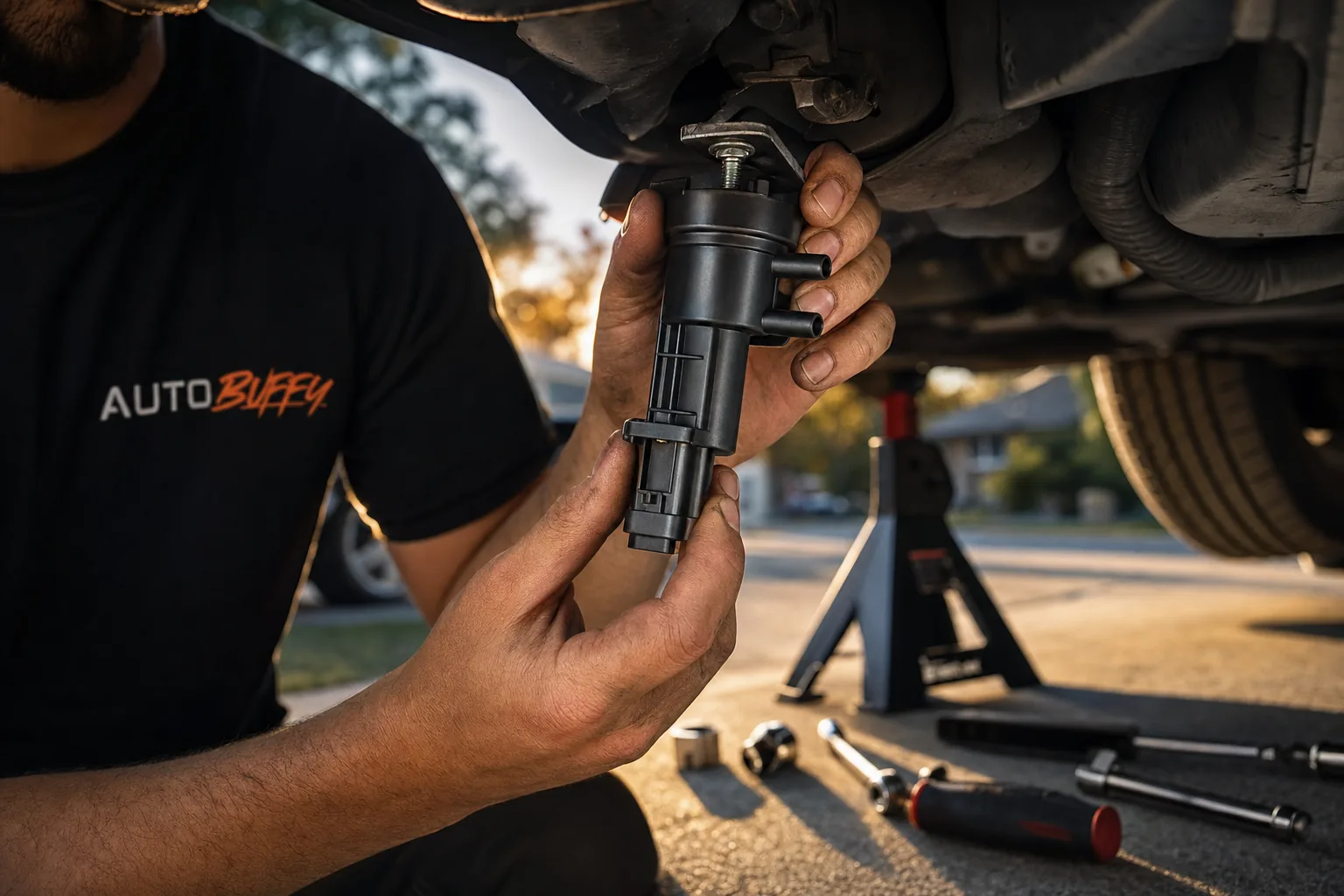
The EVAP system routes those vapors into a charcoal canister for storage, then purges them into the intake manifold to be burned as part of normal combustion. The vapor canister vent valve controls airflow into the canister. When the system purges, the vent valve closes, forcing vapors through the purge path. When purging stops, it opens to let fresh air in.
Simple concept. But when that valve's circuit isn't behaving the way the ECU expects, you get P0446.
What Triggers P0446 Specifically
The ECU monitors voltage and resistance in the vent valve circuit continuously. P0446 sets when those readings fall outside the expected range — meaning the ECU can't confirm the valve is doing what it commanded.
That's distinct from a fuel cap code (P0457) or a general EVAP leak (P0440). P0446 is pointed: something's wrong in the vent *circuit*, not just somewhere in the broader EVAP system.
P0446 is a generic OBD-II code, which means it carries the same definition across every make and model produced after 1996 — Honda, Toyota, Ford, GM, whatever you're driving. That said, you'll see it far more often on older domestic GM platforms. Dodge vehicles haven't commonly flagged it in years, and Toyota Camry models after 2007 rarely show it.
The Most Common Causes (Ranked by Frequency)
- Faulty vapor canister vent valve — by far the most likely culprit. The solenoid inside the valve wears out, sticks open or closed, or its coil resistance drifts out of spec.
- Damaged or corroded wiring/connector — the connector at the vent valve sits near the fuel tank and takes road debris, moisture, and heat. Corrosion or chafed wiring breaks the circuit.
- Plugged or cracked charcoal canister — a saturated or physically damaged canister can prevent the valve from functioning correctly even if the valve itself is fine.
- Faulty fuel tank pressure sensor — less common, but a bad FTP sensor can confuse the ECU's EVAP readings enough to set P0446 alongside other codes.
- PCM/ECU failure — rare. Don't assume this until everything else is ruled out.
How to Diagnose P0446 Step by Step
Step 1: Visual Inspection First
Pull up the vent valve location in your service manual (it's usually near the charcoal canister, often in the rear of the vehicle near the fuel tank). Look at the connector — corrosion, broken lock tabs, and pushed-back terminals are common finds on high-mileage vehicles.
Check the wiring harness for obvious chafing against frame rails or heat shields.
Step 2: Test the Valve Electrically
Unplug the connector and check resistance across the valve terminals with a multimeter. Most vent valves spec somewhere in the 20–30 ohm range, but pull your vehicle's service manual for the exact value — it varies by platform.
Out-of-spec resistance means the solenoid coil has failed. Replace the valve.
Step 3: Functional Test
Apply 12 volts directly to the valve terminals (you can use a pair of jumper wires from a 12V source). You should hear an audible click as it opens. No click is a dead valve.
Step 4: Check Power and Ground at the Connector
If the valve tests good electrically, plug it back in and use a multimeter to verify the ECU is actually supplying power and a good ground to the connector. No signal at the connector with a known-good valve points to wiring or — as a last resort — the PCM.
Step 5: Inspect the Canister
If everything electrical checks out, inspect the charcoal canister for cracks and make sure its ports aren't blocked. A saturated canister (usually from overfilling the tank repeatedly) won't behave the way the system expects.
What Does It Cost to Fix P0446?
For most people, this is a straightforward repair.
- Vapor canister vent valve (parts only): typically $20–$80 depending on vehicle
- DIY time: 30–60 minutes on most platforms
- Shop labor: $75–$150 for the valve swap at typical labor rates
- Charcoal canister replacement (if needed): $150–$350 for parts alone, plus labor
- Shop diagnostic fee: $50–$100 if you're starting from scratch at a shop
My honest take: more than 80% of P0446 cases I've seen traced directly to the vent valve. If your connector looks clean and your wiring's intact, just test the valve and replace it if it fails — you'll likely be done in under an hour for well under $100.
Will It Fail an Emissions Test?
Yes. An active check engine light is an automatic emissions failure in most U.S. states. After the repair, clear the code and drive through at least one complete drive cycle so the EVAP monitor can run to completion before you head to the test station. Showing up with an incomplete EVAP monitor is also a failure in most programs.
Choosing the Right Vapor Canister Vent Valve
Fit matters here. EVAP component connectors and mounting configurations vary significantly between platforms, and an ill-fitting valve won't seal correctly even if it functions electrically. When you're sourcing a replacement, use the part finder below — it'll match your year, make, model, and engine so you get the right valve the first time.
Pro tip: If your vehicle has over 100,000 miles and you've never touched the charcoal canister, inspect it while you're in there. Replacing a failed canister six months after a vent valve job is a frustrating second trip.
Find the right part for your vehicle
Guaranteed fit, ships free
FAQ / People Also Ask
P0446 is officially called 'Evaporative Emission Control System Vent Control Circuit Malfunction.' It means your ECU detected an incorrect voltage or resistance in the vent control valve circuit — the part of the EVAP system that manages vapor flow from the charcoal canister to the atmosphere.
Comments
Loading comments...
Comments are moderated by the AutoBuffy team.