

P0456: Small EVAP Leak — Causes, Diagnosis & Repair Cost
P0456 means your EVAP system has a pinhole-sized leak. Here's what triggers it, how to diagnose it, and what a fix typically costs.
The Short Answer
P0456 means your vehicle's evaporative emission (EVAP) system has detected a very small leak — roughly the size of a 0.020-inch opening — and the fix can range from a $15 gas cap swap to a $400+ charcoal canister replacement depending on what's actually leaking.
| Factor | Detail |
|---|---|
| Code definition | EVAP system leak detected — very small leak |
| Leak size threshold | ~0.020-inch equivalent opening |
| Most common cause | Loose or damaged gas cap |
| Standard diagnostic tool | Smoke/vapor pressure test |
| DIY difficulty | Easy (gas cap) to moderate (purge valve) |
| Typical repair cost range | $15–$400+ depending on root cause |
| Drive-safe? | Yes short-term; won't pass emissions with CEL on |
What P0456 Actually Means
P0456 is a generic OBD-II powertrain code — it applies across makes and models, not just one brand. The full definition is *"Evaporative Emission System Leak Detected (Very Small Leak)."*
Your EVAP system is a sealed network of hoses, valves, a charcoal canister, and the fuel tank itself. Its job is to capture fuel vapors and route them back into the engine to burn rather than releasing them into the air. The powertrain control module (PCM) actively tests this sealed system for integrity. When it finds a breach equivalent to that 0.020-inch opening — a genuine pinhole — it logs P0456 and lights the check-engine lamp.
The leak is small enough that you'll feel no drivability symptoms. No rough idle, no power loss. The code is easy to dismiss, but it won't resolve on its own.
How P0456 Compares to Related EVAP Codes
- P0455 — Large EVAP leak detected (often a fully missing or completely failed cap)
- P0456 — Very small EVAP leak (pinhole, hairline crack, micro-seal failure)
- P0457 — Loose or missing fuel cap specifically confirmed as the source
Same system, different leak size or confirmed source. If you see P0456, you're hunting something subtle.
The Most Common Causes of P0456
1. Loose or Damaged Gas Cap
This is where to start every time. A cracked cap body, a worn O-ring seal, or simply a cap that wasn't clicked tight after your last fill-up can open the EVAP circuit just enough to trip P0456. It sounds too simple, but a gas cap costs $10–$30 and takes 10 seconds to replace. Swap it first, drive a few normal cycles, and see if the code returns.
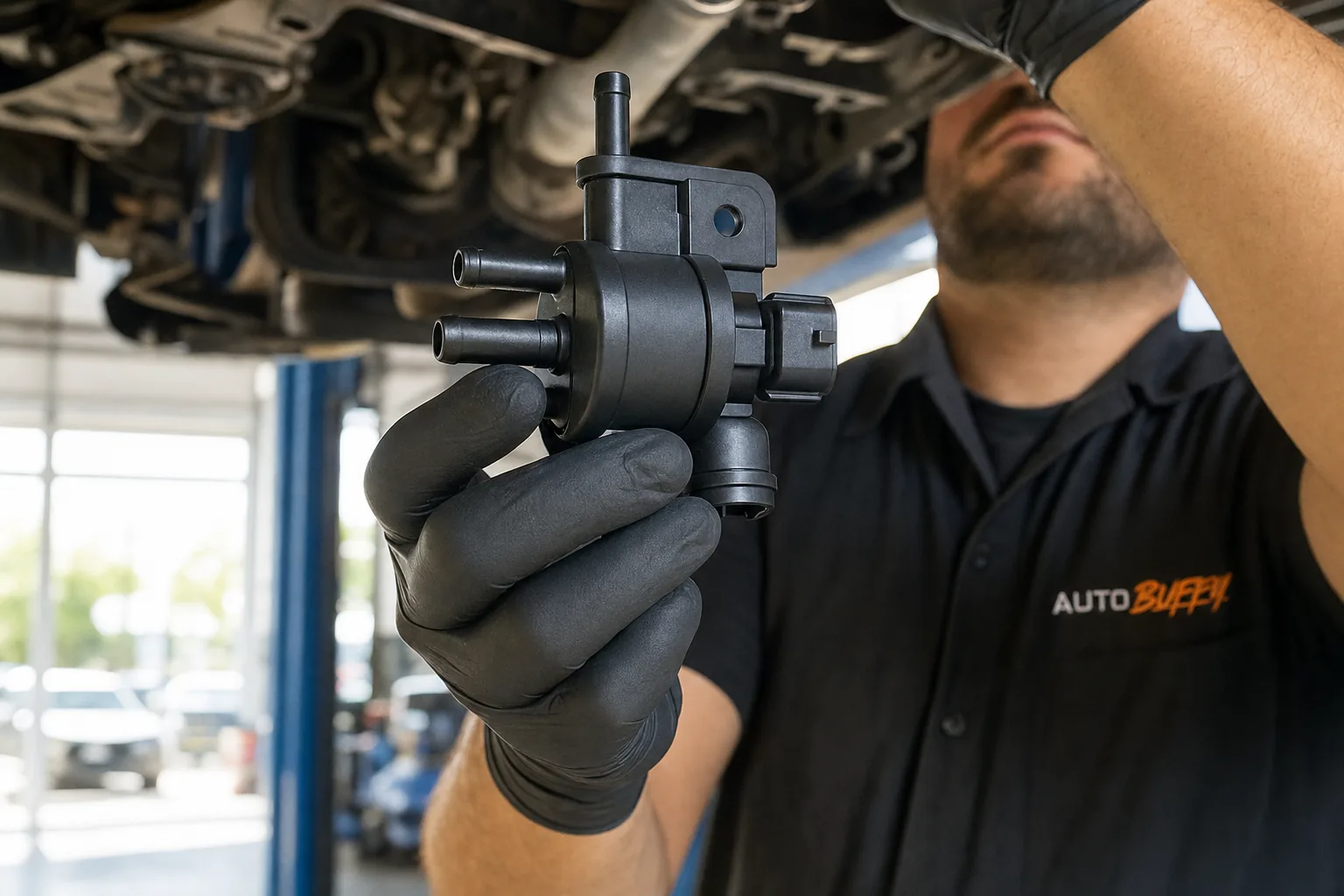
2. Failed Vapor Canister Purge Valve
The purge valve opens on command to pull stored fuel vapors from the charcoal canister into the intake manifold. When its diaphragm cracks or its solenoid sticks open, it creates a small but constant EVAP leak — exactly the symptom P0456 describes. This is one of the more common causes after a gas cap check comes back clean, and it's still a reasonable DIY repair on most vehicles.
3. Cracked or Deteriorated EVAP Hoses
Rubber hoses age. Heat cycles, UV exposure, and time cause micro-cracks — especially near clamp ends where flexing concentrates stress. A crack you can barely see with the naked eye is more than enough to trigger P0456.
4. Charcoal Canister Failure
The canister itself can crack, particularly on older vehicles or after exposure to road debris underneath the car. Canister replacement is a bigger job and a bigger expense, but a smoke test will point you there if everything else checks out.
5. Leaking Fuel Tank Sending Unit or Vent Valve
Less common, but the sending unit O-ring or the vent valve on the tank can fail and create small vapor escapes. Usually discovered during a thorough smoke test.
How to Diagnose P0456 Step by Step
Step 1 — Check the gas cap. Remove it, inspect the O-ring for cracks or deformation, reinstall firmly until you hear the click. Clear the code and drive normally for 2–3 days. If P0456 returns, move on.
Step 2 — Visually inspect EVAP hoses. Trace the hose routing from the purge valve to the canister and tank. Look for cracks, disconnected fittings, and brittle sections. Feel along the hoses while the engine is off — tiny cracks open under pressure you won't see at rest.
Step 3 — Test or replace the purge valve. You can bench-test a purge valve with a hand vacuum pump. It should hold vacuum when unpowered and release it when 12V is applied. A valve that leaks vacuum at rest is a confirmed culprit.
Step 4 — Smoke test. This is the gold-standard diagnostic for P0456. A technician pressurizes the EVAP system with a visible vapor and watches where it emerges. For a leak this small, there's really no reliable substitute. Independent shops typically charge $75–$150 for the test. In my opinion, paying for a proper smoke test is the smarter move compared to replacing parts blindly — statistically, technicians find the actual leak source on the first attempt with smoke vs. a multi-part guessing game that can run you $200+ before you're done.
What Does It Cost to Fix P0456?
| Repair | Typical Part Cost | DIY Feasible? |
|---|---|---|
| Gas cap replacement | $10–$30 | Yes |
| Vapor canister purge valve | $20–$90 | Yes |
| EVAP hose repair/replacement | $15–$60 | Yes (usually) |
| Charcoal canister replacement | $80–$300 | Moderate |
| Fuel tank vent valve | $30–$120 | Moderate |
| Shop smoke test (diagnostic) | $75–$150 | N/A |
Labor rates vary by region and shop, but plan on $75–$150 per hour if you're not doing the work yourself. Most purge valve and gas cap repairs are genuinely beginner-friendly.
Why the Vapor Canister Purge Valve Is Worth Inspecting Early
After the gas cap, the purge valve is the highest-probability culprit for P0456 on vehicles with more than 80,000 miles. It cycles thousands of times and the rubber diaphragm inside eventually fatigues. When it fails open or develops a hairline crack, it creates a persistent small vapor escape that the PCM catches reliably during its EVAP monitor test.
Replacing the purge valve is a job most home mechanics can handle in under an hour. The valve is typically mounted on or near the intake manifold, accessible without removing major components. Use the part finder below to confirm the correct valve for your exact year, make, model, and engine — fitment matters here because purge valve connectors and mounting configurations vary even within the same model line.
One Thing People Often Miss
Not every vehicle uses P0456. Certain late-model GM platforms use different EVAP monitoring logic and may never display this specific code even if a small leak exists — their system logs a different code instead. If you're on a GM product and P0456 doesn't quite fit your symptom pattern, check your vehicle's EVAP monitor status through a scan tool before assuming the code definition applies identically.
The Bottom Line on P0456
Start with the gas cap — seriously, every time. If that doesn't clear it, the purge valve is your next best suspect at a reasonable parts cost. If neither resolves the code, invest in a professional smoke test before replacing anything else. You'll save money and time compared to guessing.
Find the right part for your vehicle
Guaranteed fit, ships free
FAQ / People Also Ask
Yes, in the short term. P0456 doesn't affect engine performance or safety directly. That said, fuel vapors escaping into the atmosphere aren't harmless, and the code won't clear on its own, so plan to diagnose it soon rather than ignoring it indefinitely.
Comments
Loading comments...
Comments are moderated by the AutoBuffy team.