

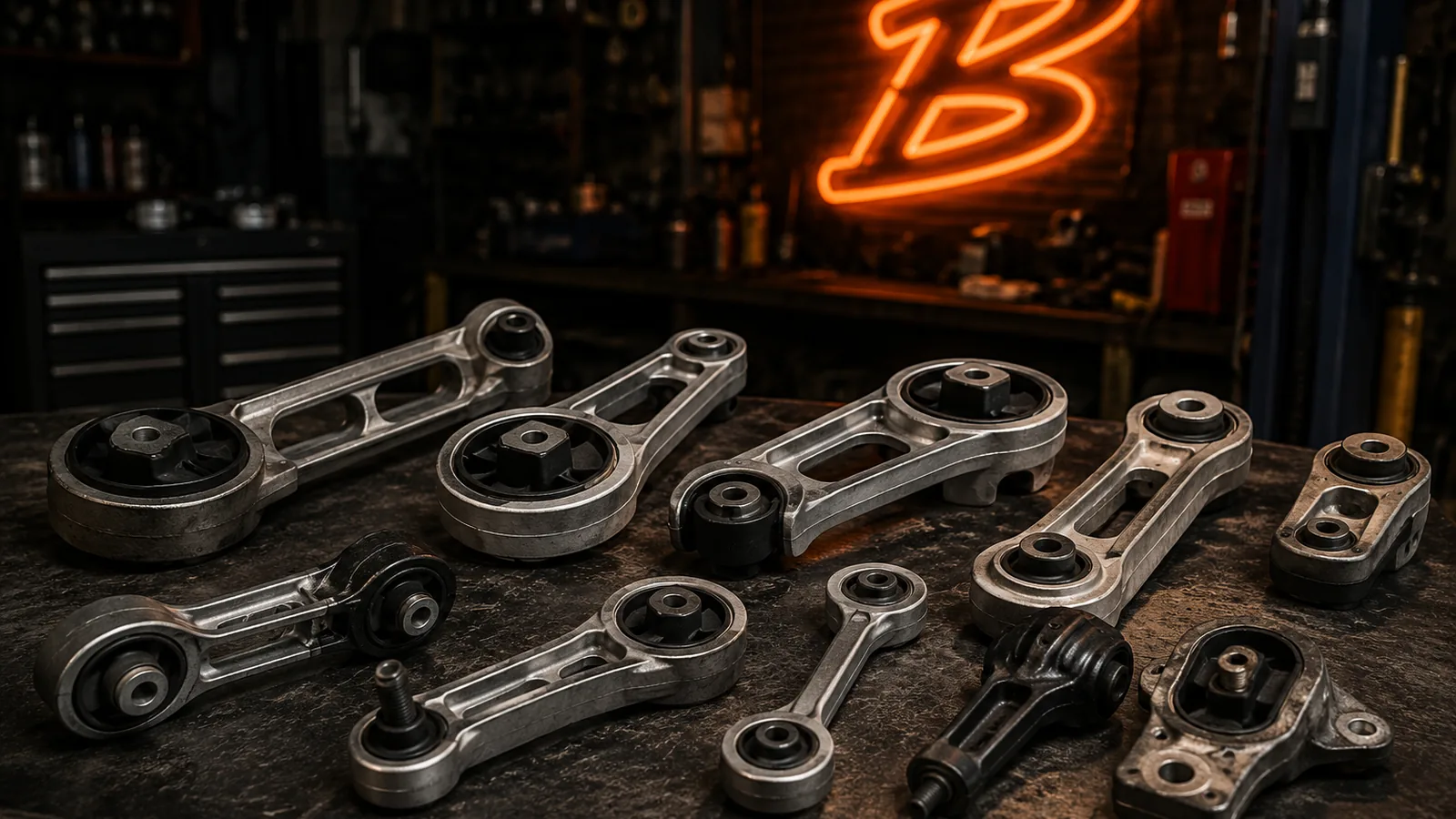
Torque Strut Mount (Dogbone Mount): Symptoms & Fix Guide
The torque strut mount — the dogbone-shaped link that stops your engine from rocking under throttle — is the cheapest mount on a FWD car and the one that fails first. Here's how to spot it and what a fix costs.
If your front-wheel-drive car clunks when you hit the gas, lurches when you let off, and thunks hard when you shift into Drive, the odds are high that one small, cheap part is worn out: the torque strut mount. Mechanics also call it the dogbone mount (because of its shape), the lower engine mount, or the torque link. Whatever you call it, it's usually the first mount to die. The good news is it's often the cheapest and easiest to replace.
The Short Answer
A torque strut mount (dogbone mount) is a small link-shaped engine mount that stops a transverse FWD engine from rocking and twisting under acceleration and braking. It's the anti-rock brace. When its rubber bushing cracks, you get clunking on acceleration and deceleration, a hard clunk shifting into gear, and vibration at idle. Parts run $20–$90, and it's a common DIY fix.
Find Your Torque Strut Mount
Enter your year, make, and model — we'll show the exact dogbone mount that fits
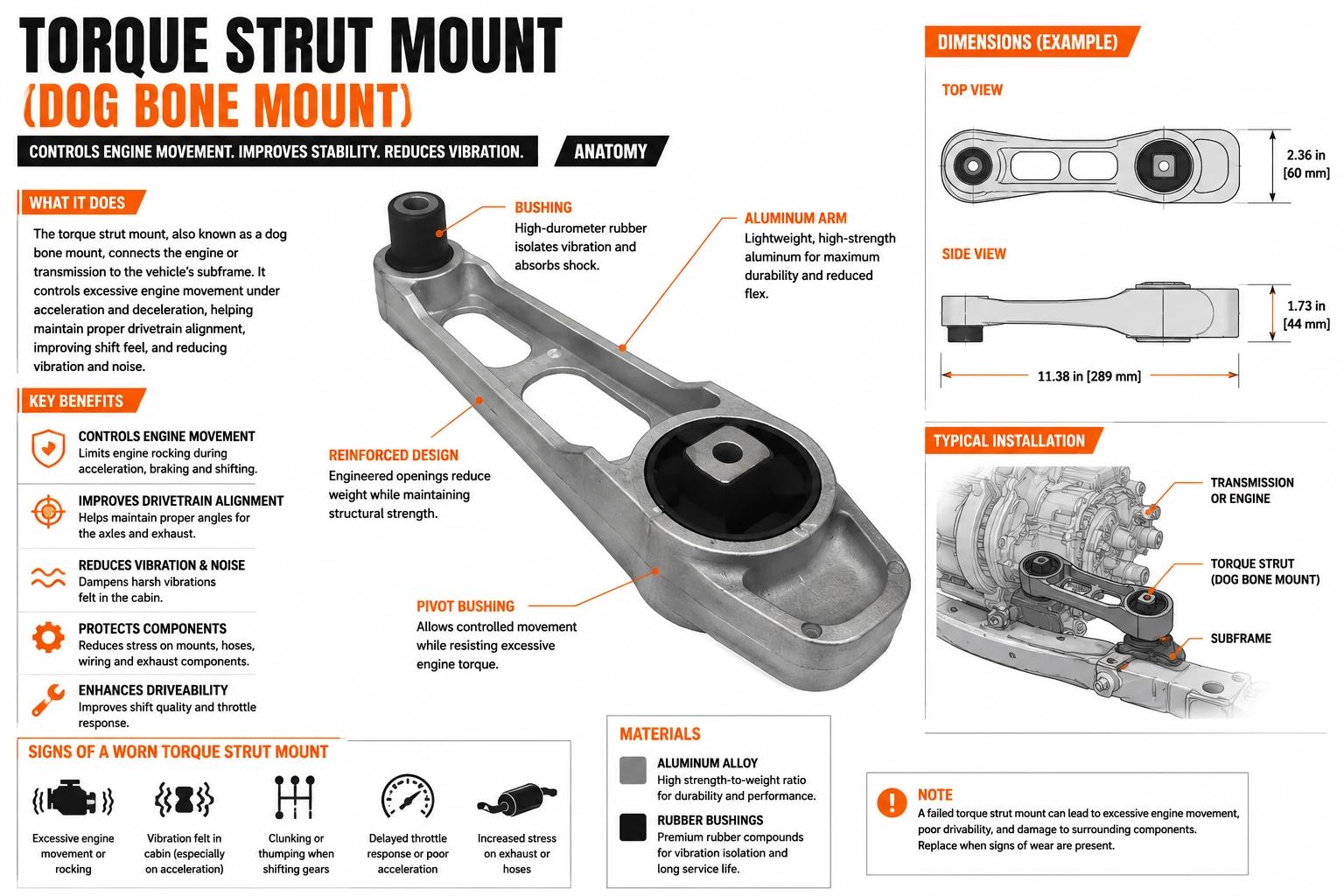
What Is a Torque Strut Mount?
Almost every modern FWD car and crossover mounts its engine sideways (transverse). Press the throttle and the engine wants to twist and roll on its axis. That's physics, torque reaction, nothing you can stop. Two big rubber-and-metal mounts hold the engine's weight, typically one on the driver's side up top and one under the transmission. But those aren't enough to control the *rotational* rocking.
That's the torque strut mount's job. It's a short link, shaped like a dogbone or a barbell, that ties the engine or subframe to the chassis and acts as the anti-rock brace. Under hard acceleration it stops the engine from lurching forward. Under braking or throttle lift-off it stops it snapping back. It takes the most load-cycling of any mount on the car, which is exactly why it wears out first.
Depending on the vehicle, it's the lower engine mount (bolted low near the subframe) or the upper engine torque strut mount (up top, more visible). Many cars have both a lower dogbone and an upper torque link. The concept is identical: control rotation, absorb shock.
Torque Strut Mount vs. Regular Engine Mounts
Don't confuse the dogbone with the main mounts. They do different jobs and fail differently.
| Mount | Job | Typical Cost (part) | Fails First? |
|---|---|---|---|
| Torque strut / dogbone | Controls engine rock/twist under throttle | $20–$90 | Yes — most load cycles |
| Front/right (main) engine mount | Holds engine weight | $40–$150 | Sometimes |
| Transmission mount | Holds trans weight | $40–$130 | Later |
| Rear mount (some cars) | Secondary anti-rock | $30–$100 | Varies |
Because the torque strut absorbs the sharpest shock loads, its rubber bushing cracks or delaminates long before the load-bearing mounts sag. That's why you can have a rock-solid engine mount and still get violent clunking. The dogbone is gone.
Torque Strut Mount Symptoms
Here's the honest, no-BS list. A failing engine torque mount almost always shows one or more of these:
| # | Symptom | When You Notice It |
|---|---|---|
| 1 | Clunk/thunk from the engine bay | Accelerating, then lifting off the throttle |
| 2 | Hard clunk shifting into gear | Park → Drive or Park → Reverse |
| 3 | Vibration / shake at idle | Stopped at a light, in gear |
| 4 | Engine "lurch" or jerk | Throttle tip-in from a stop |
| 5 | Rattle over bumps | Low speed, rough roads |
The classic tell is the clunk on acceleration and deceleration. Press the gas, *thunk*. Let off, *thunk*. That's the engine physically slamming against worn-out rubber because nothing is holding it in check anymore. Torque strut mount symptoms get worse in cold weather (stiff rubber) and under load (AC on, uphill starts).
Quick DIY check: Pop the hood, have a helper shift from Drive to Reverse (foot firmly on the brake). Watch the engine. A little movement is normal. A hard jump of an inch or more, plus a visible crack in the dogbone bushing, means it's done. You can often see the torn rubber right through the mount.
Why Dogbone Mounts Fail So Often
It comes down to duty cycle. Every launch, every gear change, every lift-off puts a shock load through this one link. Over 60,000–100,000 miles, that rubber bushing hammers itself apart. Heat from the engine bay speeds up the cracking. On higher-torque engines and on cars driven hard in stop-and-go traffic, they can go even sooner.
Some models are simply notorious for it. The 2012–2018 Ford Focus (and Focus ST) is a poster child. Owners report dogbone failures well under 80k miles, and it's one of the most-searched torque strut jobs out there. Honda Civic and Accord, most Toyota FWD models, and countless crossovers share the same pattern. It's not a defect so much as physics catching up with a hard-working part.
Replacement Cost
This is where the dogbone earns its reputation as the friendly repair. It's usually the cheapest mount to buy and one of the fastest to swap, often two or three bolts and 30–60 minutes on many cars.
| Job | Part | Labor | Total (Shop) | DIY |
|---|---|---|---|---|
| Lower torque strut / dogbone | $20–$90 | $60–$150 | $80–$240 | $20–$90 |
| Upper torque strut mount | $30–$100 | $80–$180 | $110–$280 | $30–$100 |
Compare that to a main mount job, which can run $200–$500+ once you factor in the labor to support and lift the engine. For the full picture on the other mounts, see our Motor Mount Replacement Cost guide.
A Real Example: Westar EM-2939
For that troublesome 2012–2018 Ford Focus, the direct-fit torque strut is Westar EM-2939. Westar Distribution has been a U.S. manufacturer since 1986 and specializes in exactly this, engine and transmission mounts, with 3,200+ SKUs covering the parts that actually wear out. We call it out because the Focus dogbone is one of the most-replaced mounts in the country, and it's the kind of part where a purpose-built mount matters more than the cheapest listing on a marketplace. That's not hype. It's just where a mount specialist earns its keep.
Should You Replace It Yourself?
If you can turn a wrench and the mount is accessible from the top, yes. This is one of the most beginner-friendly repairs on the car. You'll typically:
- Locate the dogbone (usually near the front of the engine, tying it to the subframe or radiator support).
- Support the engine lightly with a floor jack and a block of wood (only if it's under load).
- Remove the through-bolts.
- Swap the mount, torque the bolts to spec, done.
Lower mounts can require jacking the car and dropping a shield, which adds time. When in doubt, it's still a cheap shop job.
Get the Exact Dogbone Mount for Your Car
We match it to your VIN so you order once and it fits
The Bottom Line
The torque strut mount is small, cheap, and easy to ignore, right up until it's clunking every time you touch the pedals. If your FWD car is thunking on acceleration and deceleration, jerking on tip-in, or slamming into gear, check the dogbone first before you spend money chasing bigger, pricier mounts. It fails the most, costs the least, and fixing it often makes the whole car feel tight again.
Still not sure which mount is which? Read our companion guide on Bad Motor Mount Symptoms, then shop Motor Mounts or go straight to Westar Mounts for the mount specialists.
FAQ / People Also Ask
It's a small, link-shaped engine mount, often called a dogbone mount or lower engine mount, that stops a transverse FWD engine from rocking and twisting under acceleration and braking. It's the anti-rock brace that keeps the engine from lurching when you get on or off the throttle.

Comments
Loading comments...
Comments are moderated by the AutoBuffy team.