

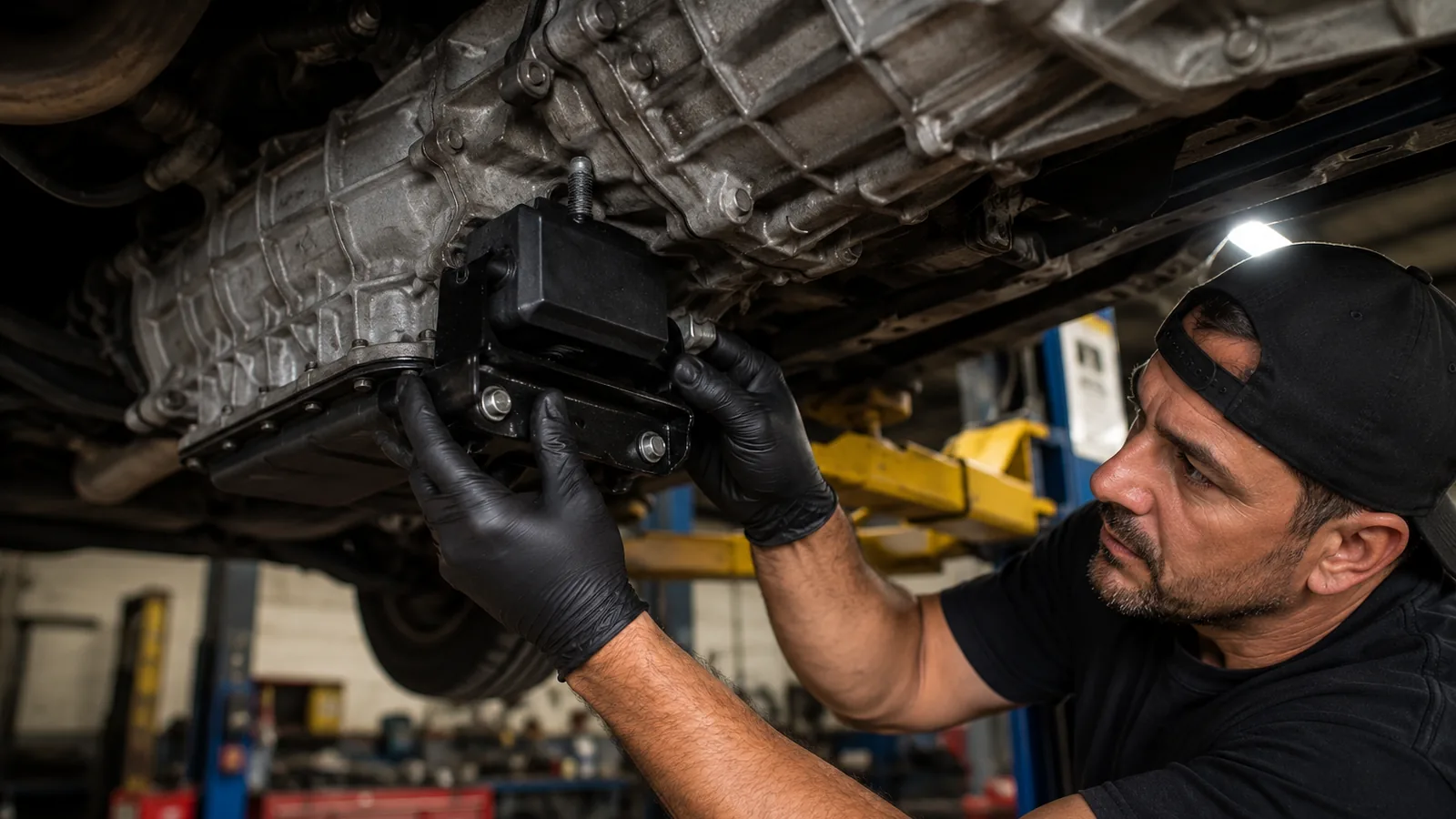
Transmission Mount: Symptoms, Cost & Engine-Mount Difference
A bad transmission mount usually clunks on shifts and vibrates through the floor. Expect $200-$500 all-in to replace one, with most of that being labor.
The Short Answer
A transmission mount is a rubber-and-steel bracket that cradles your gearbox and, together with the engine mounts, controls how the powertrain moves under load. When it wears out, you feel a clunk on shifts (Park-to-Reverse, Drive-to-Reverse), vibration through the shifter and floor, and harsh gear engagement. A single mount costs $20-$120 for the part and $200-$500 all-in at a shop. Most of that is labor.
Find the Right Transmission Mount
Enter your vehicle — we'll show only mounts that fit
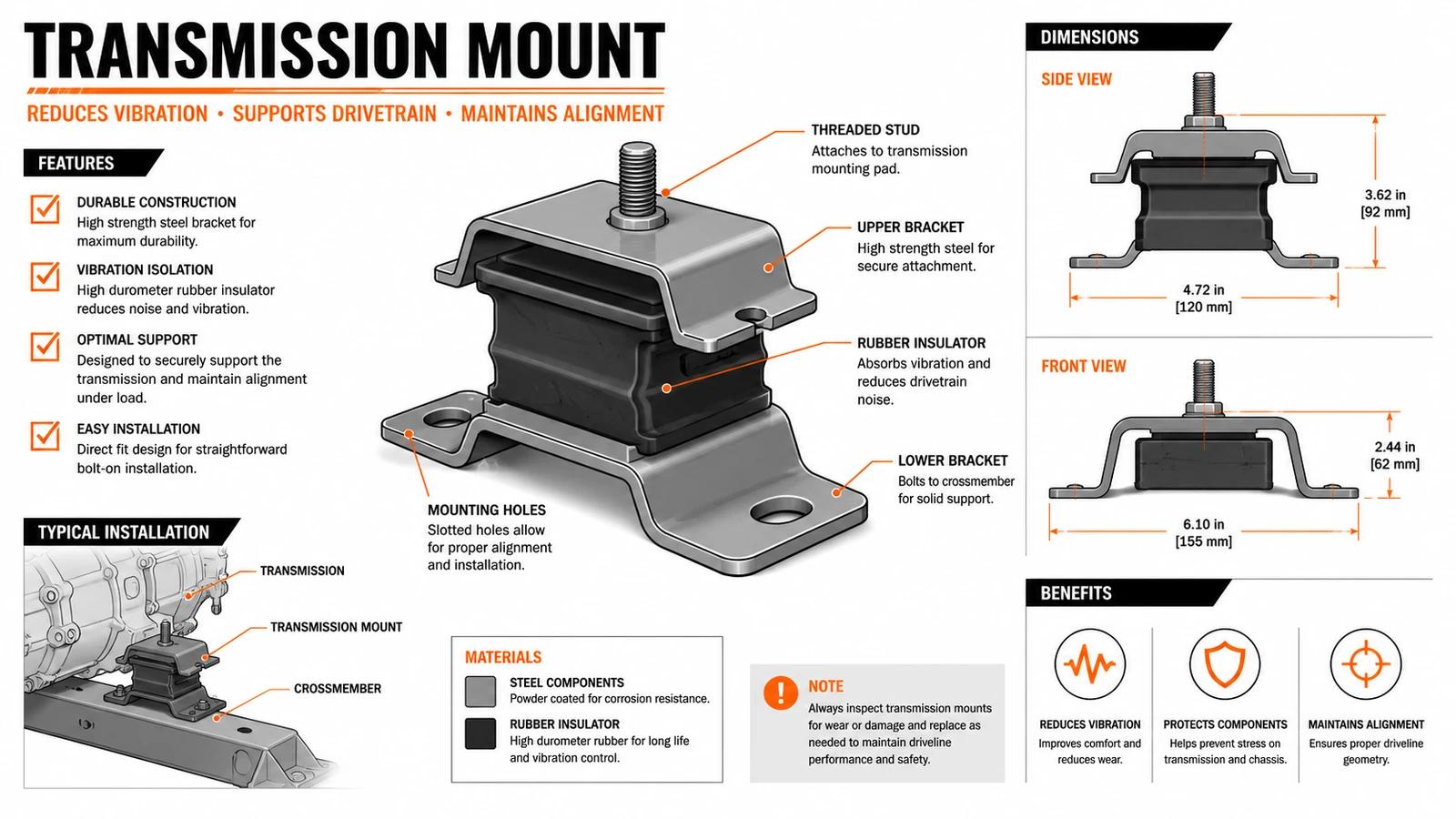
What a Transmission Mount Actually Does
Your engine and transmission are bolted together as one heavy assembly. Call it the powertrain. That whole unit is suspended in the car by a set of mounts: usually two or three engine mounts and one transmission mount (sometimes called a gearbox mount or trans mount).
The transmission mount does three jobs at once:
- Supports the weight of the transmission so it doesn't hang off the engine
- Absorbs vibration and torque so engine shake and gear engagement don't reach the cabin
- Limits movement so the powertrain doesn't rock excessively when you accelerate, brake, or shift
That middle job is why the mount is mostly rubber (or a fluid-filled hydraulic cushion on some vehicles). Rubber flexes to soak up vibration, then returns to shape. Over 8-15 years and 80,000-150,000 miles, that rubber hardens, cracks, separates from its steel, or on hydraulic mounts leaks its fluid. Once it does, the vibration and movement it used to absorb go straight into your shifter and floorpan.
Signs of a Bad Transmission Mount
Here's the honest part most parts sites won't tell you: a bad transmission mount will never throw a check-engine light. It's a mechanical rubber part. There's no sensor watching it and nothing for the computer to log. Diagnosis is by feel, sound, and a physical inspection, not a scan tool. Anyone who says a code confirms a bad mount is guessing.
Here are the real symptoms, ranked by how commonly they show up first:
| Symptom | What you feel/hear | How often it's the mount |
|---|---|---|
| Clunk when shifting P↔R or D↔R | A distinct "thunk" from under the center of the car | Very common — the #1 tell |
| Vibration through shifter/floor | Buzz or shake that worsens at idle in gear | Common |
| Harsh gear engagement | Driveline "shunt" or jolt when it grabs a gear | Common |
| Clunk over bumps | Metallic knock as the powertrain shifts | Moderate |
| Vibration that eases in Neutral | Shake in gear that calms in N or P | Strong indicator |
The single most reliable test: with the parking brake on and your foot firmly on the brake, shift between Drive and Reverse. A worn mount lets the transmission lurch and produces a sharp clunk you can feel through the seat. A healthy mount barely moves.
A mechanic will also do a visual and "load" check: open the hood, watch the powertrain while a helper brake-torques it lightly, and look for excessive lift or a mount whose rubber has cracked, collapsed, or torn away from the metal. On hydraulic mounts they look for oily fluid residue. That's a dead mount.
Transmission Mount vs. Engine Mount — the Real Difference
This is the question that confuses most people, so let's be blunt. They're the same kind of part doing the same job. The difference is location.
| Transmission Mount | Engine (Motor) Mount | |
|---|---|---|
| Holds | The transmission / gearbox | The engine block |
| Count per vehicle | Usually 1 | Usually 2-3 |
| Symptom felt through | Shifter, floor, driveline | Steering wheel, whole cabin, engine bay |
| Worst symptom | Clunk on P↔R / D↔R shifts | Engine "jump" on start/accel, thud on load |
| Same failure mode? | Yes — cracked/collapsed rubber | Yes — cracked/collapsed rubber |
Because they share the same powertrain and age in the same heat cycles, when one mount is shot, the others are usually close behind. That's why a good shop inspects the entire mount set together, and why many people replace the transmission mount and engine mounts in one visit to save on repeated labor.
If your symptoms feel more like the engine jumping forward on hard acceleration or a thud on startup, read our companion guide on Bad Motor Mount Symptoms. That's a different (but related) diagnosis.
Transmission Mount Replacement Cost
Here's what you'll actually pay. We'll separate part from labor, because the split matters, and because it tells you when a DIY makes sense.
| Line item | Typical range | Notes |
|---|---|---|
| Standard rubber mount (part) | $20-$80 | Most cars and trucks |
| Hydraulic mount (part) | $60-$120+ | Fluid-filled; common on newer/premium vehicles |
| Shop labor | $120-$350 | 1-3 hours depending on access |
| All-in at a shop (one mount) | $200-$500 | Part + labor combined |
| Full mount set (trans + engine) | $400-$900 | If done together |
Why labor dominates the bill: the transmission mount often sits above a crossmember or behind other components. To get the old one out, the shop frequently has to support the transmission on a jack and drop or lift a crossmember to make room. That access, not the $40 part, is what you're paying for. On easy-access vehicles it's a 45-minute job. On tight engine bays it's 2-3 hours.
DIY reality check: if you have a floor jack, jack stands, a block of wood to cradle the transmission, and reasonable clearance, one mount is a very doable weekend job. You'd spend $20-$120 on the part and keep the $120-$350 labor. If the mount is buried under a crossmember, it's fair to hand it to a shop.
For the engine-mount side of this equation, our Motor Mount Replacement Cost breakdown runs the same numbers for those parts.
Don't Wait — But Don't Panic Either
A worn transmission mount isn't an immediate breakdown risk, so you won't be stranded tomorrow. But driving on a fully collapsed or torn mount lets the powertrain move too far, which can:
- Stress and eventually crack the remaining mounts (turning one repair into three)
- Strain shift linkage, exhaust hangers, and CV axles as the powertrain shifts
- Turn an annoying clunk into a genuine driveline problem
Rule of thumb: a small crack you catch on inspection can wait for your next service. A mount that's clunking hard on every shift or leaking hydraulic fluid should be replaced within a few weeks.
What to Buy — and Why Rubber Quality Matters
A mount is only as good as its rubber compound and steel. Cheap mounts use soft, under-cured rubber that hardens and fails again in 2-3 years. You feel the clunk return and you're back under the car. The two specs that actually matter are rubber durometer (hardness tuned to your vehicle's weight and torque) and steel gauge (thick enough not to flex or crack).
This is where a specialist earns its keep. Westar has manufactured engine and transmission mounts in the US since 1986, runs ISO-certified plants, and focuses specifically on mounts. That's 3,200+ SKUs with durometer and steel gauge dialed in per application rather than one generic rubber blend across everything. For a part whose whole job is controlling vibration and movement, matching the original spec is what keeps the clunk from coming back. That's the honest reason we point people toward it. Not because it's the priciest option, but because a mount that lasts saves you the second labor bill.
Match Your Exact Mount
Select year, make and model — no guesswork, no wrong parts
Shop the parts: Transmission Mounts · Motor Mounts · Westar Mounts
Bottom Line
A transmission mount holds your gearbox and quiets the powertrain. When it fails you get a clunk on shifts, vibration through the floor, and harsh engagement, and never a check-engine light. Budget $200-$500 all-in for one at a shop, or $20-$120 if you DIY the part. Because mounts age together, inspect the full set, and buy a mount with the right rubber durometer so you're not doing this job twice.
FAQ / People Also Ask
The most common signs are a clunk when shifting between Park and Reverse or Drive and Reverse, vibration through the shifter and floor (worst at idle in gear), harsh or jolting gear engagement, and a metallic knock over bumps. If the vibration eases when you shift to Neutral, the mount is a strong suspect.

Comments
Loading comments...
Comments are moderated by the AutoBuffy team.