

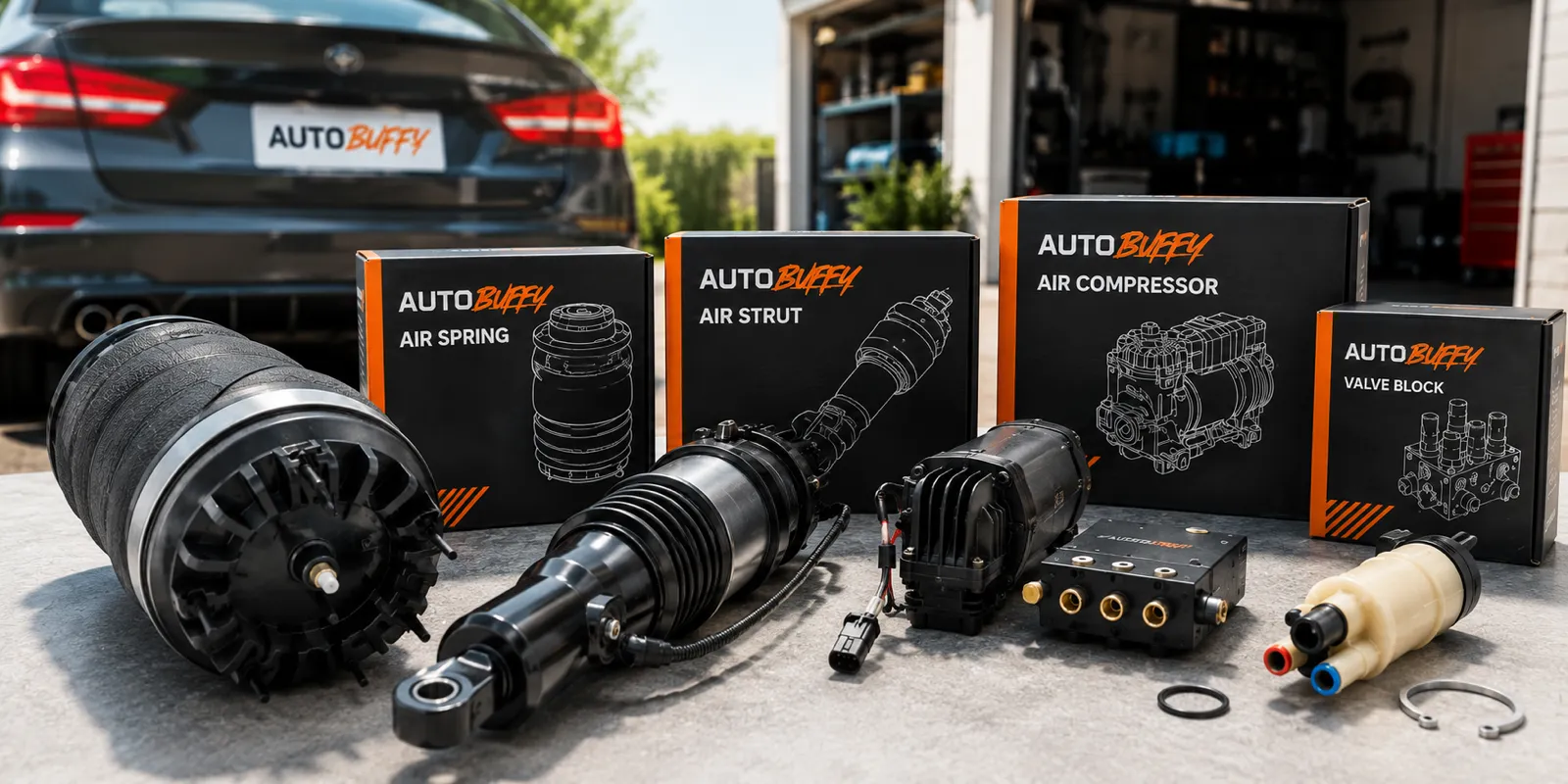
Air Suspension Explained: How It Works & Fails
Air suspension trades steel coil springs for air-filled springs and a compressor so the vehicle can self-level under load — and it fails one of three ways: a leaking spring, a dead compressor, or a bad solenoid. Here's how the six-part system works and what to do when it doesn't.
The Short Answer
Air suspension replaces steel coil springs with air-filled rubber springs (or air struts) plus a compressor system, so the vehicle can self-level and adjust ride height — and it fails almost always for one of three reasons: a leaking spring, a dead compressor, or a bad solenoid/sensor.
| Component | Job | Typical failure |
|---|---|---|
| Air spring / air strut | Holds vehicle weight, sets ride height | Rubber bellows dry-rot and leak (most common failure) |
| Compressor | Pumps air into the springs on demand | Burns out from overwork or moisture ingestion |
| Dryer | Strips moisture from incoming air | Saturates, lets water reach compressor and springs |
| Solenoid valve block | Routes air to the correct corner | Internal leaks, stuck valves, wrong-corner inflation |
| Height sensors | Measure ride height at each corner | Linkage wear, corrosion, false readings |
| Control module | Reads sensors, runs compressor/solenoids | Software faults, corroded connectors |
If you're here to shop, not read, jump to the vehicle finder near the bottom of this page — it pulls every air suspension part we stock by year, make, and model. If you want to understand what you're looking at first, keep going.
What Is Air Suspension, and Why Do Manufacturers Bother With It?
Steel coil springs are simple and cheap. They also do one thing: hold a fixed spring rate no matter what you load into the vehicle. Air suspension trades that simplicity for adjustability. An air spring's stiffness changes with how much air is pumped into it, so the same suspension can ride soft and comfortable empty and firm up automatically when you load four passengers and a trunk full of gear, or tow a trailer.
Two reasons automakers keep specifying it. First, ride comfort — luxury sedans and SUVs use it to isolate the cabin from road imperfections better than steel can, especially at low speeds over broken pavement. Second, self-leveling under variable load — trucks and SUVs rated to carry or tow heavy loads use it to keep the vehicle level and keep headlights aimed correctly instead of squatting under weight. Some systems go further and let the driver raise the vehicle for off-road clearance or lower it at highway speed for aerodynamics, which is why you'll see a "vehicle sagging" or "ride height fault" light instead of a simple check-engine light when something's wrong.
It's not a niche feature anymore. It shows up across three vehicle categories: full-size luxury SUVs and sedans (self-leveling comfort), body-on-frame trucks and SUVs that tow or haul (load leveling), and a handful of sport and off-road applications where adjustable ride height matters (ground clearance or aero).
How Does an Air Suspension System Actually Work?
Six parts do the job, and each one fails in its own predictable way.
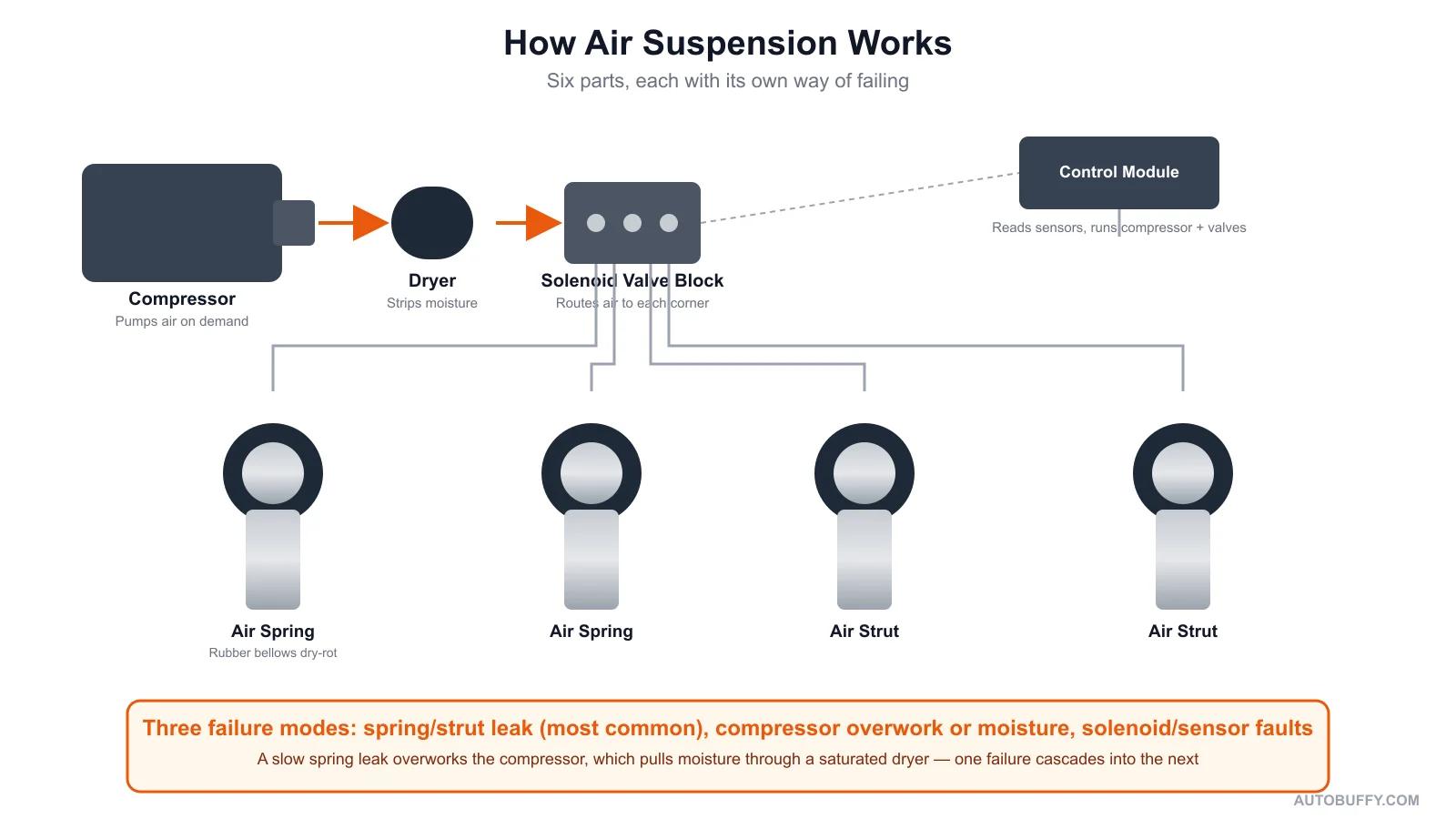
Air spring or air strut. An air spring is a rubber bellows, reinforced with fabric plies like a tire, that inflates to support the corner of the vehicle in place of a coil spring — the shock absorber sits inside or alongside it. An air strut combines the air spring and the shock/damper into one unit, the way a conventional strut combines a coil spring and shock. Either way, the rubber is the weak point. It flexes every time you drive, and rubber that flexes for 10-15 years starts to crack, especially at the folds. A cracked air spring leaks air constantly and can't hold the vehicle up.
Compressor. An electric pump, usually mounted in the trunk, under the hood, or near a wheel well, that pushes atmospheric air through the dryer and into the springs whenever the height sensors call for more air. It runs in short bursts under normal conditions. It runs constantly, or for unusually long stretches, when something downstream is leaking and the system can't hold pressure — which is the compressor's own early warning sign that it's about to be asked to do more work than it was built for.
Compressor dryer. A small canister packed with desiccant (usually silica gel) sitting between the compressor and the rest of the system. Its only job is pulling moisture out of the air before it enters the springs and valve block. It's a $15-80 part, and it's disposable by design — the desiccant saturates over time and years of humid air pumped through it. Once it's saturated, water starts making it into the compressor and springs, and that's the single most common way a $300-550 compressor gets killed early: not by age, but by moisture its own dryer should have stopped.
Solenoid valve block. A bank of electronically controlled valves, one per corner (sometimes shared front/rear), that opens to let air into or out of a specific spring on command from the control module. When a valve gets sticky or an internal seal wears out, you get symptoms that look electrical but aren't: one corner won't fill, one corner won't hold air overnight, or the system dumps air it shouldn't.
Height sensors. Usually a small potentiometer connected by a linkage arm to the suspension, one at each corner or one front and one rear depending on the vehicle. They tell the control module the actual ride height in real time. Corroded connectors or a bent/disconnected linkage arm feed the module bad data, and the system either overcorrects or gives up and sets a fault code.
Control module. The brain that reads the height sensors, decides when to run the compressor and open which solenoid, and sets the dash warning ("Check Air Suspension," "Ride Control Fault," "Vehicle Sagging" — wording varies by make) when something doesn't add up. On some platforms the module also handles ride-height presets (off-road high, highway aero low) tied to a dash button.
Which Vehicles Come With Air Suspension From the Factory?
It's standard or optional equipment on a long list of trucks, SUVs, and full-size/luxury sedans built specifically to carry variable loads or ride softer than steel allows. Based on our own fitment data, here's what we see the most air suspension part requests for:
| Vehicle | Years with factory air suspension |
|---|---|
| Ford Expedition | 1997-2018 |
| Lincoln Navigator | 1998-2018 |
| Land Rover Range Rover | 1993-2021 |
| Range Rover Sport | 2006-2020 |
| Lincoln Continental | 1984-2002 |
| Lincoln Town Car | 1990-2011 |
| BMW X5 | 2000-2019 |
| VW Touareg | 2004-2016 |
| Porsche Cayenne | 2003-2018 |
| Audi Q7 | 2007-2017 |
| Mercedes GL / ML / S-Class | Multiple generations |
| Jeep Grand Cherokee WK2 | 2011-2020 |
| Cadillac Escalade / Tahoe / Yukon / Suburban | GM Autoride-equipped years |
| Lexus LS460 | 2007-2017 |
That's not the complete universe of air-suspended vehicles, but it's where the bulk of the repair and replacement demand actually lands. Full-size body-on-frame SUVs (Expedition, Navigator, Escalade/Tahoe/Yukon/Suburban) tend to use it for load leveling and towing; the Range Rovers, S-Class, LS460, and 7-Series-adjacent platforms use it primarily for ride comfort and often add height-adjustable modes on top.
The Three Ways Air Suspension Fails
Nearly every air suspension complaint traces back to one of three root causes.
1. Air spring or strut leak from dry rot (most common). The rubber bellows ages the way any rubber part ages — heat cycles, UV exposure, and years of flexing crack it, usually starting at the fold near the top or bottom mount. A slow leak shows up as the vehicle sagging overnight or after sitting for a few hours, then rising back to height once the compressor catches up in the morning. As the crack grows, the sag gets faster and the compressor has to run longer and more often to compensate — which is exactly the overwork that kills compressors next.
2. Compressor failure, usually caused by dryer failure or moisture. A compressor rarely just dies from age alone. Far more often, a saturated dryer lets moisture into the pump, or a slow spring leak forces the compressor to run far more than it was designed for, and it overheats or burns out its internal seals. Symptoms: compressor runs constantly, runs for unusually long periods, makes a labored or grinding sound, or stops running entirely and the vehicle won't rise at all.
3. Solenoid, valve, or height sensor faults. Less common than the first two, but it happens — a stuck solenoid that won't open a specific corner, a valve block seal that leaks internally, or a corroded height sensor connector feeding the module bad data. These often present as one-corner problems (one side low, one side won't respond) or as fault codes without an obvious leak anywhere.
In practice, these three causes cascade. A slow spring leak overworks the compressor. An overworked compressor pulls more air through a saturated dryer. A saturated dryer lets moisture reach the solenoid block and corrode it. That's why a system that's been "just a little low in the mornings" for six months often shows up needing a compressor and a dryer, not just the spring that started the whole thing.
Repair, or Convert to Coil Springs?
Once a system starts failing, you've got two paths: replace the failed air components with OE-style parts and keep the air suspension, or convert that corner (or the whole vehicle) to a coil spring and conventional shock/strut setup, which permanently deletes the air system.
Conversion makes the most sense when a vehicle is older, has already had one or more air components fail, or when the owner values simplicity and lower long-term cost over the ride quality and load-leveling the air system provided. It doesn't make sense on a newer vehicle still under warranty consideration, or one where the air ride is a major part of what the owner paid for (a lot of Range Rover and S-Class owners specifically don't want to lose it). We cover the full decision — cost comparison, what you gain and lose, and which vehicles have well-proven conversion kits — in our air suspension to coil spring conversion guide.
What Does Air Suspension Repair Actually Cost?
Rough numbers so you're not walking in blind: a single air spring or strut, parts and labor, typically runs somewhere between $500 and $1,600 depending on the vehicle and whether the shop uses OE, aftermarket, or a remanufactured unit. A compressor replacement, parts and labor, usually lands between $400 and $900. Independent shop labor rates run $80-150/hour in lower cost-of-living areas and $120-200/hour in expensive metros, with dealerships often at $150-250/hour — and air suspension jobs frequently involve trim removal, wheel-well liners, or a lift, so labor time adds up faster than a basic strut swap. A conversion kit deleting the air system entirely often costs less overall than repeatedly fixing individual air components, especially past the second or third repair. We break down cost by component, by vehicle, and by repair-vs-conversion math in our full air suspension repair cost guide.
How Long Does Air Suspension Actually Last?
There's no single number — it depends heavily on climate, mileage, and which system the vehicle came with. Rubber bellows in hot, dry climates dry-rot faster than the same part in a mild climate. Vehicles that sit outside year-round see more UV damage than garaged vehicles. Some platforms are simply better engineered than others and go 10+ years without a single air component failure; others are known in owner forums for compressor or spring problems well under 100,000 miles. We walk through realistic lifespan expectations by vehicle type, what shortens it, and how to tell if a given repair is worth doing versus converting, in our how-long-does-air-suspension-last guide.
Bad Compressor? Here's the Quick Version
If the compressor is running constantly, running long after the vehicle should have reached height, making a labored or grinding noise, or not running at all while the vehicle sits low, that's compressor territory — though it's worth checking for a spring leak first, since an overworked compressor is often a symptom of a leak elsewhere, not the root cause. Full symptom-by-symptom diagnosis, how to test before you buy a $300+ part, and replacement cost breakdown live in our air suspension compressor symptoms and replacement guide.
Is "Air Suspension Kit" What You're Looking For?
If you searched "air suspension kit" specifically, you're probably shopping, not researching — that term usually points to a complete kit for one vehicle application (spring, strut, or full kit with hardware), which lives on our product category pages rather than in an article like this one. This guide covers the informational side: what the system is, why it fails, and what your options are once it does. Use the finder above or below to jump straight to parts for your vehicle.
Brands We Carry for Air Suspension
We stock air suspension parts across several manufacturers, with real depth in struts, springs, compressors, and conversion kits. SKU counts as of our current catalog:
| Brand | Air suspension SKUs | Notable depth |
|---|---|---|
| Arnott | 865 | 312 struts, 139 compressors, 108 springs, 84 conversion kits |
| Suncore | 841 | 164 conversion kits (deepest in that category), 122 struts, 90 compressors |
| Unity | 784 | 263 struts/sets, 211 springs/sets, 140 conversion kits |
| Westar | 491 | 13 part types, manufacturer since 1986 |
| Bilstein | ~250 | 142 air struts |
None of these is a universal "right answer" — the right part depends on your specific vehicle, whether you want OE-match or a documented conversion, and what's actually in stock for your application. Use the vehicle finder to see what fits.
Shop Air Suspension Parts
Struts, springs, compressors, and conversion kits by vehicle
FAQ / People Also Ask
The vehicle sags overnight or after sitting parked for a few hours, then rises back to normal height once you start it and the compressor catches up. You might also notice the compressor running longer than usual, a dash warning like "Check Air Suspension" or "Vehicle Sagging," or one corner sitting visibly lower than the others.


Comments
Loading comments...
Comments are moderated by the AutoBuffy team.