

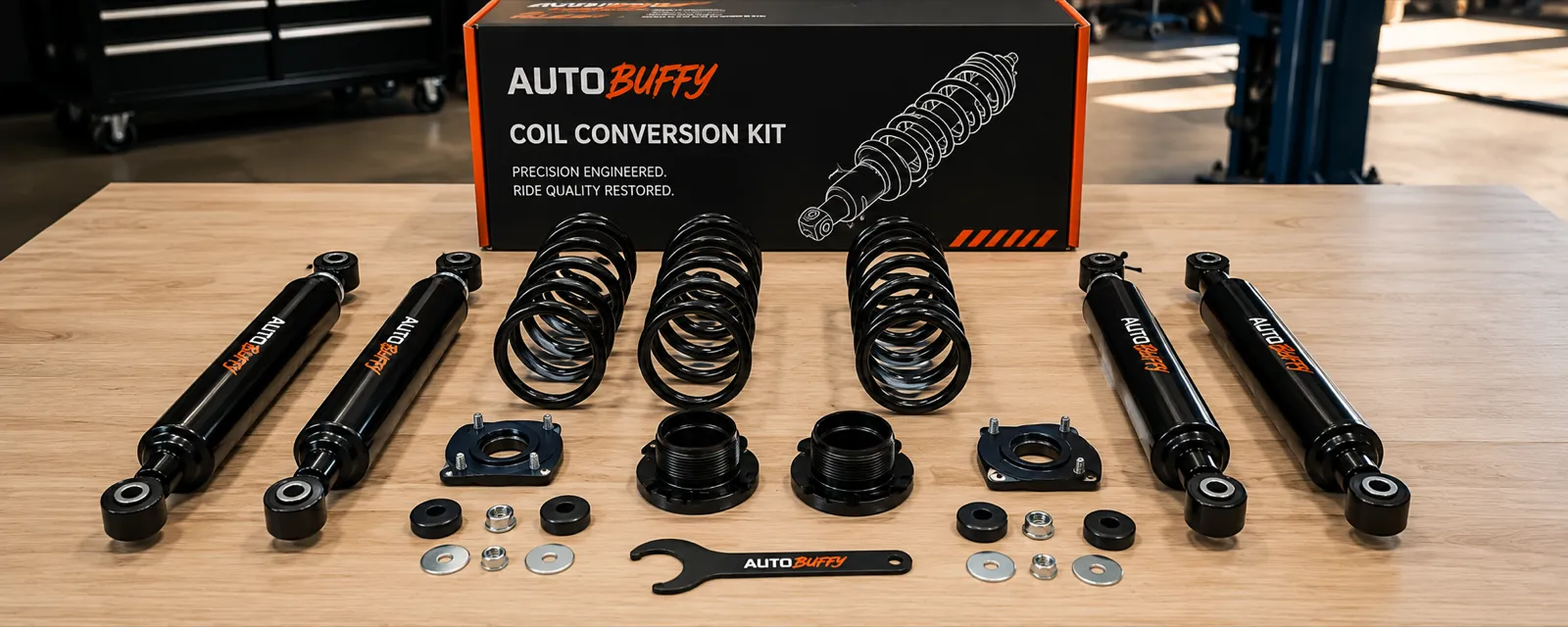
Air Suspension to Coil Spring Conversion: When to Convert
A conversion kit swaps air springs, compressor, and electronics for steel coils and shocks, permanently. It's the right move on an old, paid-off vehicle with a repeat failure — often once two-corner repairs already run 40-60% of the kit's cost — and the wrong move on a newer luxury vehicle or a truck that actually uses air for load-leveling.
The Short Answer
A conversion kit replaces your air springs (or air struts), compressor, and the electronics that run them with conventional steel coil springs and shocks — permanently. No more self-leveling, no more ride-height adjustment, but also no more $600 air spring or $400 compressor showing up on your invoice every couple of years. Whether that's a good trade depends entirely on the vehicle sitting in your driveway right now.
| Convert to coils when... | Stick with air when... |
|---|---|
| The vehicle is 10+ years old and paid off | It's a newer luxury vehicle where ride quality matters to you or a future buyer |
| You've already replaced one air spring or the compressor once | The system uses air for load-leveling towing or hauling, not just comfort |
| Fixing one corner properly costs half of what a full kit costs | You just want to save money short-term without understanding what you're giving up |
| You don't care about factory ride-height adjustment | The rest of the system (compressor, dryer, other springs) is still original and healthy |
We carry 71 Air Spring to Coil Spring Conversion Kits ($87.95–$1,132.95) plus 19 Active-to-Passive kits for GM trucks, across Arnott, Suncore, Unity, Westar, Bilstein, and Dorman. The rest of this guide walks through the actual decision, with real numbers, not a sales pitch either direction.
What a Conversion Kit Actually Replaces
Strip away the marketing language and a conversion kit is simple: it swaps the air spring or air strut at each corner for a coil spring (and a shock or strut, depending on the vehicle) sized to hold the factory ride height. Most kits also include a bypass module or resistor pack that fools the body control module into thinking the air system is still there and functioning, so you don't drive around with a "Check Air Suspension" light glaring at you for the next ten years.
What it does NOT do: it doesn't touch your brakes, your alignment geometry (a good kit is engineered to match factory ride height within a half inch or so), or anything else structural. It's a suspension swap, not a rebuild of the vehicle. Install time runs 2-5 hours depending on the vehicle and whether you're doing two corners or all four, and most of that time is fighting rusted bolts, not doing anything clever with springs.
One thing people get wrong going in: they think "conversion kit" means one universal part. It doesn't. A Lincoln Navigator rear kit is a completely different animal from a Range Rover front kit, and the kits are not interchangeable across trims within the same model year, either. Buy for your exact VIN, not just "2015 Expedition."
When You Should Convert to Coil Springs
The vehicle is old and paid off
If you're driving a 2005 Navigator with 160,000 miles on it and no loan payment, you're not protecting resale value on a car that's worth $4,000. You're protecting your own wallet from repeat repair bills. This is the single biggest reason owners convert, and it's the right reason. An air suspension system on a vehicle like this isn't going to get more reliable with age — the rubber bellows on the springs dry-rot regardless of mileage, and once one corner has failed, the other three are on the same clock.
You've already been burned once
If you replaced one air spring last year and it's the compressor's turn this year, you're not looking at a repair problem anymore. You're looking at a system that's failing corner by corner, on a timeline you don't control. Converting stops the bleeding in one visit instead of three or four spread across 18 months.
The math favors it (see below)
This is the part most guides skip, and it's the actual decision-maker for a lot of owners. Run the numbers on your specific vehicle before you decide anything.
You don't use — or want — the height adjustment
Factory air suspension exists to self-level under load and, on some trucks, to raise for off-road clearance or lower for easier entry. If you never load the vehicle heavily and you've never once used a height-adjust button, you're paying maintenance costs for a feature you don't use. Coils give up nothing you were using.
When You Should NOT Convert
Newer luxury vehicles where ride quality (and resale) matter
A Mercedes S-Class, Range Rover, or Porsche Cayenne buyer is paying for that vehicle's specific ride character, and air suspension is part of what they're buying. Converting a low-mileage, still-under-warranty-adjacent luxury vehicle to coils will change how it rides, usually firmer and less isolated over rough pavement, and it will show up as a red flag to the next buyer's pre-purchase inspection. If you're planning to sell within a couple years, or the vehicle still has real market value, air-to-coil conversion is usually the wrong move even if the repair bill stings now.
Trucks that actually use air for load-leveling or towing
Some trucks and vans run air suspension specifically because owners tow or haul heavy, uneven loads and need the rear to self-level. If that's your actual use case, not a hypothetical, converting to fixed coil rate springs means the rear will sag under load exactly like a non-air-suspension truck does, because that's what you've made it into. Fine for a truck that never tows. A real problem for one that does every week.
"I just want to save money" without understanding the tradeoff
This sounds harsh, but it's the honest version: if your only goal is avoiding a repair bill and you haven't thought about what height-adjust and self-leveling actually did for you, you might regret it in six months when the ride feels harsher than you remember, or when a trade-in appraiser dings the vehicle for a non-factory suspension. Go in with eyes open.
The Real Math: One Corner vs. the Whole Car
Here's where a lot of "should I convert" articles get vague. Don't be vague — do the arithmetic on your actual vehicle before deciding anything.
Say you're driving a Lincoln Navigator and the rear passenger air spring just failed. An OEM-quality replacement air spring in our catalog runs roughly $200-$280 depending on brand, plus 1-1.5 hours of labor at the 2026 national average independent-shop rate of around $132/hour. That's somewhere between $330 and $480 to fix that one corner.
Now the honest part: air springs almost never fail alone for long. The other rear corner is the same age, same rubber, same mileage. Replace both rear springs and you're at roughly $650-$950 in parts and labor — and you still haven't touched the compressor, the dryer, or the front struts, all of which are the same age and on the same failure clock.
Compare that to a full front-and-rear conversion kit like CK-7846 at $1,132.95 in parts, plus maybe 3-4 hours of labor (call it $400-$530) for a complete swap: roughly $1,530-$1,660 out the door, done once, for the entire car.
| Approach | Parts | Labor (approx.) | Total | What's left exposed |
|---|---|---|---|---|
| Fix one rear corner | $200-$280 | $130-$200 | $330-$480 | Other 3 corners + compressor + dryer, all original |
| Fix both rear corners | $400-$560 | $260-$400 | $650-$950 | Front struts + compressor + dryer, all original |
| Full CK-7846 conversion (F+R) | $1,132.95 | $400-$530 | ~$1,530-$1,660 | Nothing — whole system replaced |
Fixing both rear corners lands at roughly 40-60% of the full conversion cost — and that's before the front struts or the compressor take their turn. That's the "half the price" tipping point owners hit right before they call us asking about conversion kits instead of another single-corner repair. If you're only ever fixing one corner and the rest of the system is genuinely healthy, the math doesn't favor converting yet. Once you're two repairs deep, it usually does.
If your vehicle's conversion kit runs cheaper, and several of ours in the $87.95-$300 range do, mostly on smaller sedans and older SUVs with simpler rear setups — the math tips toward conversion even faster, sometimes after just one failed component.
Read the full air suspension repair cost breakdown for per-component pricing before you run this math on your own vehicle.
Ride Quality, Cost, and Reliability: The Honest Tradeoffs
| Factor | Air Suspension (working) | Coil Spring Conversion |
|---|---|---|
| Ride quality | Smoother over small bumps, self-leveling keeps ride height constant under load | Firmer, more consistent — doesn't sag under load but doesn't self-adjust either |
| Cost over 5 years | Higher — bellows, compressor, dryer, and solenoids all wear and fail on their own schedules | Lower — coil springs and a quality strut/shock rarely need attention for years |
| Complexity / failure points | 4 air springs, compressor, dryer, solenoid block, height sensors, control module | 4 springs, 4 struts/shocks. That's it |
| Reliability after the fix | Depends on which corner or component you just fixed — others are still aging | Whole system is new and mechanical, nothing to leak or fail electronically |
| Resale on a luxury vehicle | Expected feature, buyers pay for it | Can be a red flag on a pre-purchase inspection for higher-value vehicles |
| Off-road / load-leveling capability | Retained, if the system works | Lost — height is now fixed |
Neither column is universally "better." A working air suspension system rides better and preserves the vehicle's intended character. A conversion is more reliable going forward and usually cheaper over time, but it's a one-way door — once you convert, going back to air means buying most of the same parts you just paid to remove, in reverse.
Active-to-Passive Kits: A Related Option for GM Trucks
If you're driving a GM truck or SUV with Autoride (Escalade, Tahoe, Yukon, Suburban), there's a related but distinct category worth knowing about: Active-to-Passive conversion kits. Instead of swapping air components for coils, these kits replace the electronically-controlled Autoride shocks with fixed-valve passive shocks, while keeping the factory coil (or air, on some trims) springs in place. We stock 19 of these SKUs, up to $738.95 for the Cadillac application.
The logic is the same as an air-to-coil conversion, get rid of an electronically complex, failure-prone component and replace it with something mechanically simple — but it's a narrower fix aimed specifically at the Autoride shock/sensor system rather than the full air spring setup. If your GM truck's issue is a "Ride Control" fault rather than physical sag, check whether you're dealing with Autoride shocks or actual air springs before you buy a kit. They're not interchangeable, and buying the wrong category is the single most common return we see in this part of the catalog.
Conversion Kit Depth by Brand
No favorites here — just what's actually in stock and what it costs, so you can compare before you buy.
| Brand | Conversion Kit SKUs | Notes |
|---|---|---|
| Suncore | 164 | Deepest conversion-kit lineup we carry |
| Unity | 140 | Broad coverage across struts, springs, and conversion sets |
| Arnott | 84 | Also our deepest air-strut lineup (312 SKUs) if you're repairing instead of converting |
| Westar | Part of 491 total air SKUs across 13 part types | Manufacturer since 1986 |
| Dorman | 41 | Straightforward OE-style delete kits |
Full catalog range for this part type: $87.95-$1,132.95, averaging around $387. The spread is almost entirely about vehicle size and complexity — a compact sedan rear kit and a full-size luxury SUV front-and-rear kit are not the same job, and shouldn't cost the same.
Find Your Conversion Kit
Enter your vehicle to see exact-fit kits and pricing
How the Install Actually Goes
For most vehicles, a front-and-rear kit installs in 2-5 hours for a shop that's done one before, longer if it's their first time on that platform, or if rust has turned every bolt into a fight. The general order: relieve air pressure from the system (some kits include instructions for this, some vehicles have a service mode), remove the air spring or strut, install the coil spring and shock/strut assembly, install the bypass module or resistor, and clear the dash warning. Most owners with moderate mechanical skill and a spring compressor (for kits that don't come pre-assembled) can do this in a weekend, per the DIY accounts you'll find on Expedition and Navigator forums — under two hours per corner is a commonly reported time for straightforward applications.
The part people skip and regret: the bypass module. Without it, most vehicles throw a permanent warning light and some will limit other functions until the fault is addressed. Buy a kit that includes one, or budget for it separately.
More on Air Suspension
Check the air suspension guide for the full breakdown of how the system works and why it fails in the first place, and see how long air suspension actually lasts if you're still deciding whether to repair, convert, or just wait it out. If your specific problem is a dead or constantly-running compressor, our compressor symptoms and replacement guide covers that repair path in detail before you commit to a full conversion.
FAQ / People Also Ask
On an older, high-mileage vehicle, usually not much — buyers in that price range often prefer a converted vehicle because it removes a known expensive failure point. On a newer luxury vehicle where air ride is an expected feature, a conversion can be a red flag on a pre-purchase inspection and may lower what a private buyer or dealer offers.


Comments
Loading comments...
Comments are moderated by the AutoBuffy team.