

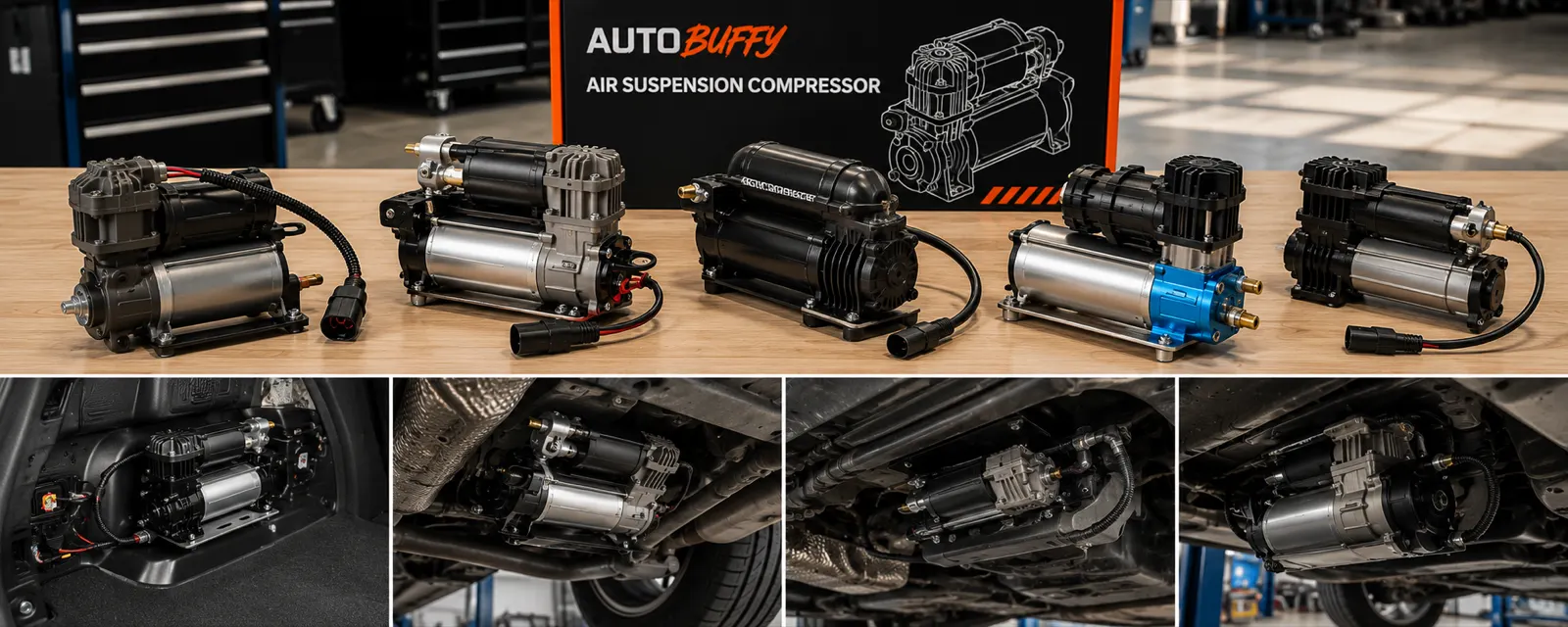
Bad Air Suspension Compressor: Symptoms & Cost
A failing air suspension compressor sags overnight, runs nonstop trying to keep up, then quits — parts run $29.95 to $553.95, and a saturated $15-80 dryer is usually what killed it in the first place.
The Short Answer
A failing air suspension compressor sags overnight, runs constantly trying to keep up, and eventually won't build pressure at all — replacement parts run $29.95 to $553.95 depending on vehicle, and if the culprit is a saturated dryer, replace both or the new compressor dies the same way.
| Symptom | What's Actually Happening | Urgency |
|---|---|---|
| Vehicle sags overnight or over a few hours | Slow leak somewhere in the system, compressor can't keep pace | Medium — get it looked at this week |
| One corner slow to rise or won't rise | Solenoid stuck, air spring leak, or compressor too weak to fill that circuit | Medium-high |
| Compressor runs constantly or in long cycles | Fighting a leak, or a saturated dryer is choking its own airflow | High — this is the moisture spiral starting |
| Compressor won't run at all | Dead relay, blown fuse, seized motor, or a control module that gave up on it | High |
| Loud grinding, whining, or clicking from under the hood/trunk | Worn piston rings, dry bearings, or a compressor eating itself from corrosion | High |
| Dash warning ("Check Air Suspension," "Ride Control Fault," "Vehicle Sagging") | Height sensors detected the system can't hold target ride height | Get it scanned soon |
Most of these overlap. A vehicle that sags overnight and shows a dash light might have a leaking air spring, not a compressor at all — the compressor is often the last thing to die, not the first. It fails because it's been overworked compensating for something else that's already broken.
Why Is My Air Suspension Compressor Running All the Time?
This is the number one complaint we hear, and there are really only two causes.
First: a leak somewhere downstream — a cracked air spring bellows, a leaking solenoid valve, a loose fitting — is bleeding pressure faster than normal, so the compressor cycles on to compensate. Spray soapy water on the air lines, fittings, and springs with the vehicle running and look for bubbles. This is the more common cause by a wide margin.
Second, and less obvious: the compressor dryer has saturated and is restricting airflow, so the compressor has to run longer and harder to push the same volume of air through a clogged filter. This one doesn't show up as an obvious leak. It just quietly ages the pump.
If you've had a slow leak for months and never traced it, assume both are in play by the time the compressor sounds strained. The leak wore out the dryer's desiccant capacity faster than a healthy system would, and now the tired dryer is wearing out the compressor.
The Moisture Death Spiral (Read This Before You Buy a Compressor)
Here's the part almost nobody explains clearly, and it's the single most useful thing you'll learn about air suspension maintenance.
Every time your compressor pumps air into the system, that air came from the atmosphere around your vehicle — which contains water vapor. The compressor dryer sits right after the compressor and before the air travels to the springs and valve block. Its job is simple: strip the moisture out of that air before it goes anywhere near metal parts, seals, or the compressor's own internals on the return stroke. Inside the dryer is a canister of desiccant beads, the same basic chemistry as the little silica packet in a shoebox, just built to handle continuous airflow instead of sitting in a closed box.
Desiccant has a finite capacity. Every fill cycle uses a little of it up. Eventually — faster if you live somewhere humid, faster still if you've got a slow leak forcing the compressor to cycle more often than a healthy system would — the desiccant saturates and stops absorbing water. Once that happens, moisture starts passing straight through into the compressor itself.
Moisture inside a compressor is bad news in a specific, mechanical way. It condenses on the piston, the cylinder walls, and the internal check valves. That water rusts metal surfaces that were never designed to get wet, and rust flakes and pits then chew up the piston rings and cylinder bore every time the compressor runs. It also gets into the electrical relay and motor windings over time, which is one of the ways compressors go from "running weak" to "won't run at all" seemingly overnight.
Here's the number that should change how you think about this part: a compressor dryer costs $14.95 to $80.95 in our catalog. A compressor costs $29.95 to $553.95, averaging around $324. A dryer that gets ignored for a year or two doesn't just fail on its own — it takes the compressor down with it. You're not choosing between "replace the $30 part" and "don't." You're choosing between replacing the $30 part now, or replacing it AND a $300+ compressor later once the moisture finishes its work. We've seen plenty of vehicles where the compressor and dryer failed within a few months of each other for exactly this reason, and it's rarely a coincidence.
Some systems make this worse by design. Higher humidity climates, vehicles that sit outside instead of in a garage, and any vehicle with an existing slow leak that forces extra compressor cycles will all burn through dryer capacity faster than the "normal" service interval some manufacturers quote.
How to Test It Yourself
You don't need a shop visit to narrow this down. Fifteen minutes and a flashlight gets you most of the way there.
Listen to the cycling pattern. Park on level ground, turn the vehicle off, and listen. A healthy system might cycle briefly once every few hours as it corrects for normal air loss. A compressor that runs for 60-90+ seconds at a stretch, or that cycles every few minutes, is either fighting a leak or fighting its own clogged dryer. Time it if you can — that number matters if you end up calling a shop.
Check for a stuck relay or blown fuse first. If the compressor makes zero sound — no hum, no click, nothing — before you assume the pump itself is dead, pull the compressor relay and fuse (check your owner's manual or a fuse box diagram for location; these are usually in the underhood fuse box) and inspect them. A stuck relay or blown fuse is a $5-20 fix that mimics a dead compressor perfectly. Swap the relay with an identical one from the fuse box if you're not sure, and see if the compressor wakes up.
Do a visual inspection for corrosion. Pop the compressor cover (usually in the trunk, under the hood, or tucked near a wheel well depending on the vehicle) and look at the housing, the dryer canister, and the wiring connector. White or green corrosion around the electrical connector, rust streaks running down from the dryer, or a wet-looking residue around fittings all point straight back to the moisture problem above. A dryer that looks visibly wet or has rust bleeding from its base has already saturated — don't wait on that one.
Listen for mechanical noise, not just cycling. Grinding, whining that changes pitch, or a knocking sound while it runs points to worn internals — piston, rings, or bearings — rather than a simple leak. That's a compressor that needs replacement regardless of what the dryer looks like.
If your compressor cycles constantly, looks corroded, or grinds when it runs, you're not looking at a maybe. You're looking at a part that's failing right now.
What Does It Cost to Replace an Air Suspension Compressor?
| Part | Our Price Range | SKU Count | Notes |
|---|---|---|---|
| Air Suspension Compressor | $29.95 – $553.95 (avg ~$324) | 58 SKUs | Price mostly tracks vehicle — Land Rover Discovery and Range Rover units run toward the top of that range |
| Compressor Dryer | $14.95 – $80.95 | 8 SKUs | Cheap insurance relative to what it protects |
Shop labor for a compressor swap typically runs $160-$240 in labor hours on top of parts, per recent repair-cost data, though access matters a lot here — a compressor tucked in an SUV trunk corner is a different job than one buried behind a bumper cover on a luxury sedan. All-in quotes from independent shops commonly land in the $800-$1,400 range for the job, with dealership quotes and tight-engine-bay European vehicles running higher, sometimes north of $2,000. Doing it yourself with our parts and basic hand tools skips most of that labor line — most compressor mounts are a handful of bolts, an electrical connector, and one or two air line fittings.
Get three shop quotes if you're not doing it yourself. A $300-600 spread between shops for the identical job isn't unusual.
Find your compressor and dryer
Enter your vehicle to see exact-fit parts and pricing
Should I Replace the Dryer Alone, or the Compressor and Dryer Together?
Depends entirely on why the compressor died.
Replace the dryer alone if: the compressor is running fine — normal cycling, no grinding, no corrosion — and you're doing preventive maintenance, or you caught a saturated dryer early before it did any damage to the pump. This is the cheap, proactive move and it's the single best dollar-for-dollar thing you can do for an air suspension system.
Replace both together if: the compressor already failed, is grinding, or shows any corrosion, AND the dryer is original or unknown-age. This is the more common scenario people actually call us about, and it's not optional if moisture killed the first compressor. Putting a brand-new compressor behind a dryer that's already saturated is throwing money away — that new pump inherits the exact same moisture problem that killed the old one, usually within months. We'd rather tell you to spend the extra $20-80 now than have you back here in six months buying a second compressor.
If you genuinely don't know the dryer's age or condition — no service records, previous owner, whatever — treat it as original and replace it. It's cheap enough that guessing wrong in the "replace it" direction costs you almost nothing, and guessing wrong in the other direction costs you the whole compressor again.
Brands We Stock
We carry compressor and dryer parts across several manufacturers, each with different depth depending on part type and vehicle coverage.
Westar runs dedicated CD- (compressor) and DR- (dryer) line codes across their air suspension catalog, part of a broader lineup they've built since 1986.
Arnott has the largest compressor selection we carry — 139 SKUs — spanning entry-level replacements up to OE-match units for European and luxury applications.
Suncore carries 90 compressor SKUs, alongside one of the deepest conversion-kit lineups in our catalog if a customer ends up going that route instead (more on that decision below).
Unity stocks 86 compressor SKUs, with broader coverage across struts and spring sets for shoppers who need more than just the pump.
Coverage and pricing vary by exact vehicle and trim — the fastest way to see what fits yours and compare pricing across brands is to search your vehicle above.
When a Compressor Failure Means It's Time to Consider Converting to Coil Springs
A compressor replacement makes sense on a vehicle that's otherwise healthy. But if this is the second or third air suspension component to fail on an aging vehicle — you already replaced an air spring last year, or you're staring down a compressor AND a dryer AND a solenoid all at once — it's worth stepping back and running the math against a coil spring conversion. We break down exactly when that trade makes sense and when it doesn't in that guide.
For the full picture on air suspension — how the system works, what typically fails first, and vehicle-by-vehicle fitment — start at our air suspension guide. If you want the complete cost breakdown across every component, not just the compressor, see our air suspension repair cost guide. And if you're trying to decide whether repairing an older vehicle's air suspension is even worth it long-term, our air suspension lifespan guide walks through that decision tree.
FAQ / People Also Ask
Spray soapy water on the air lines, fittings, and the springs themselves with the engine running — bubbles mean a leak, and that's the more common failure. If everything's dry but the compressor still runs constantly, cycles in short bursts, or won't run at all, the compressor or its dryer is the problem.


Comments
Loading comments...
Comments are moderated by the AutoBuffy team.