

How Long Does Air Suspension Last? (And Worth Fixing?)
Air springs and struts usually run 6-10 years or 50,000-100,000 miles before the rubber bellows dry-rot and start leaking. Compressors often die years sooner, and it's almost never age alone that kills them.
The Short Answer
Air springs and struts typically last 6 to 10 years or 50,000 to 100,000 miles before the rubber bellows dry-rot and start leaking. Compressors and dryers usually die years before that, and it's almost never pure age that kills them — it's moisture, overwork, or a slow leak nobody chased down.
| Component | Typical Lifespan | What Actually Kills It |
|---|---|---|
| Air spring / air strut | 6-10 years, 50,000-100,000 mi | Rubber bellows dry-rot, crack, leak |
| Air compressor | 3-5 years (often sooner) | Overwork covering a slow leak, moisture ingress, worn piston seal |
| Compressor dryer | 2-4 years if never serviced | Saturates with moisture, stops protecting the compressor |
| Solenoid valve block | 5-8 years | O-ring wear, internal leak-by |
| Height sensor | Often the life of the vehicle | Linkage wear, corrosion at the connector |
Those ranges hold up across the forums, the shop write-ups, and what we see in our own air suspension parts data — a Range Rover in Phoenix and one in Seattle are not aging on the same clock, and neither is a compressor that's been quietly fighting a leak for two years versus one on a tight, leak-free system.
Air Springs and Struts: The 6-10 Year Number, Explained
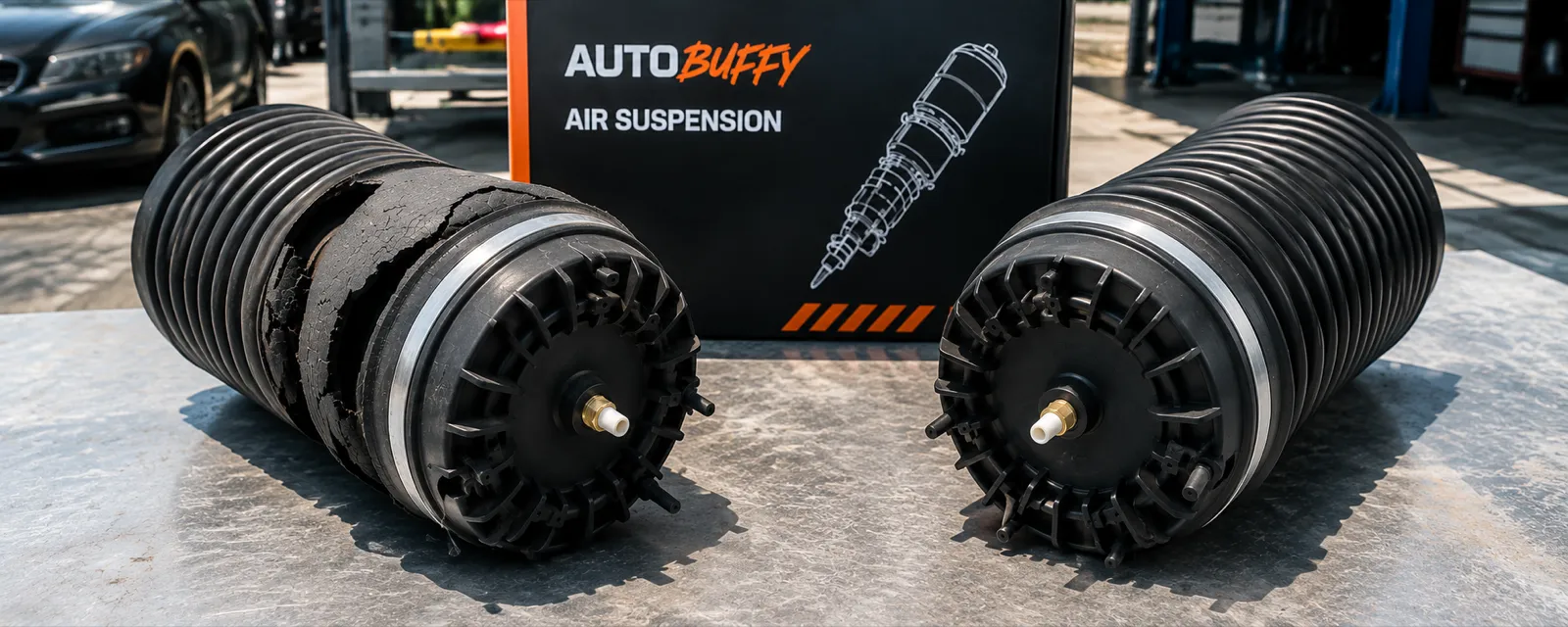
The rubber bellows on an air spring do the same job a steel coil does, just with air pressure instead of a solid coil. Rubber does not age like steel. It dries out. Heat and UV exposure cook the plasticizers out of the compound over years, and the bellows lose the elasticity that lets them fold and unfold thousands of times a day without cracking. Eventually a hairline crack opens where the sleeve rolls over the piston, and that's your slow leak — the corner that sags overnight, then over a few hours, then within minutes.
A vehicle that lives in Phoenix or Las Vegas heat sees this on the faster end of the range, often closer to 6-7 years or 60,000-70,000 miles. A vehicle that spends most of its life in a garage in a cooler, milder climate can push past 100,000 miles before the same failure shows up. We've pulled air struts off a 2008 Range Rover at 143,000 miles where the bellows looked like a cracked leather boot left in the sun for a decade — that's what dry rot actually looks like up close, not a slow leak you can hear, a surface that's just given up being rubber.
Mileage matters less here than most people expect. A low-mileage vehicle that sat outside for 12 years will often have worse bellows than a high-mileage one that got driven daily and garaged at night. Time and heat do more damage than miles do.
Compressors: Why They Rarely Make It to the Air Spring's Timeline
Here's the part that surprises people: the compressor is usually the first thing to fail, not the last, even though it has no rubber bellows to dry-rot. Compressors fail early for a specific reason, and it's almost never simple wear from normal use.
A compressor is designed to run occasionally, to top off the system after normal air loss or to correct ride height. When one of the air springs develops even a small leak, the compressor starts running far more often to compensate, sometimes cycling every few minutes instead of a few times a day. That constant duty cycle burns through the piston seal and overheats the motor windings, and the compressor that should have lasted 6 years is dead in 2.
Moisture is the other big one, and it's covered in more depth in our compressor symptoms and replacement guide, but the short version: every time the compressor runs, it pulls in ambient air, and that air carries humidity. The dryer's entire job is to strip that moisture out before it reaches the compressor's internals. When the dryer is saturated, old, or was never replaced on schedule, water gets into the compressor body, and corrosion or a locked-up piston follows. A compressor that failed at 45,000 miles almost never failed from mileage. It failed because a leak or a bad dryer made it work far harder than it was built for.
Dryers: The Part Nobody Replaces Until It's Too Late
The dryer is a $15-80 part depending on the vehicle. The compressor it protects is a $300-550 part in most applications. That math alone makes a case for replacing the dryer on a schedule rather than running it to failure, the same way you'd replace a fuel filter before it clogs rather than waiting for the engine to stall.
Most owners never think about the dryer until the compressor is already dead, at which point a shop that knows what it's doing replaces both together — putting a new compressor behind an old, saturated dryer just restarts the same failure clock. If you're already in the system for a compressor job, replacing the dryer at the same time is one of the few genuinely cheap insurance moves in this whole category.
What Actually Kills Air Suspension Early — Ranked
- Dry rot from heat, UV, and age — the single biggest factor in air spring and strut failure, full stop. Climate does more here than mileage.
- Moisture and dryer neglect — the leading cause of early compressor death, and almost entirely preventable with proactive dryer replacement.
- Overloading capacity — towing or hauling above the vehicle's rated air suspension capacity for extended periods stresses both the springs and the compressor duty cycle.
- Pothole and curb impact damage — a hard hit can crack a strut housing or damage the piston rod even when the rubber itself was fine, and this failure mode has nothing to do with age at all.
Is Air Suspension Reliable?
Honestly, less reliable than a steel coil spring over the long haul, and it's worth saying plainly instead of dancing around it. A coil spring has one job and basically one failure mode, and that failure is rare. Air suspension replaces that with a spring, a compressor, a dryer, a valve block, height sensors, and a control module, and every one of those parts can fail on its own timeline.
What you get for that added complexity is real: a ride that self-levels regardless of load, a noticeably smoother highway ride at speed, and the ability to raise or lower the vehicle for clearance or aerodynamics. Owners who bought a Range Rover or an Escalade specifically for that ride quality generally don't regret it. But anyone shopping a used vehicle with air suspension should walk in knowing they've bought a system with more parts that can go wrong, not fewer, and budget accordingly. See our full cost breakdown by component before you commit to a repair.
One Corner Failed — Are the Others About to Go Too?
This is the question that actually decides whether a repair makes sense, and it gets skipped constantly. If one air spring failed from age-related dry rot, the other three corners were installed at the same time, in the same climate, and have seen roughly the same UV exposure and mileage. They are not far behind. They're on the same clock.
A single leaking rear corner on a vehicle that's otherwise healthy and 4 years old is a straightforward one-corner repair. That same leak on an 11-year-old vehicle that's never had any air suspension work done is a different conversation — the shop quote for one corner today is very likely to be followed by a second corner's quote next year, and a third the year after that. Piecemeal, corner-by-corner replacement on an aging system usually ends up costing more in total than doing all four at once, or than converting the whole system to coil springs in one job.
Shop Air Suspension Parts
Springs, struts, compressors, dryers, and conversion kits — filtered to your vehicle
Is It Worth Fixing on an Older Car?
Run through this in order before you write a check:
How old is the vehicle, and how long are you keeping it? A repair on a vehicle you plan to drive another 5+ years pencils out very differently than the same repair on something you're selling in 8 months.
What's the actual quote, corner by corner? A single strut is a manageable bill. Get quotes on all four before deciding, because if the tech tells you the other three are showing early wear, that changes the math immediately.
How many corners are failing right now, not eventually? One corner failing on an otherwise sound system: repair it. Two or more corners failing, or a compressor and a spring failing close together: that's a full-system conversation, not a patch job.
What's the vehicle actually worth? A $1,200-1,800 full air suspension repair on a vehicle worth $18,000 is an easy yes. The same repair on a vehicle worth $6,000 total needs a harder look, and that's exactly the scenario where a coil spring conversion tends to make more sense than another round of air parts. Conversion kits in our own catalog run $87.95 to $1,132.95 depending on the vehicle, and for a car you're keeping past the point where air parts are worth chasing again, it's often the cheaper long-term math even though the ride changes.
Does resale value depend on the air suspension working? On some luxury and truck platforms, a functioning air suspension is expected by buyers and its absence tanks resale. On others, buyers don't know or care, and a documented coil conversion doesn't hurt resale at all. Know which category your vehicle falls into before you decide.
There's no universal right answer here. A well-kept Jeep Grand Cherokee WK2 at 90,000 miles with one leaking rear spring is worth fixing. A Lincoln Navigator at 190,000 miles with a dead compressor, a saturated dryer, and one already-sagging corner is a much stronger candidate for a full conversion, and that decision guide walks through the vehicle-specific tradeoffs in more detail.
Brands and What They Stock
None of the major aftermarket air suspension brands are meaningfully more or less reliable than the others once you're comparing OE-quality replacement parts — the bigger reliability question is almost always upstream of the part itself (climate, leak history, whether the dryer was ever serviced), not which name is stamped on the box. A few notes on what's actually available, since depth-of-catalog varies more than quality does:
- Arnott carries roughly 865 air suspension SKUs, including 312 struts and 139 compressors, one of the deepest strut catalogs in the space.
- Suncore runs about 841 SKUs, with 164 conversion kits, the deepest conversion-kit selection we carry.
- Unity covers around 784 SKUs across struts, springs, and sets.
- Westar, a manufacturer since 1986, lists 491 SKUs across 13 different air suspension part types.
- Bilstein focuses on roughly 250 SKUs with a heavier tilt toward premium struts (142 of them).
- Dorman rounds out the field with about 180 SKUs split across struts, compressors, and conversion kits.
If your vehicle needs a specific part, fitment availability matters more than brand loyalty. Check what actually fits your year, make, and model before anything else.
The Bottom Line
Air springs and struts run 6-10 years or 50,000-100,000 miles in normal conditions, shorter in hot climates, longer in mild ones. Compressors and dryers usually check out first, and almost always because of a leak or moisture problem rather than plain age. When one corner goes on an older vehicle, treat it as a warning about the other three, not an isolated event, and run the numbers on full replacement or conversion before sinking money into a second and third repair down the road. For the full picture on how the system works and what else can go wrong, start at our air suspension guide.
FAQ / People Also Ask
The air springs or struts themselves generally hold up 6 to 10 years before the rubber starts cracking. Compressors and dryers usually check out earlier than that, often around year 4 or 5, because they fail from moisture and overwork rather than pure age.
Comments
Loading comments...
Comments are moderated by the AutoBuffy team.