

7 Bad Carrier Bearing Symptoms (How to Confirm It Yourself)
A bad carrier bearing starts as a floor vibration at 40-70 mph, a takeoff clunk, or a growl under the cab. Here are all 7 symptoms, plus a 15-minute hands-on check that confirms it before you spend a dime - the part can cost as little as $4.95.
The Short Answer
A failing carrier bearing shows up as driveline vibration that builds with road speed, a clunk when you take off or shift, and a growl or rumble from under the cab floor — and you can confirm it yourself in about 15 minutes with a flashlight and your bare hands.
| # | Symptom | What it feels or sounds like | How far gone |
|---|---|---|---|
| 1 | Vibration that builds with speed | Buzz in the floor and seat, usually 40–70 mph, not in the steering wheel | Early to mid. Rubber cushion softening |
| 2 | Clunk on takeoff or gear change | One metallic knock under the cab when you hit the gas or shift into gear | Mid. Cushion torn, shaft has slack |
| 3 | Growl or rumble under the cab | Droning that tracks road speed, centered under you rather than at a wheel | Mid to late. The bearing itself is drying out |
| 4 | Shudder under acceleration | Bucking or juddering pulling away from a stop, worse towing or lifted | Mid. Sagged cushion or bad shaft angle |
| 5 | Squeal or chirp | High-pitched cry leaving a stop that often fades as you gain speed | Late. Bearing running near-dry |
| 6 | Visible sag or cracked rubber | Driveshaft drooping at the center hanger, cracked or missing rubber | Confirmed. Replace it |
| 7 | Binding or vibration in a narrow speed band under load | Shakes hard at one specific speed, worse loaded or uphill | Late. Shaft running out of line |
Quick naming note so we're talking about the same part: the carrier bearing and the center support bearing are the same thing — the rubber-cushioned bearing that holds up the middle of a two-piece driveshaft on trucks, vans, and long RWD vehicles. There's a different part called a carrier bearing inside your differential; that's not this. Our carrier bearing guide sorts out the naming mess in detail.
Here's why the 15-minute check matters. The part is cheap — a rubber cushion runs $3–$63 and a complete center support assembly averages around $110 in our catalog — but shops quote $250–$600 for the job, and dealers push $600–$900. Confirming it yourself before anyone touches the truck is the difference between buying one small part and paying for guesswork. Full pricing math is in our carrier bearing replacement cost breakdown.
1. Vibration That Builds With Speed
This is the opener for most trucks. A buzz or drone comes up through the floorpan and the seat cushion — not the steering wheel — and it climbs with road speed. Most owners first notice it in the 40–70 mph band. Let off the throttle and it usually stays, because it's tied to driveshaft speed, not engine load.
What's happening underneath: the rubber cushion that centers the bearing has softened or started tearing, so the middle of the driveshaft is orbiting instead of spinning true. Even a few millimeters of runout at the center of a shaft turning 2,500 rpm makes the whole cab hum.
Steering-wheel vibration points at wheels and tires. Floor-and-seat vibration that tracks road speed points at the driveline. That one distinction saves people a lot of wasted tire balancing.
2. Clunk on Takeoff or Gear Change
You let out the clutch or roll into the throttle from a stop, and there's a single metallic knock from under the cab. Same thing shifting from reverse to drive, or when an automatic grabs a downshift. F-150 and Powerstroke forums are full of this exact complaint — "clunk on takeoff" threads go back twenty years.
The clunk is slack. A torn cushion lets the driveshaft physically shift inside the hanger bracket before the slack pulls tight, and that take-up is what you hear. U-joints and slip yokes make a very similar noise, which is why the hands-on check below matters before you buy anything. One clue that leans carrier bearing: the clunk often pairs with symptom #4, because the same dead rubber causes both.
3. Growl or Rumble From Under the Cab Floor
A dull growl, rumble, or drone from directly under the cab — roughly under your right heel on most pickups — that gets louder with speed. Owners describe it as a roughness you hear and feel at the same time, like driving on coarse chip-seal that isn't there.
This one is the bearing itself. It's a sealed ball bearing, and when the grease dries out or water gets past the seal, the balls start running on pitted races. Wheel-bearing growl changes when you sway the truck side to side at speed; carrier bearing growl doesn't care about steering input, only road speed. Location is your other clue — a wheel bearing growls from a corner, this growls from the middle of the truck.
We covered the full sound catalog, with comparisons against every other driveline noise, in what a bad carrier bearing sounds like.
4. Shudder Under Acceleration (the Classic Carrier Bearing Shudder)
The truck bucks or judders as you pull away from a stop, smooths out once you're rolling, then does it again at the next light. Load makes it worse. Hook up a trailer and what was a mild shiver becomes a full shake. This is the complaint truck owners literally call "carrier bearing shudder."
Two ways it happens. First, a sagged cushion lets the shaft droop, which changes the working angles of the u-joints — and u-joints running at unequal angles create a torque pulse twice per revolution. Second, and this is huge on lifted trucks: raising the rear changes driveline geometry, and a stock-height carrier bearing can put the shaft at an angle it was never meant to run. That's why the lifted-truck fix is often a carrier bearing drop kit — spacing the hanger down 1/2" to 1" restores the angle and the shudder disappears. If your truck is lifted and shudders on takeoff, check the shaft angle before condemning the bearing itself.
A worn transmission mount causes a near-identical takeoff shudder, by the way. If the rubber checks out at the carrier, look there next — our transmission mount symptoms article covers how to tell them apart.
5. Squeal or Chirp at Speed
A high-pitched squeal or rhythmic chirp, usually as you accelerate away from a stop. Oddly, it often quiets down once you're up to speed, which fools people into ignoring it. Some owners describe the end stage as a howl that cuts through everything else in the cab.
Don't ignore this one. Squeal means the bearing is running with almost no lubrication left, metal complaining against metal. A vibrating bearing might give you months. A squealing one is on its countdown, and when a center bearing finally seizes, it can chew through the shaft splines or wipe out the u-joints on its way down. Some owners also report a burning-rubber smell around this stage — the cushion heating up from all the movement — and that's another late-stage flag.
6. Visible Sag or Cracked Rubber on Inspection
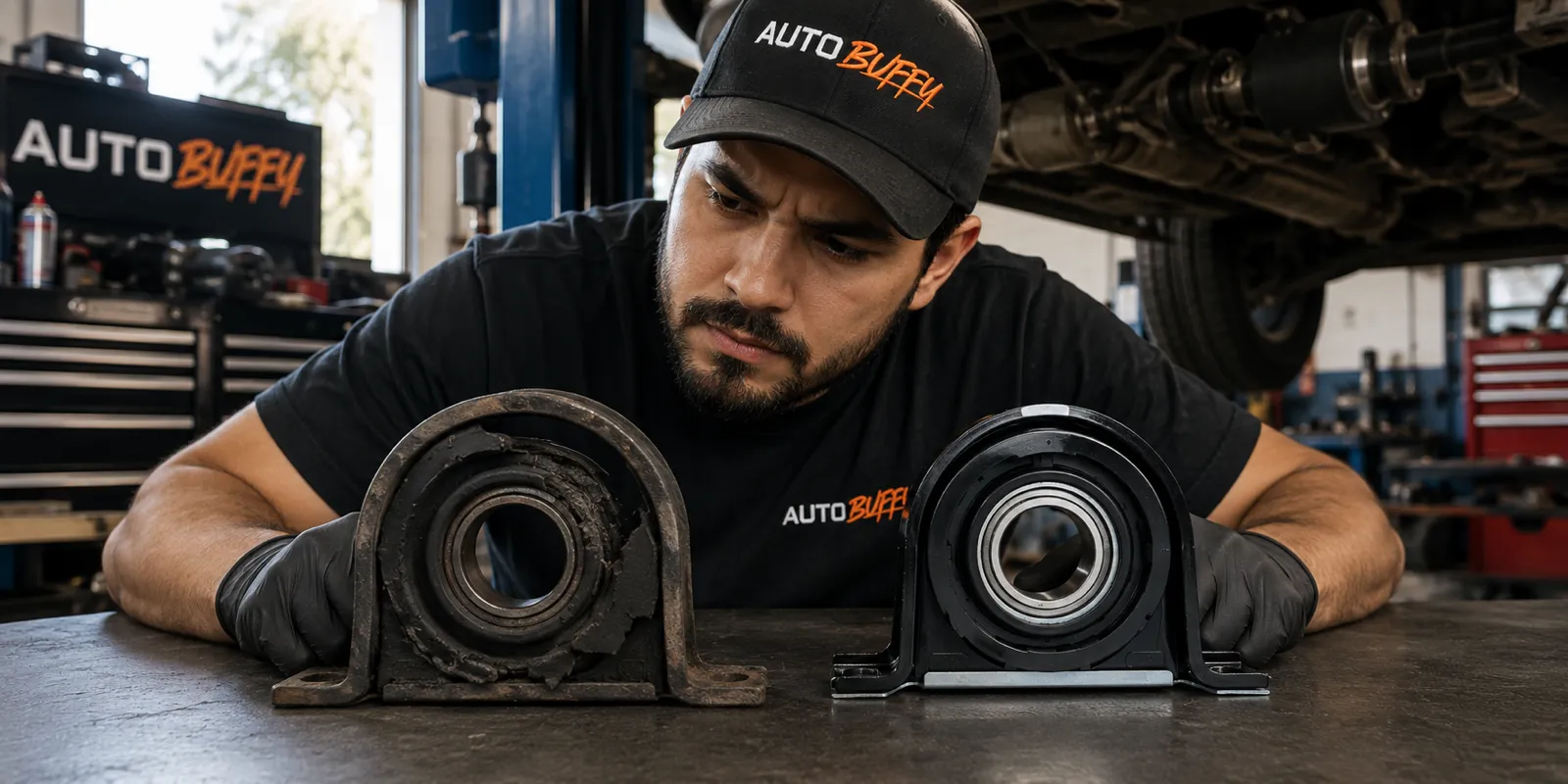
The only symptom you see instead of hear. Crawl under with a flashlight and look at the center hanger: the driveshaft should run essentially straight through it, with the bearing centered in its rubber donut. A failing one shows the shaft sitting visibly low in the bracket, rubber that's cracked, dry-rotted, or soaked in leaked oil, or chunks of the cushion missing outright.
Oil-soak deserves a special mention. A leaking transmission tailshaft seal drips right onto the cushion, and petroleum turns rubber to mush in months. If you find an oil-soaked cushion, fix the leak too or the new part dies the same death.
This is the confirming symptom. Everything else on this list can have another cause. Torn, sagging rubber at the carrier has exactly one fix.
7. Binding or Vibration at Specific Speeds Under Load
The most advanced version: the truck shakes hard in one narrow speed window — say 45 to 50 mph — and it's dramatically worse under load, climbing a grade or towing. Some owners describe a binding sensation, like the driveline is fighting itself, occasionally with a rhythmic surge you can feel in the throttle.
By this stage the shaft is running so far out of line that it hits a resonant speed where everything amplifies at once. The u-joints are now wearing fast at angles they weren't built for, and the bearing is taking side loads it was never designed to see. Trucks at this stage shouldn't tow anything until it's fixed, and honestly shouldn't see the highway.
How to Confirm It Yourself in 15 Minutes
This is the part every thin blog skips, and it's the part that saves you money. You don't need a lift. You need a flashlight, maybe a pry bar, and safe access underneath.
Get under the truck safely. Ramps, or jack stands on a level surface, wheels chocked. Never work under a vehicle held only by a jack. On most full-size pickups there's enough ground clearance to slide under without lifting anything.
Find the carrier bearing. Follow the driveshaft back from the transmission. Where the two-piece shaft meets, you'll see a stamped-steel bracket bolted to a frame crossmember with the shaft passing through a rubber-mounted bearing. That's it.
Grab the shaft and shake it. Hands on the driveshaft on either side of the carrier. Push up, down, side to side, hard. You want to feel the rubber flex slightly and return — a healthy cushion allows maybe a quarter inch of controlled movement. What you don't want: the shaft moving freely before the rubber even engages, any metallic clicking from inside the bearing, or the shaft staying wherever you push it. A pry bar between the shaft and the bracket, levered gently, shows the same thing with more control.
Inspect the rubber. Flashlight on the cushion, all the way around. Cracks, splits, missing chunks, oil sheen, or the bearing sitting off-center in the donut all mean it's done.
Do the spin check. With the transmission in neutral and the rear axle safely raised and supported (or skip this step if you can't do it safely), rotate the driveshaft slowly by hand while resting your fingers on the bearing housing. A good bearing feels like nothing. A bad one transmits a gritty, sandy texture through the housing, like grinding coffee. Any notchiness or catch is a fail.
Check the bracket. Rusted-through hangers and loose bracket bolts cause identical symptoms. Thirty seconds with a wrench rules it out.
If the rubber's torn or the bearing feels gritty, you've confirmed it. No shop diagnostic fee, no parts-cannon guessing.
Find the Carrier Bearing That Fits Your Truck
Enter your year, make, and model to see exact-fit center supports from Westar, SKF, Timken, and more — from $2.95
What Else Mimics a Bad Carrier Bearing?
Four parts produce look-alike symptoms, and they're all in the same neighborhood:
- U-joints. Clunk on takeoff, vibration at speed — nearly identical. While you're under there, grip the shaft at each u-joint and twist. Any free play or clicking means a joint. Rust-colored powder around a joint's caps is a dead giveaway it's run dry.
- Out-of-balance driveshaft. A thrown balance weight (look for a clean rectangular spot on the shaft) or dried mud packed inside the shaft causes speed-dependent vibration with perfectly good bearings. The difference: no play, no noise, no torn rubber.
- Transmission mount. Takeoff clunk and acceleration shudder, but the movement is at the back of the transmission, not the middle of the shaft. Watch the driveline with a helper loading the brakes and throttle (torque test) and you'll see which one moves.
- Wheel bearing. Growls like symptom #3 but from a corner, and the pitch changes when you gently weave at speed as the load shifts across the bearing.
The 15-minute check covers the first three without any extra work, which is exactly why it's worth doing before spending anything.
What Happens If You Ignore It?
Carrier bearing failure is a chain, and every link you let break multiplies the bill.
It starts with the rubber. The cushion tears, the shaft starts running off-center, and for a while that's the whole problem: a $3–$63 piece of rubber, or roughly a $110 assembly with the bearing. Ignore it and the bearing starts eating itself from the misalignment and the extra pounding. Ignore that, and the u-joints (now running at angles they weren't set up for, hammered by the shaft's orbit) begin to wear fast. Now you're buying joints and paying driveline-shop labor on top.
The end of the chain is the one that matters: a seized bearing or a failed joint can drop the front half of the rear driveshaft onto the road at speed. Usually the shaft just flails and destroys everything it touches under there. In the ugly scenario, the front end of a dropped shaft digs into the pavement. Rare, but it's why no driveline shop will tell you to run a screaming carrier bearing another month.
It's urgent — park it or fix it this week — if: the bearing squeals or grinds, the shaft visibly sags, you can move the shaft more than half an inch by hand, or a clunk has gotten noticeably louder over a few weeks. A mild hum with intact rubber gives you time to order the part. A howl does not.
The Rubber Is What Fails — and Rubber Is Westar's Whole Business
Here's the honest engineering read on this part: the sealed bearing inside a center support is rarely the first thing to die. The rubber cushion around it is. It tears, sags, dry-rots, or melts under a transmission leak, and everything else fails downstream of that. So when you're picking a replacement, the rubber-to-metal bond is the part of the part that matters most.
That's the case for Westar. They've been manufacturing rubber-to-metal bonded driveline and mount components since 1986 out of Columbia, Maryland — they're one of the biggest engine and transmission mount makers in the aftermarket, and a center support cushion is exactly that kind of part. We stock 144 Westar center supports and cushions, running $2.95 to $131 with an average around $33.
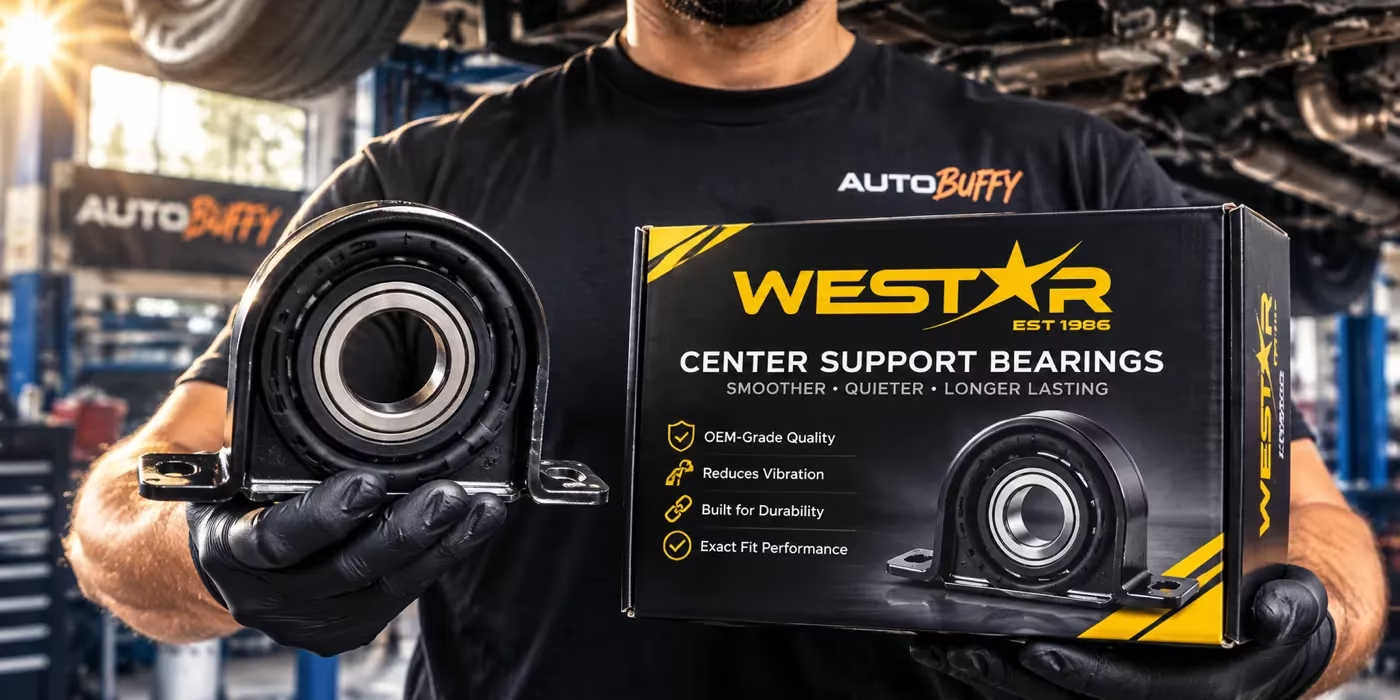
The coverage is the quiet superpower. Westar still catalogs center supports for trucks the big brands walked away from decades ago: a DS-6056 center support for 1960s–80s Chevy, GMC, and Ford trucks is $11.95, the DS-6027 rubber cushion alone is $4.95, a DS-8471 for an '89–'95 Toyota Pickup is $10.95, and there's coverage for a 1980–85 Nissan 720, old BMW and Mercedes two-piece shafts, all the way back to a 1961 C10. If you own a classic truck, that's often the difference between fixing it and fabricating something.
To be clear, SKF, Timken, and BCA build excellent bearings and we stock about 360 SKUs across those three at $52–$394. On a late-model daily driver they're a great pick. But when the failure is the rubber (and it usually is), a manufacturer that specializes in rubber isolation, at a $12 price point, is hard to argue with. AutoBuffy is a direct authorized Westar source, and I've watched a shop quote $460 to chase a takeoff shudder that turned out to be a torn cushion — a $4.95 Westar DS-6027 and about an hour on jack stands.
Confirmed It's Bad? Here's Your Next Move
You've got two paths. The DIY route is genuinely doable on most trucks with hand tools — the hard part is pressing the old bearing off the shaft, and our step-by-step carrier bearing replacement guide walks through the whole job including the press work and the marking trick that keeps your shaft in phase. If you're paying someone, go in knowing the real numbers from our replacement cost breakdown — the part is $3–$130 for most trucks, the labor is 1–2 hours, and any quote north of $600 at an independent shop deserves a second opinion.
Either way, you walked under the truck with a flashlight and walked out knowing exactly what's wrong. That 15 minutes is worth more than any estimate.
FAQ / People Also Ask
The earliest signs are a vibration in the floor and seat that builds with road speed (usually 40-70 mph) and a single clunk when you take off from a stop or shift into gear. Both come from the rubber cushion softening or tearing before the bearing itself is damaged. Growling, squealing, and shudder show up as it progresses.
Comments
Loading comments...
Comments are moderated by the AutoBuffy team.