

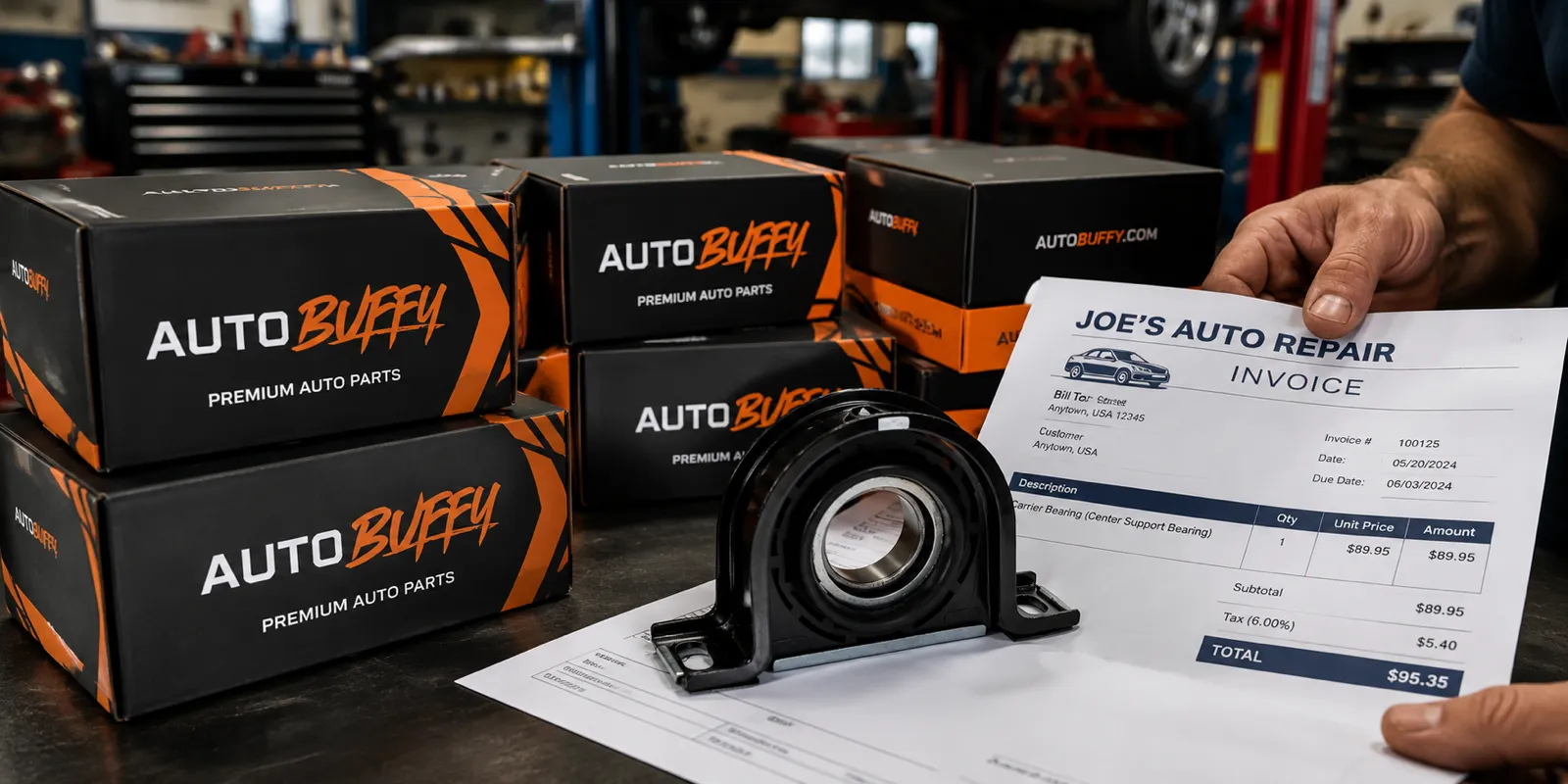
Carrier Bearing Replacement Cost (2026): Real DIY vs Shop Numbers
Carrier bearing replacement runs $250-$600 at an independent shop in 2026, but the part itself can cost as little as $3. Full cost tables by scenario and vehicle type, plus how to tell when a $1,500 driveshaft quote is legit and when it's lazy.
The Short Answer
In 2026, carrier bearing replacement costs $250–$600 at an independent shop, $400–$900 at a dealer, or $10–$130 in parts if you do it yourself. The bearing is one of the cheapest parts on your driveline. The labor to drop the driveshaft and get to it is what you're actually paying for.
| Scenario | Parts | Labor | Typical all-in |
|---|---|---|---|
| DIY, rubber cushion only (classic Chevy/GMC/Ford) | $3–$25 | $0 | $3–$25 |
| DIY, complete center support assembly | $10–$130 | $0 | $10–$130 |
| Independent shop, bolt-in assembly | $30–$150 | $110–$340 (1–2.5 hrs) | $250–$600 |
| Dealer | $80–$400 | $210–$450 (1.5–2.5 hrs) | $400–$900 |
| Shop job with press work (bearing pressed off the shaft) | $50–$200 | $280–$600 | $350–$800 |
| Shop replaces the whole driveshaft instead | $400–$1,500+ | $150–$300 | $600–$1,800 |
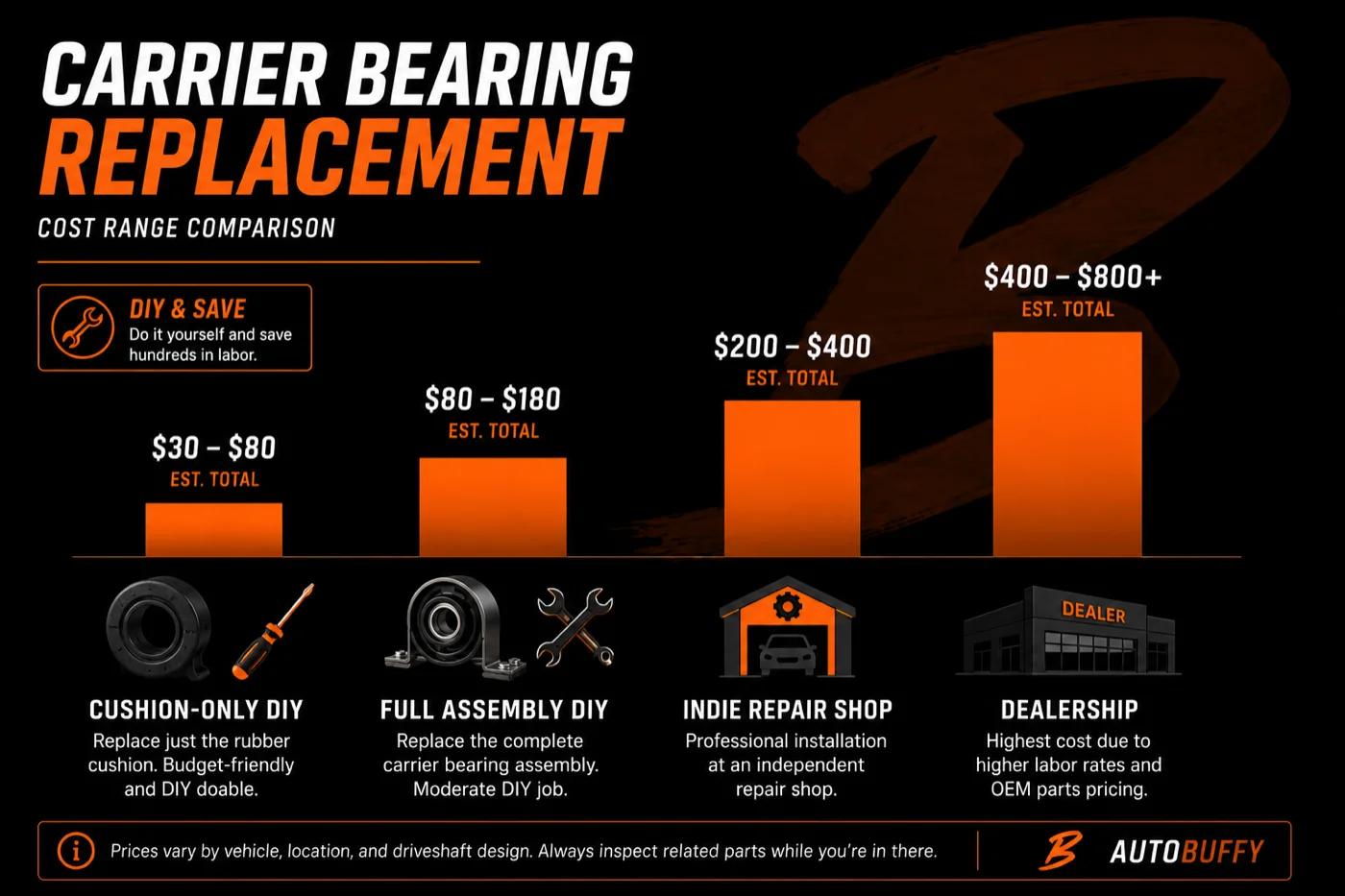
*Ballpark totals for common bolt-in light-truck jobs. HD trucks, press-fit designs, and European applications trend toward the top of the tables in this guide.*
Quick naming note before the numbers: carrier bearing and center support bearing are two names for the same part — the rubber-cushioned bearing that holds up the middle of a two-piece driveshaft. Catalogs call it a drive shaft center support. Truck guys say carrier bearing. Same thing. (There's a different part called a carrier bearing inside your differential — that's a whole other repair. Our carrier bearing guide sorts out the naming mess in detail.)
Why a $12 Part Turns Into a $500 Bill
Labor. That's the whole answer, but here's why.
The carrier bearing lives in the middle of the driveshaft, bolted to a frame crossmember under the cab. To replace it, a tech has to mark the driveshaft orientation, unbolt the rear U-joint straps or flange, unbolt the center support bracket from the crossmember, slide the shaft out of the transmission (or split the two-piece shaft at the slip joint), swap the support, and put everything back exactly the way it came apart. Book time on most trucks runs 1 to 2.5 hours.
At 2026 rates — $110–$135/hr at independent shops, $140–$180/hr at dealers — that's $110 to $450 of labor wrapped around a part that might cost $12.
I've seen a shop quote $580 on a 1999 K1500 for this job. The Westar center support for that truck is about $25, and on that body style it's four strap bolts and two crossmember bolts. Maybe 50 minutes with a floor jack under the shaft. The quote wasn't dishonest exactly — it had a $190 "driveline inspection" and an OE-priced part baked in — but nobody at the counter was going to volunteer that.
Then there's the press-work wrinkle. On some driveshafts, the bearing's inner race is pressed onto the shaft itself. The old bearing has to be pulled or pressed off and the new one pressed on, which usually means the shaft goes to a driveline shop bench. That adds $75–$200 and sometimes a day of turnaround. On other designs — most classic Chevy/GMC and Ford trucks, for instance — the whole support unbolts or the shaft splits at a splined slip joint, and no press is involved. Whether your vehicle needs press work is the single biggest variable in the quote, so ask that question first.
What the Part Actually Costs in 2026
Here's real pricing from our live catalog, where we stock about 920 priced SKUs in this family:
| Part type | Price range | Notes |
|---|---|---|
| Rubber cushion only | $3–$63 | Just the vibration isolator — the piece that usually fails |
| Complete center support assembly | $7–$368 | Bearing + cushion + bracket, ready to bolt in (avg ~$110) |
| Westar assemblies | $2.95–$131 | Manufacturer-direct, avg ~$33 |
| Premium bearing brands (SKF, Timken, BCA) | $52–$394 | Premium bearings from common OE suppliers |
A few real part numbers to anchor those ranges: the Westar DS-6027 rubber cushion for classic Chevy/GMC and Ford trucks is $4.95. The DS-6056 complete center support for those same trucks is $11.95. DS-8471 for a 1989–1995 Toyota Pickup runs $10.95. Even the German stuff is cheap at the part level — DS-8626 for BMW is $11.95, DS-6520 for Mercedes is $12.95.
Read those numbers again next time someone quotes you $400 in parts.
The rubber cushion matters more than people think. In most failures, the sealed bearing itself is fine — it's the rubber isolator around it that tears, sags, or rots from oil exposure. That's why a $5 cushion can genuinely fix a truck, and why a growling bearing versus a sagging cushion changes what you should buy. If you're not sure which one you've got, the bad carrier bearing symptoms checklist will tell you in about ten minutes under the truck.
Carrier Bearing Replacement Cost by Vehicle Type
Classic Chevy, GMC, and Ford trucks (1960s–1980s)
The cheapest version of this job that exists. A C10, K5 Blazer, Suburban, or F-100/F-250 from this era has a strap-and-bolt driveline you can take apart in the driveway with hand tools. Cushion: $3–$8. Complete support: $10–$25. A shop will do it for $200–$350 because there's nothing exotic about it.
The catch on these trucks isn't cost. It's finding the part at all — most big brands stopped cataloging a 1967 C10 Suburban decades ago. More on that below.
Modern half-ton and HD pickups (1988–2010s)
C/K 1500–3500, F-250/F-350, Rams, Titans, Tundras with two-piece shafts. Parts run $30–$150 for a quality assembly. Shop all-in lands in the $250–$600 window, with HD trucks at the top because the shafts are heavy and some designs press the bearing onto the shaft. Forum owners consistently report totals in this range — one Nissan owner paid $75 for the bearing and $200 for a local shop to install it. That's the fair-price benchmark: a couple hundred in labor, not five.
BMW, Mercedes, and other European RWD cars
Same part, same $12–$60 price tag (we stock VAICO, URO, SKF, and Westar for these), but the labor climbs. Exhaust sections and heat shields usually have to come down, the center support hides above a chassis brace, and shops often recommend doing the flex discs (giubos) while the shaft is out — smart advice, but it grows the bill. Independent Euro shops quote $500–$800 for the job; dealers have quoted owners $1,600 by skipping the bearing entirely and pricing a complete driveshaft. On a Touareg forum thread, one owner got a $350 dealer quote while a local Euro shop wanted $750 for the identical repair. Shop around. The spread on these cars is enormous.
Toyota and Nissan trucks
Old Toyota Pickups and Nissan 720s are nearly as friendly as the classic Chevys — bolt-in supports, $10–$15 parts, simple two-piece shafts. A shop job should land $250–$400.
Find the Carrier Bearing That Fits Your Truck
Enter your year, make, and model — see exact-fit center supports with real prices, from $2.95
When a Shop Says You Need a Whole Driveshaft
This is where carrier bearing repairs go from $300 to $1,500, so it deserves its own section.
Some shops don't rebuild driveshafts. Their fix for a bad center support is a complete replacement shaft — $400–$900 aftermarket, $800–$1,500+ OE, plus an hour of labor. Sometimes that's lazy quoting. Sometimes it's legitimately the right call. Here's how to tell the difference.
A new driveshaft is the right call when:
- The shaft tube is bent, dented, or has thrown a balance weight. A vibrating shaft with a good new bearing is still a vibrating shaft.
- The U-joints are staked-in (non-serviceable) and worn. On many modern trucks you can't press in new U-joints, so a worn joint condemns the shaft anyway.
- The bearing seized and spun on the shaft, chewing up the journal the new bearing needs to press onto.
- The slip-yoke splines are worn enough to clunk. New bearing won't touch that.
A new driveshaft is the wrong call when:
- The rubber cushion is torn or sagging but the shaft spins true and the U-joints are tight. That's a $5–$60 part.
- The quote never itemizes why the shaft itself is bad. "It's all one assembly" is often shop policy, not mechanical fact — on most trucks the center support is a serviceable, bolt-through part.
Ask one question: "Is the shaft damaged, or just the bearing?" If they can't point to a bent tube, bad joint, or damaged journal, get a second quote from a driveline specialty shop. Driveline shops rebuild two-piece shafts all day and will usually replace a center support, check the U-joints, and rebalance the whole shaft for $250–$450 — often cheaper than a general shop's bearing-only quote.
How to Avoid Overpaying
- Get the quote itemized. Part number, part price, labor hours, labor rate. A fair quote is 1–2.5 hours of labor plus a part you can price-check in 30 seconds.
- Ask whether your bearing is bolt-in or pressed. Bolt-in should be at the bottom of the labor range. Press work justifies more — but then the part should be cheap.
- Supply your own part if the shop allows it. Plenty of independents will install a customer-supplied center support. That alone can turn a $580 quote into a $300 one.
- Bundle it with U-joints. The shaft is already out. If your U-joints are serviceable and original, doing them at the same time costs one extra part and almost no extra labor — and skipping them means paying the same removal labor twice later.
- Don't pay assembly-replacement money for a cushion failure. If the diagnosis is "torn rubber," the fix can be a cushion, not a driveshaft.
- Sanity-check the noise diagnosis first. Driveline growls and vibrations get misdiagnosed in both directions — a bad transmission mount can mimic a carrier bearing and vice versa. Our carrier bearing noise guide covers how to tell them apart before you authorize anything, and transmission mount symptoms covers the other usual suspect.
The Westar Option: Why Classic-Truck Owners End Up Here
Here's the quiet problem with this repair on older trucks: the part is simple, but almost nobody still makes it for your application. The big bearing brands trimmed their catalogs to the high-volume late-model stuff years ago. Try to buy a center support for a 1960 F-100 or a 1980 Nissan 720 at a chain parts store and you'll get a shrug.
Westar didn't trim. They've been manufacturing rubber-to-metal bonded driveline and mount components since 1986 out of Columbia, Maryland — they're one of the biggest engine and transmission mount makers in the aftermarket, and a center support is fundamentally the same engineering: a bearing carried in bonded rubber. Their center support catalog still covers Chevy/GMC C10 through C30 trucks and Suburbans back to 1961, Ford F-100s back to 1960, F-250/F-350 through 2004, K5 Blazers, Toyota Pickups, Nissan 720s, International medium-duty trucks, and BMW and Mercedes two-piece-shaft cars back into the 1960s.
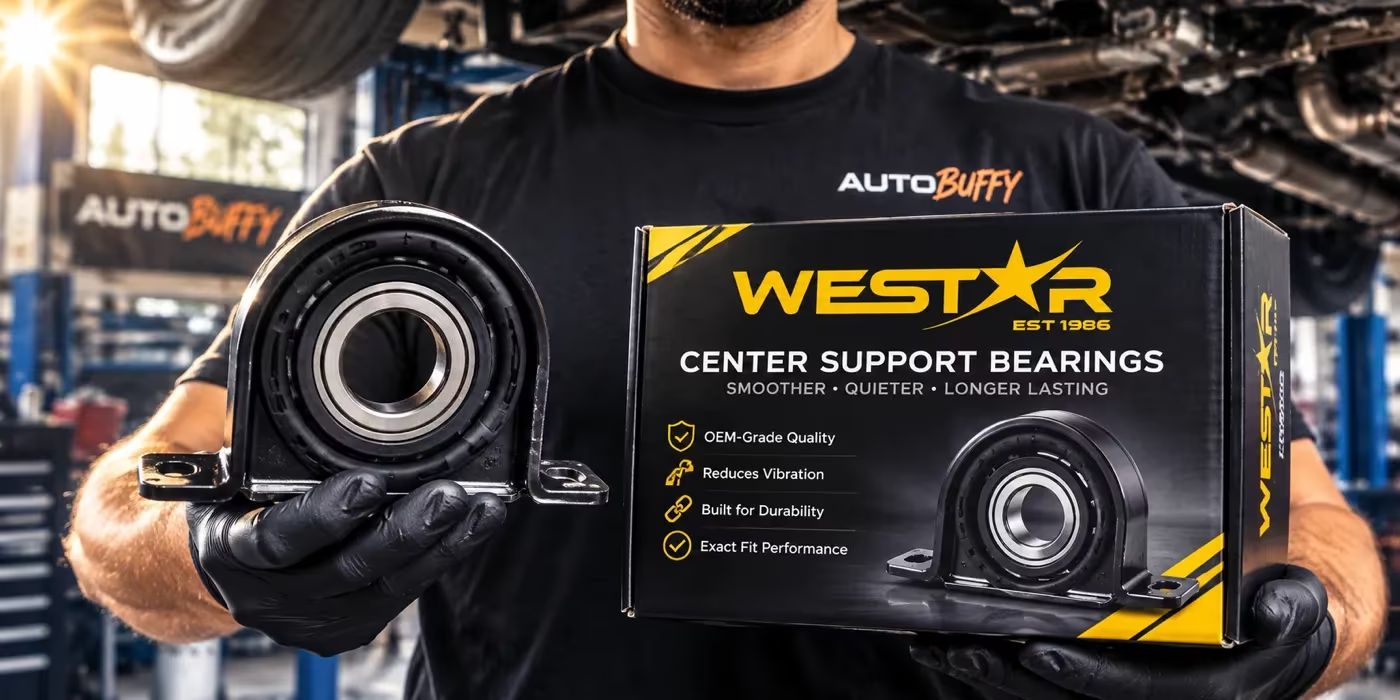
We stock 144 Westar center support SKUs, priced $2.95 to $131 with an average around $33, and we're a direct authorized source — the parts come from the manufacturer, not a broker. To be straight with you: SKF and Timken make outstanding bearings and we sell plenty of both. If you've got a late-model HD truck and want the premium bearing, buy it. Westar's edge is coverage and value — they still make the part for trucks everyone else abandoned, and the rubber isolation piece that actually fails is literally their specialty.
Is It Worth Fixing on a High-Mileage Truck?
Almost always yes, and it's not close.
This is one of the highest-value repairs on an old truck. The part costs less than lunch, the failure is progressive, and ignoring it gets expensive fast: a sagging center support changes your driveline angles, which eats U-joints, hammers the slip yoke, and in a full failure can let the front section of the shaft flail — people call it "grenading" for a reason. A $12 bearing problem left alone becomes a $600 driveshaft problem, and occasionally a hole in the floor pan.
So on a 250,000-mile work truck: fix it. Spend $15–$60 on the part and a Saturday morning, or $300 at an honest shop. The only version of this repair that isn't worth it on a high-mileage vehicle is the $1,500 dealer driveshaft on a truck worth $3,000 — which is exactly why knowing the bearing-only price matters.
If you're doing it yourself, our step-by-step carrier bearing replacement guide walks through the whole job — marking the shaft, strap bolts, press-vs-bolt-in, and the torque notes that keep you from doing it twice. And if you're still at the "is it even the bearing?" stage, start with the symptoms checklist before you spend anything.
FAQ / People Also Ask
At an independent shop in 2026, expect $250-$600 all-in for a bolt-in center support, and $400-$900 at a dealer. Doing it yourself costs only the part: $3-$25 for a rubber cushion or $10-$130 for a complete assembly. If the bearing is pressed onto the shaft, add $75-$200 for driveline-shop press work.
Comments
Loading comments...
Comments are moderated by the AutoBuffy team.