

Carrier Bearing Noise: What It Sounds Like (and What Else Does)
A bad carrier bearing makes a low growl or rumble that rises with road speed, not engine RPM. Here's the 60-second test that confirms it, how to tell it from u-joints, wheel bearings, and tires, and why the fix can cost as little as $4.95.
The Short Answer
A bad carrier bearing makes a low growl or rumble from under the middle of the floor that gets louder as road speed rises and doesn't change when engine RPM does. That last part is the tell. Rev it in neutral at a stoplight and the sound stays put? It's not the engine. It's something turning at driveshaft speed.
Here's the quick sound-identification table. Find your noise, then read the matching section below.
| Sound | When you hear it | Most likely cause |
|---|---|---|
| Low growl / rumble / drone under the cab floor | 30–70 mph, any gear, even coasting in neutral | Carrier bearing (dry or worn bearing) |
| Squeal or chirp | Low speed, takeoff, sometimes fades when warm | Carrier bearing seal gone dry, or bearing spinning in its cushion |
| Single clunk on throttle tip-in | Shifting into Drive, or getting back on the gas after coasting | Collapsed carrier bearing rubber (or a worn u-joint) |
| Shudder or bucking on takeoff | Accelerating from a stop, roughly 5–25 mph | Sagged carrier bearing cushion changing driveshaft angle |
| Clicking or ticking that speeds up with the wheels | Low speed, load changes | U-joint |
| Steady hum that changes when you swerve | Highway speed, louder in sweeping curves | Wheel bearing |
| Gear whine on acceleration or deceleration only | Under load or on coast-down, not both | Differential |
| Rhythmic tread roar | All speeds, changes character on different pavement | Cupped or chopped tires |
| Clunk on gear changes or hard shifts | Reverse-to-Drive, 1-2 shift | Transmission mount |
Quick naming note before we go further: carrier bearing and center support bearing are two names for the same part, the rubber-cushioned bearing that holds up the middle of a two-piece driveshaft. Some people also use "carrier bearing" for the bearings inside a differential carrier, which is a completely different part with different symptoms. Our full carrier bearing guide untangles that in depth. This article is about the driveshaft one.
The Speed vs. RPM Test (Do This First)
This is the 60-second test that separates driveline noise from engine noise, and you can do it on any open road.
Get the truck up to whatever speed makes the noise. Say 45 mph. Now shift into neutral and let it coast. Engine RPM drops to idle, but your road speed barely changes for a few seconds.
Listen.
- Noise still there, same volume, same pitch? It's tied to road speed. That means driveshaft, carrier bearing, u-joints, wheel bearings, differential, or tires. The engine just cleared itself.
- Noise dropped or changed with the RPMs? It's engine-side. Fan clutch, belt, pulley, exhaust drone. A stuck fan clutch is famous for a "helicopter" roar that people mistake for driveline trouble, and it'll give itself away here because it follows RPM.
One more pass while you're out there: hold the same road speed in a different gear. 45 mph in fourth, then 45 mph in third. If the noise is identical at both engine speeds, you've confirmed it. Whatever is making that sound is spinning at driveshaft or wheel speed.
The carrier bearing spins at driveshaft speed, which is 3 to 4 times wheel speed in most axle ratios. That's why a failing one tends to produce a busier, higher-frequency growl than a wheel bearing at the same mph. Not a rule you can take to the bank, but a useful nudge.
What a Bad Carrier Bearing Actually Sounds Like
There are four classic presentations. A truck can have one, or all four at once if it's been ignored long enough.
The low growl or rumble that builds with speed
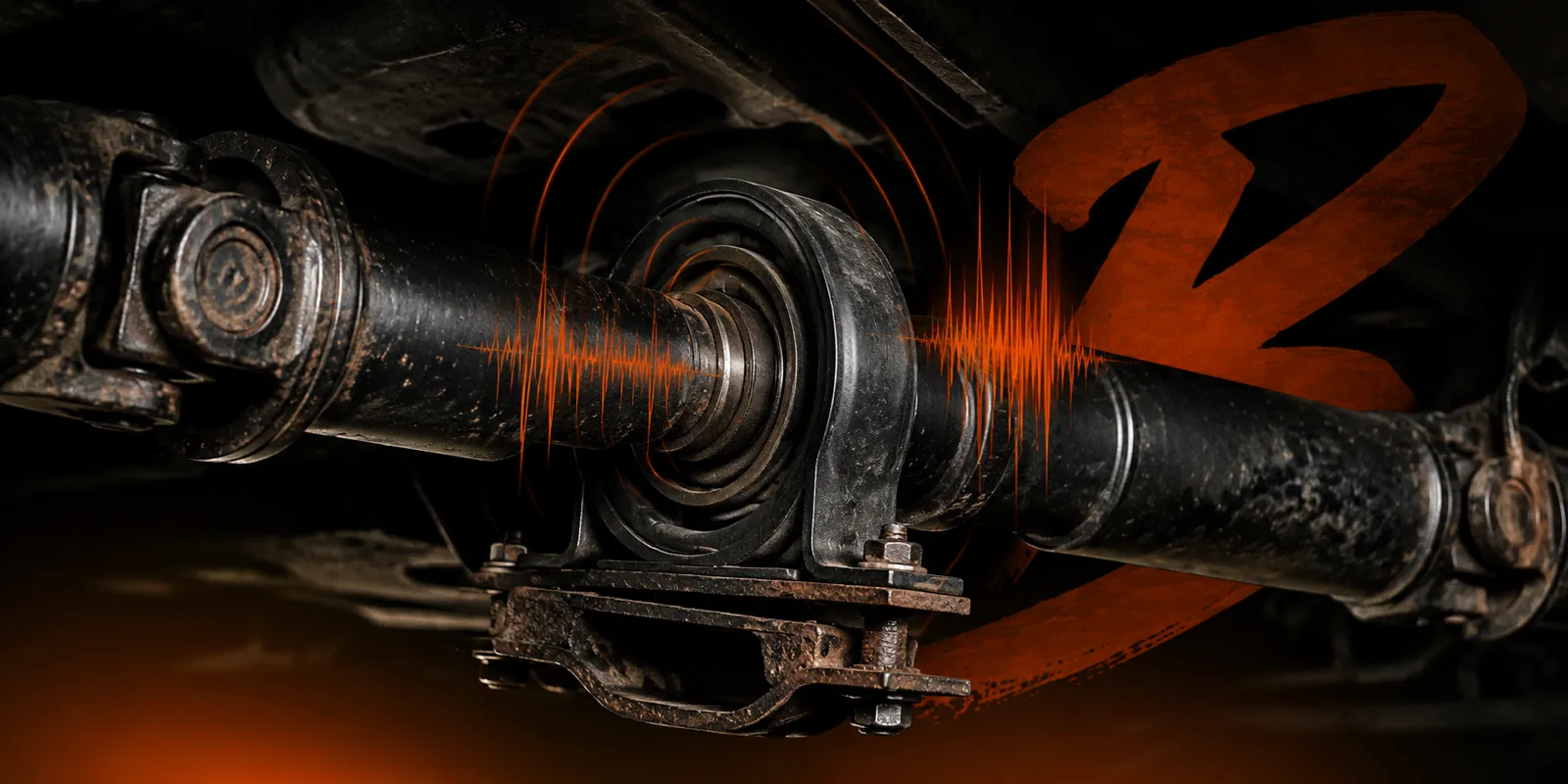
This is the signature sound of the bearing itself dying. The sealed ball bearing loses its grease, the balls and races start wearing metal on metal, and you get a growl or drone from under the cab floor, roughly under your right elbow or the front of the bed on most pickups.
Owners describe it in wonderfully specific ways on the forums. "Helicopter sound" comes up constantly, that rhythmic whirring beat at speed. So does "like driving over rumble strips that aren't there." One Diesel Stop member chased a "weird chirping noise" for weeks before finding his carrier bearing. Others land on "marbles in a can" once the bearing gets really loose. However your brain files it, the pattern is what matters: it rises with vehicle speed, it doesn't care about engine RPM, and it's coming from the middle of the truck, not a corner.
That location detail is worth trusting. A wheel bearing growls from a corner. A carrier bearing growls from under the floor, midway down the truck, because that's exactly where it lives, bolted to the frame crossmember at the joint of the two-piece driveshaft.
The squeal or chirp
Less common, more confusing. A dry carrier bearing can chirp or squeal at low speeds, especially on takeoff or during parking-lot maneuvers, and the sound sometimes fades as things warm up and the leftover grease softens. There's even a manufacturer service bulletin on certain medium-duty trucks for a high-pitched squeal at low speed traced to the center support bearing.
Chirping gets misdiagnosed as a belt constantly. The speed vs. RPM test sorts it out. A belt chirp follows the engine. A carrier bearing chirp follows the driveshaft.
The clunk on throttle tip-in
The rubber cushion around the bearing is a vibration isolator, and it's usually the first thing to die. It tears, sags, or rots from oil and road salt. Once it's collapsed, the driveshaft has free play at the center support, so every time driveline torque reverses direction you hear it take up the slack.
In practice that's a single metallic clunk when you shift from Reverse to Drive, when you tip into the throttle after coasting, or when you lift off hard. In bad cases the driveshaft is physically knocking against the bearing's steel bracket because the rubber that used to center it is gone.
A u-joint makes almost the same clunk. So does a worn transmission mount. The differential-diagnosis section below splits them apart.
The takeoff shudder
Not exactly a noise, but it shows up in the same complaint. When the cushion sags, the driveshaft droops at the center joint and its operating angles go wrong. Accelerate from a stop and you get a shudder or vibration through the floor from about 5 to 25 mph, smoothing out as speed builds. Truck people call it "carrier bearing shudder" and on some trucks it's the very first symptom, months before any growl. The full symptom progression is covered in our bad carrier bearing symptoms checklist.
Could It Be Something Else? The Differential Diagnosis
Five other parts make sounds that get blamed on (or blamed instead of) the carrier bearing. Here's how to tell each one apart.
U-joint
The u-joints live at each end of the driveshaft sections, and they fail in the same neighborhood, at the same mileage, for the same reasons. A dry u-joint clicks or squeaks at low speed, once per driveshaft revolution, so the clicking speeds up and slows down exactly with the truck. A worn one clunks on throttle reversal, just like a collapsed carrier cushion, and can set up a vibration at a specific speed band that stays no matter what gear you're in.
How to split them: get under the truck (engine off, wheels chocked) and grab the driveshaft near each joint. Twist and push. A u-joint with any detectable play or rust dust bleeding from the caps is bad. Then look at the carrier bearing itself: cracked, sagging, or oil-soaked rubber is your answer. Honestly, if either one is bad and the shaft is coming out anyway, replace both. You're already paying the labor once. The replacement cost breakdown covers why that combo makes sense.
Wheel bearing
A wheel bearing makes a hum or growl that rises with speed too, which is why the two get confused. The differentiator is steering load. On the highway, make a gentle lane-change swerve. Load the left side, then the right. A wheel bearing gets louder or quieter as weight shifts onto or off of it. A carrier bearing doesn't care where the weight is; it's turning at driveshaft speed in the middle of the frame, and steering input does nothing to it.
Location helps too. Wheel bearing noise comes from a corner. Carrier bearing noise comes from under the floor.
Differential
A differential with worn ring-and-pinion gears whines, and the whine is load-sensitive: it appears on acceleration, or on deceleration, and often disappears at steady cruise. Worn diff carrier bearings (there's that other "carrier bearing" again) rumble more than whine. Either way the sound comes from the axle, at the very back of the truck, not from under the cab. Pitch is another clue: gear whine is a higher, singing tone. A center support bearing growls low.
Tires
Cupped or chopped tread makes a rhythmic roar that rises with speed and fools everyone, including shops. Two tests. First, the pavement test: tire noise changes character on different road surfaces; bearing noise doesn't care. Second, just look. Run your hand across the tread of each tire. If it feels like scalloped saw teeth, rotate or replace them before spending a dime on driveline parts. I've seen a $540 diagnostic goose-chase for a "driveline growl" end with a set of cupped rear tires that a hand on the tread would have caught in ten seconds.
Transmission mount
A dead transmission mount clunks when the drivetrain rocks: shifting into gear, hard 1-2 shifts, aggressive throttle lift. It won't ever growl at speed, so it only overlaps with the carrier bearing on the clunk symptom. The quick check is watching the drivetrain move; have a helper shift between Reverse and Drive with the brakes held while you watch how far the tailhousing jumps. If clunks on gear changes are your main complaint, read transmission mount symptoms before condemning the carrier bearing.
Find the Carrier Bearing That Fits Your Truck
Pick your year, make, and model to see exact-fit center support bearings, from $3 rubber cushions to complete assemblies
Is It Safe to Drive With a Noisy Carrier Bearing?
Honest answer: it depends on which stage you're in.
Early rubber stage: yes, briefly. If your only symptoms are the takeoff shudder and a clunk on gear changes, the bearing itself is probably still fine and the rubber cushion is what's failed. The truck is drivable for now. You're accelerating wear on the u-joints and the bearing by running the shaft at bad angles, so it's a fix-this-month problem, not a park-it-tonight problem.
Growling stage: genuinely risky. Once the bearing itself is growling, the grease is gone and the bearing is eating itself. A dry bearing gets hot, and heat is what finishes them. From here the failure modes get ugly: the bearing can seize and then spin inside its rubber (or spin the inner race on the shaft, ruining the driveshaft), or it can break up entirely.
Worst case: the driveshaft drops. If the center support lets go completely at speed, the middle of a two-piece driveshaft has nothing holding it up. A shaft flailing or dropping at highway speed can pole-vault the truck, tear out lines, or become a road hazard behind you. Rare? Yes. Worth gambling on to save a $110 part? No.
If the noise is loud enough that passengers comment on it, stop driving it on the highway. Around town at low speed to the shop, fine. A 70-mph road trip, no.
How Long Do I Have?
Nobody can promise a number, but the progression is predictable enough to plan around:
| What you're hearing now | Typical runway | What to do |
|---|---|---|
| Takeoff shudder, occasional clunk, no growl | Weeks to months | Order the part, schedule the job |
| Faint growl at highway speed | Days to weeks | Fix it now, limit highway miles |
| Loud growl, chirping, vibration everyone feels | Don't count on tomorrow | Park it, tow or limp it in |
The part is cheap relative to the risk. A complete center support assembly averages around $110 in our catalog, rubber cushions alone start at $3, and shop labor typically adds $200 to $400 because the driveshaft has to come out. All-in shop quotes usually land between $250 and $600 at an independent. Full numbers, DIY math included, are in the carrier bearing replacement cost article, and if you want to do it yourself in an afternoon, the step-by-step replacement guide walks the whole job.
The Quiet Fix: Fresh Rubber From a Company That Specializes in It
Here's the part of this that surprises people: the component that usually starts all this noise is a piece of molded rubber, and it can cost less than lunch.
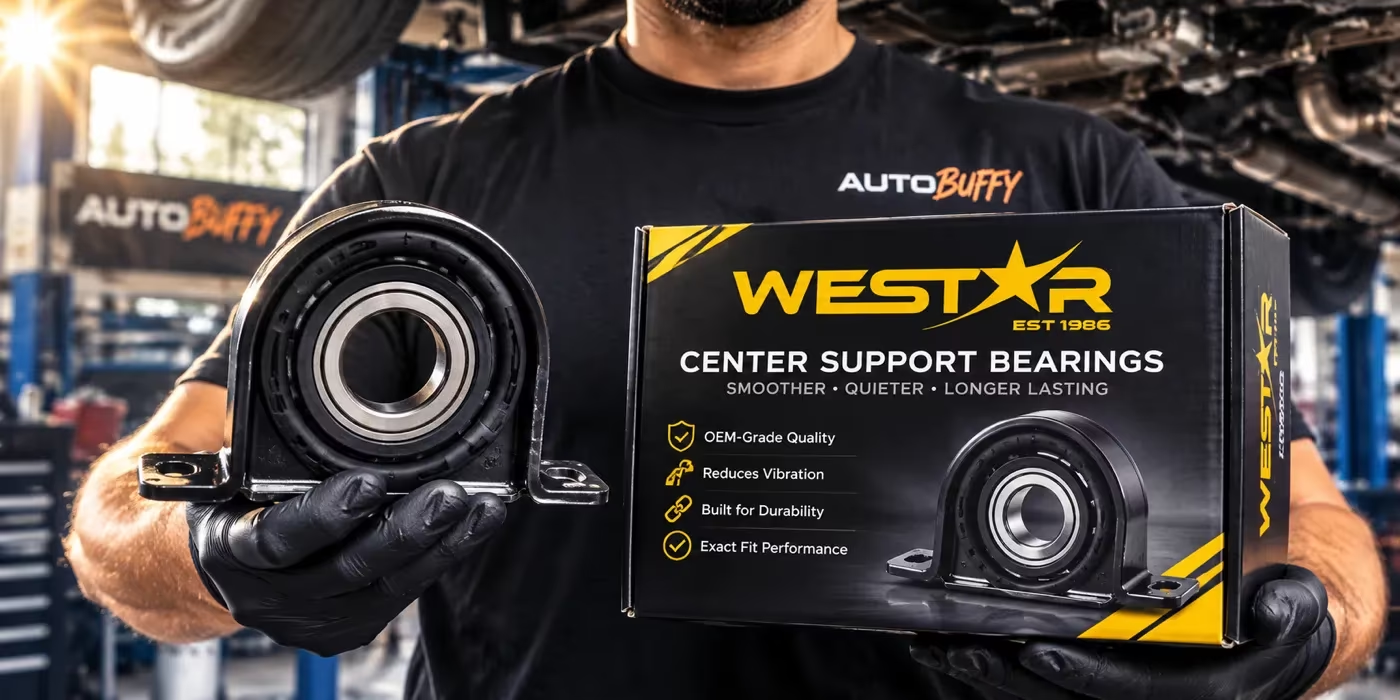
Westar has been manufacturing driveline and mount components since 1986 out of Columbia, Maryland, and rubber-to-metal bonded parts are specifically what they do; they're one of the biggest engine and transmission mount manufacturers in the aftermarket, and a center support is the same engineering problem in a different spot. Their carrier bearing line runs 144 SKUs from $2.95 to $131, averaging about $33.
Two things make them worth a look when your truck is the one rumbling:
They sell the cushion by itself. Westar's DS-6027 rubber cushion is $4.95 and fits decades of Chevy, GMC, and Ford trucks. If your bearing spins smooth and quiet but the rubber is torn and sagging, that five-dollar piece is the whole repair. Complete center supports aren't much more: the DS-6056 for Chevy/GMC/Ford trucks is $11.95, with bearing, cushion, and bracket assembled and ready to press on.
They still cover the trucks everyone else dropped. A 1967 C10, a 1960 F-100, a 1989–1995 Toyota Pickup (DS-8471, $10.95), a 1980 Nissan 720 (DS-8472, $12.95), old BMW and Mercedes two-piece-shaft cars back to the 1960s. Big bearing brands quietly discontinued a lot of that coverage years ago. Westar kept cataloging it.
We stock premium bearing brands too, SKF, Timken, and BCA are excellent and run $52 to $394, and for a daily-driven modern truck there's a fair argument for them. But since the rubber isolator is what usually fails first, a fresh cushion from the company that specializes in rubber isolation is very often the fix that makes the noise gone.
Silence That Growl
Enter your vehicle to find the exact center support bearing or cushion that fits, in stock from $3
The Bottom Line
Trust the pattern, not the panic. A growl from under the floor that tracks road speed and shrugs off the RPM test is a carrier bearing until proven otherwise. Check the u-joints while you're under there, put a hand on the tire tread before you buy anything, and don't let a growling bearing rack up highway miles. The part's cheap. The tow after a driveshaft lets go isn't.
FAQ / People Also Ask
Most commonly a low growl, rumble, or drone from under the middle of the floor that gets louder as vehicle speed rises. Owners also describe a helicopter-like whirring, a chirp or squeal at low speed, a clunk when tipping into the throttle, and a shudder when accelerating from a stop.
Comments
Loading comments...
Comments are moderated by the AutoBuffy team.