

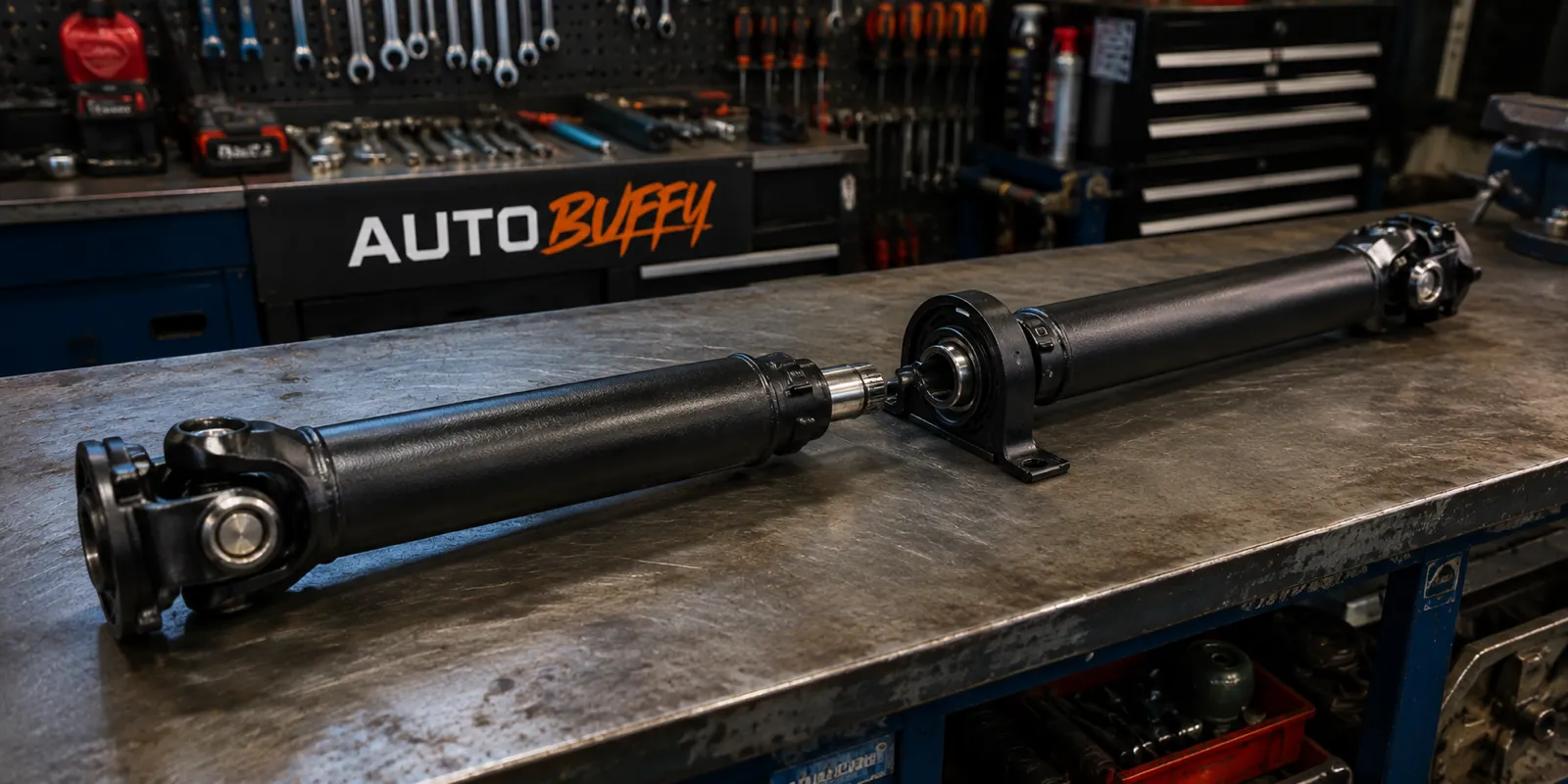
Carrier Bearing (Center Support Bearing): Complete Guide
A carrier bearing and a center support bearing are the same part: the rubber-cushioned bearing holding up the middle of a two-piece driveshaft. Most last 100,000+ miles, and replacement runs $250-$600 at a shop or as little as $5 in parts if you DIY.
The Short Answer
A carrier bearing (also called a center support bearing) is the rubber-cushioned bearing that holds up the middle of a two-piece driveshaft, and when it fails you'll feel vibration that grows with speed, hear a growl under the cab floor, or get a clunk on takeoff. Same part, two names. Truck owners say carrier bearing. Parts catalogs and engineers say center support bearing. Either way, it's a wear item, and on most trucks it's one of the cheaper driveline repairs you'll ever do.
| Quick Facts | |
|---|---|
| Other names | Center support bearing, drive shaft center support, hanger bearing |
| What it does | Supports the midpoint of a two-piece driveshaft |
| Found on | Trucks, vans, long-wheelbase SUVs, many RWD BMW/Mercedes models |
| Typical lifespan | 100,000+ miles (less with lift kits or off-road use) |
| Part price | $3-$63 for the rubber cushion alone; roughly $7-$368 for a complete assembly |
| Shop replacement cost | Roughly $250-$600 at an independent shop, $600-$900 at a dealer |
| DIY difficulty | Moderate. See our step-by-step replacement guide |
That's the one-paragraph version. The rest of this guide covers how the part actually works, why the same two words can mean a completely different component inside your differential, what fails first, and what your repair options cost.
Why Does the Same Part Have Two Names?
Blame the split between the garage and the catalog. The official name in ACES/PIES parts data (the standard the entire aftermarket runs on) is Drive Shaft Center Support Bearing. That's what engineers drew on the blueprint: a bearing that supports the center of the drive shaft.
But out in the real world, mechanics and truck forums have called it a carrier bearing for sixty years, because it carries the driveshaft. Search volume tells the story: about five people search "carrier bearing" for every one who types "center support bearing." So if you've been going back and forth between forum threads that say one thing and parts sites that say the other, relax. You've been reading about the same part the whole time.
One warning before you order anything. "Carrier bearing" has a second, older meaning in the differential world, and mixing the two up leads people to buy $30 parts for $400 problems (or panic in the other direction). We'll untangle that in a minute.
How Does a Two-Piece Driveshaft Work?
A driveshaft is just a spinning steel (or aluminum) tube that carries power from the transmission back to the rear axle. On a short-wheelbase car, one tube does the job fine.
Stretch that distance out, though, and physics starts fighting you. A long single tube spinning at 3,000+ RPM wants to whip in the middle like a jump rope. Engineers call the speed where that happens the critical speed, and it drops as the shaft gets longer. On a long-bed pickup, a full-size van, or a Suburban, a single shaft long enough to reach the axle would hit its critical speed within normal highway driving. Not acceptable.
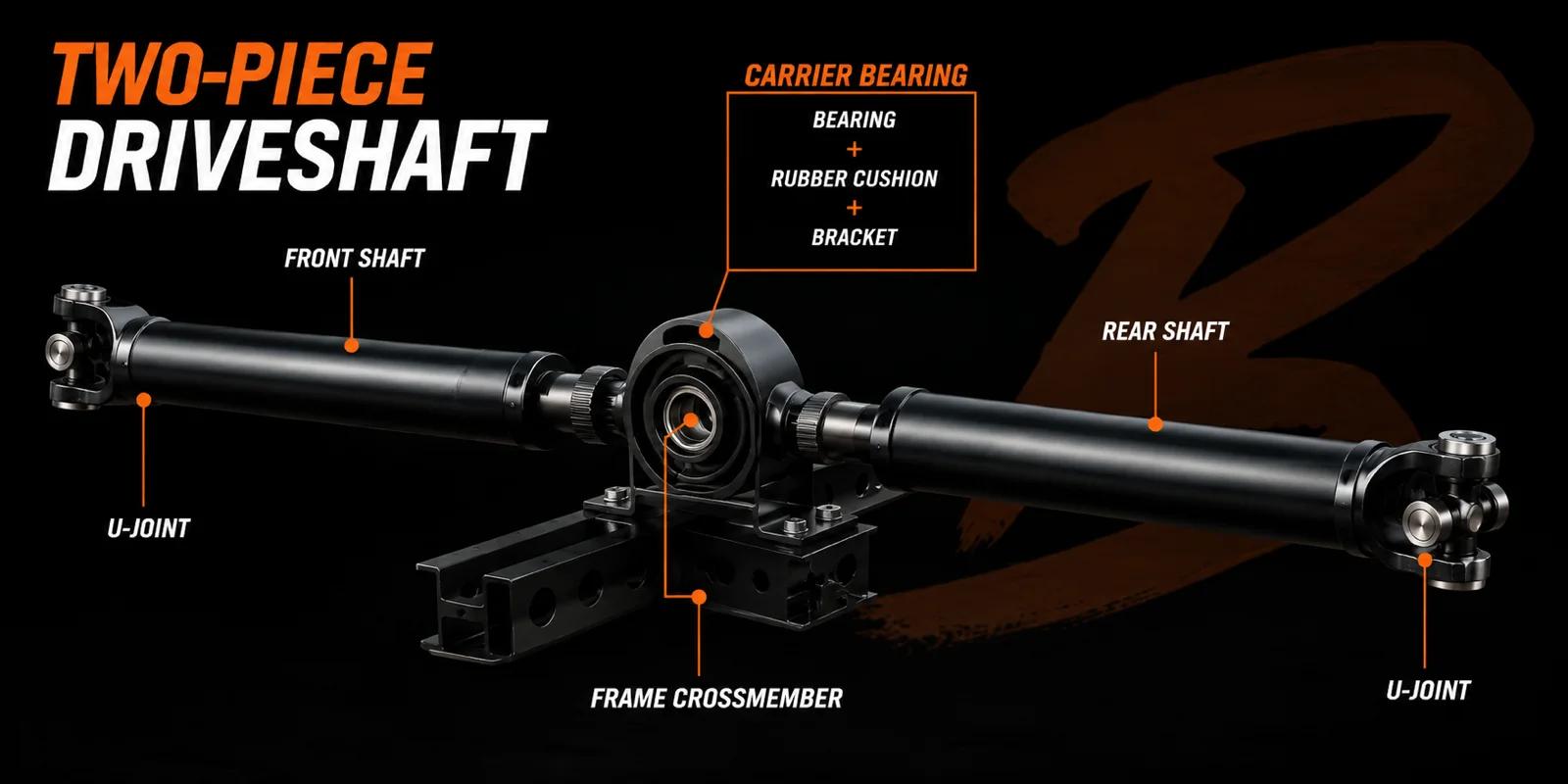
The fix is old and elegant: cut the shaft in two. The front section bolts to the transmission output, the rear section runs to the differential, and a U-joint or CV joint connects them so the rear axle can move up and down on its springs. But now the joint in the middle needs something to hold it up. That something is the center support bearing, hung from a frame crossmember, letting the shaft spin freely while keeping its midpoint exactly where the driveline geometry needs it.
That's the whole job. Hold the middle of the shaft at the right height, let it spin at engine speed, and soak up vibration so the cab stays quiet.
Is a Carrier Bearing the Same as a Differential Carrier Bearing?
No, and this trips up almost everyone at some point. Two totally different parts share the name:
| Driveshaft carrier bearing | Differential carrier bearings | |
|---|---|---|
| Where it lives | Under the truck, mid-driveshaft, bolted to a crossmember | Inside the differential housing, on each side of the carrier |
| What it does | Supports the center of a two-piece driveshaft | Lets the ring-gear carrier spin inside the diff |
| How many | Usually one (two on some three-piece shafts) | Always a pair |
| Typical symptom | Vibration with speed, clunk on takeoff, growl under the cab floor | Whine or howl from the rear axle that changes with load |
| Part cost | $3-$368 | $30-$150 per bearing, but the labor is the story |
| Repair difficulty | Moderate DIY, no gear setup required | Requires a press, gear pattern and preload setup; a specialty job |
The quick test when someone (a forum, a mechanic, a parts listing) says "carrier bearing": does the vehicle have a two-piece driveshaft? Is the noise coming from under the cab or bed floor rather than the rear axle? Then it's the driveshaft center support bearing, the part this guide covers. If the noise is a rear-end whine and the conversation involves ring and pinion gears, they mean the bearings inside the differential. Everything below is about the driveshaft part.
Which Vehicles Have a Carrier Bearing?
Any vehicle with a two-piece driveshaft has one. That mostly means length: long wheelbase plus rear-wheel or four-wheel drive. From our own fitment database, the heart of the market looks like this:
- Full-size American pickups and SUVs. Chevy and GMC C10/C20/C30 pickups and Suburbans from 1961-1986, the C/K 1500-3500 trucks from 1988-2002, and the K5 Blazer. On the Ford side, F-100 from 1960-1983 and F-250/F-350 all the way from 1960 to 2004. Long beds and crew cabs especially.
- Compact pickups with long beds. Toyota Pickup 1989-1995 and the Nissan 720 from 1980-1985 both used two-piece shafts.
- Full-size vans. Extended-length work vans almost always run a center support.
- Medium-duty trucks. International medium-duty trucks from 1990-2002, plus plenty of box trucks and buses.
- RWD European cars. This one surprises people. BMW and Mercedes-Benz have used two-piece driveshafts on their rear-drive sedans and coupes going back to the 1960s, so a quiet 3-series or E-class can absolutely have a failing center support bearing.
Short-wheelbase cars, front-wheel-drive cars, and most modern half-ton crew cabs with single-piece aluminum shafts don't have one. If you're not sure, slide under the vehicle: a two-piece shaft has an obvious rubber-and-steel hanger bolted to a crossmember about halfway along the driveline.
Find the Carrier Bearing That Fits Your Truck
Pick your year, make, and model and we'll show the exact center support bearing for your driveline
What's Inside a Carrier Bearing, and Which Piece Actually Fails?
Three parts, sandwiched together:
- The bearing. A sealed ball bearing pressed onto the driveshaft. It's greased for life and does the actual spinning.
- The rubber cushion. A molded rubber isolator that surrounds the bearing. This is the vibration damper; without it, every driveline pulse would transmit straight into the frame and up through the cab floor.
- The bracket. A stamped-steel hanger that holds the cushion and bolts to the frame crossmember.
Here's the part most guides skip: the rubber is usually what fails, not the bearing. Rubber ages. It tears, it sags under the constant weight of the shaft, and it rots fast if a leaking transmission or transfer case seal keeps it soaked in oil. Once the cushion sags, the driveshaft drops out of alignment, the U-joint angles go wrong, and you get vibration and clunk even though the bearing itself still spins fine. The bearing does fail too (it dries out and growls, and in bad cases seizes), and brackets rust through on salt-belt trucks, but if you put failed units on a bench, torn and collapsed rubber wins by a mile.
That matters for your wallet, because on many trucks the cushion is sold separately for a few dollars, while a shop will quote you for a complete assembly or even a whole driveshaft. More on that below.
How Long Does a Carrier Bearing Last?
There's no service interval. A center support bearing is a replace-when-worn part, and on a stock truck driven on pavement it routinely lasts 100,000 miles or more. Plenty go the life of the vehicle.
Three things shorten that dramatically:
- Lift kits. Lifting a truck changes the driveline angles the center support was designed around. The rubber cushion runs deflected all the time, and the extra U-joint angle hammers it. Lifted-truck forums are full of guys on their second or third carrier bearing in a couple of years, and shimming or dropping the carrier to correct the angle is a standard part of doing a lift right.
- Off-road use. Mud, sand, and water find their way past the bearing seal, and constant suspension articulation works the rubber.
- Oil contamination. A slow leak from the transmission tailshaft or transfer case drips right onto the cushion. Petroleum destroys rubber. If you replace a carrier bearing that came out oil-soaked and don't fix the leak, you'll be doing the job again.
Age matters as much as miles on older trucks. The rubber in a 1970s C10's original center support is fifty-year-old rubber. It's done, whether the odometer agrees or not.
What Are the Symptoms of a Bad Carrier Bearing?
The short list, roughly in order of how often we hear it:
- Driveline vibration that builds with road speed (not engine RPM)
- A clunk on takeoff, in reverse, or on gear changes
- Growling or rumbling from under the cab floor, right about under the seats
- Shudder under acceleration, the classic "carrier bearing shudder"
- In advanced cases, visible driveshaft sag or rubber hanging in shreds
A quick visual check settles most of it: get under the truck and look at the cushion. Torn, cracked, sagging, or oil-soaked rubber is your answer. Grab the shaft near the bearing and push up and down; more than slight movement means the cushion is gone.
We keep the full diagnostic walkthrough in two dedicated articles: the complete bad carrier bearing symptoms checklist, and a deeper dive on what a bad carrier bearing sounds like and how to tell it from U-joints, wheel bearings, and axle noise. Worth reading both before you buy anything, because a worn transmission mount can fake several of these symptoms, and it's a cheaper fix.
What Are Your Repair Options?
Three levels, wildly different in price:
1. Rubber cushion only ($3-$63). On many trucks, especially older GM, Ford, Toyota, and Nissan models, the cushion is available as its own part. If the bearing spins smooth and quiet and only the rubber is shot, this is the honest fix. The catch is labor: the driveshaft still has to come out and the shaft may need to be pressed apart, so the labor is nearly the same as a full assembly. At $4.95 for a cushion, though, the parts math is hard to argue with.
2. Complete center support assembly ($7-$368, most around $110). Bearing, cushion, and bracket as one pre-assembled unit. This is what most people should buy: you're already in there, and a new sealed bearing resets the clock on everything. Value-priced assemblies from Westar, SKP, and DEA run roughly $7-$60; premium bearing brands like SKF, Timken, and BCA run $52-$394 depending on application.
3. Complete driveshaft assembly ($400-$1,500+). Some shops and some manufacturers only service the driveshaft as a unit. Sometimes that's legitimate (the shaft is bent, the slip splines are worn, U-joints are staked-in and hammered). Often it's just the fastest thing for the shop to bolt in. If a quote comes back at four figures, ask specifically whether the center support is available separately for your truck. It usually is.
Picture how this usually goes wrong: a takeoff clunk on an early-2000s F-250, a $500 shop quote for the full assembly job, and an actual failure that turns out to be the rubber cushion, a $4.95 part plus about an hour of labor. Nobody's lying to anyone. The shop just quotes the assembly-plus-book-time path because that's the default. Knowing the part has three levels of repair is how you avoid paying level-three money for a level-one failure.
How Much Does Carrier Bearing Replacement Cost?
Quick overview. Shop labor in 2026 runs about $110-$135/hr at independents and $140-$180/hr at dealers, and the job books at one to two hours on most trucks.
| Repair path | Parts | Labor | Typical total |
|---|---|---|---|
| DIY, cushion only | $3-$63 | $0 | $3-$63 |
| DIY, complete assembly | $7-$368 | $0 | $10-$370 |
| Independent shop | $40-$250 | $150-$350 | $250-$600 |
| Dealer | $150-$400 | $250-$500 | $600-$900 |
| Full driveshaft replacement | $400-$1,500+ | $150-$300 | $600-$1,800+ |
Vehicle, region, and whether the U-joints get done at the same time all move these numbers. The full breakdown, including per-vehicle examples and when the U-joint upsell is actually worth taking, is in our dedicated carrier bearing replacement cost guide.
Can You Replace a Carrier Bearing Yourself?
Yes, and it's a satisfying Saturday job on most trucks. Honest difficulty: moderate. You'll drop the driveshaft (mark everything for reindexing first), unbolt the old support, and on many vehicles press or pull the old bearing off the shaft and press the new one on. That press step is the one wildcard; some designs slip on and off with hand tools, others want a puller or a trip to a driveline shop for a $30 press job. Budget two to three hours your first time.
The full walkthrough with tools, torque notes, and the mistakes that cause comeback vibrations (skipping the alignment marks is the big one) is in our guide on how to replace a carrier bearing.
Who Still Makes Carrier Bearings for Older Trucks?
Here's a problem the cost tables don't show: if your truck is a 1972 C10 or a 1965 F-100, the dealer stopped stocking your center support before you were born, and several big aftermarket lines have quietly pruned those old applications from their catalogs.
This is where Westar has become our go-to answer. Westar has been manufacturing driveline and mount components since 1986 out of Columbia, Maryland, and their core specialty is rubber-to-metal bonded parts; they're one of the biggest engine and transmission mount manufacturers in the aftermarket. A center support is exactly that kind of part: a steel bracket with a precision rubber isolator bonded into it. It's not a sideline for them. It's the thing they do.
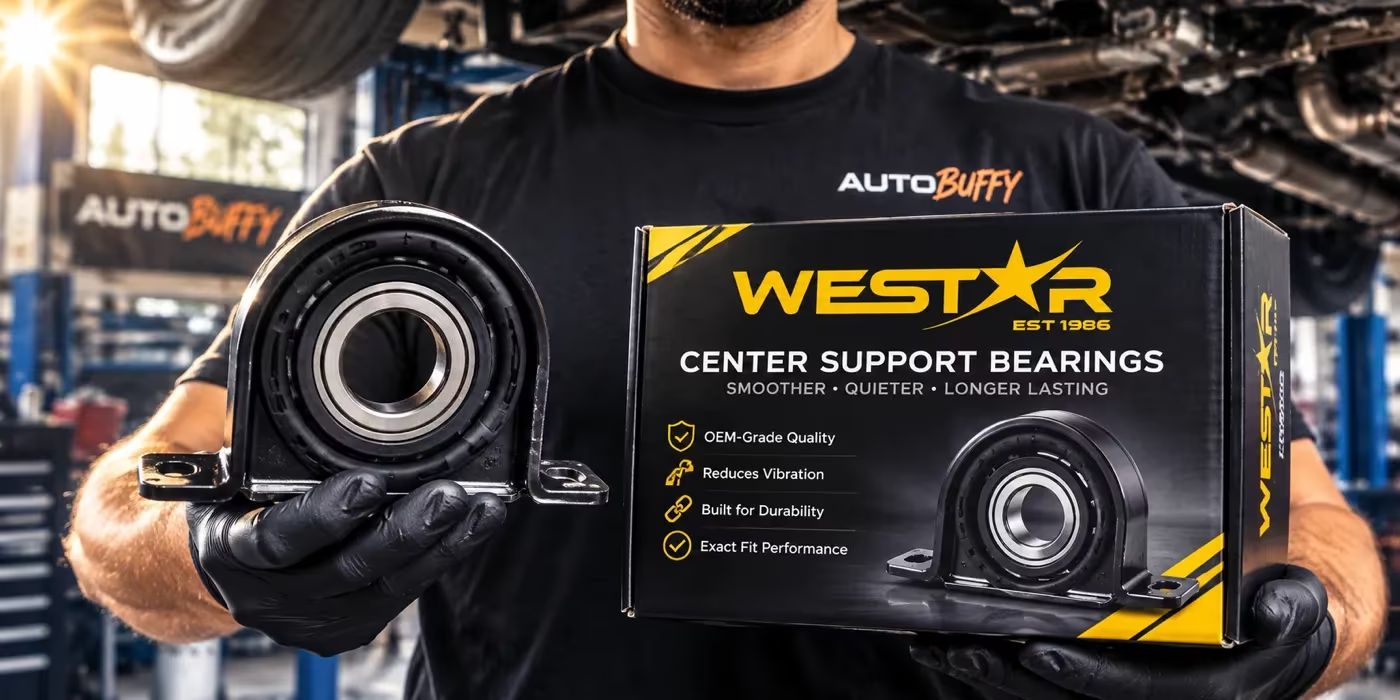
The coverage is what stands out. Westar still catalogs center supports and cushions for trucks the rest of the industry gave up on decades ago:
| Westar part | Fits | Price |
|---|---|---|
| DS-6027 rubber cushion | Chevy/GMC and Ford trucks | $4.95 |
| DS-6056 center support | Chevy/GMC and Ford trucks | $11.95 |
| DS-8471 center support | Toyota Pickup 1989-1995 | $10.95 |
| DS-8472 center support | Nissan 720 pickup | $12.95 |
| DS-8626 center support | BMW two-piece-shaft models | $11.95 |
| DS-6520 center support | Mercedes-Benz | $12.95 |
We stock 144 Westar SKUs in this family, priced from $2.95 to $131 with an average around $33, and AutoBuffy is a direct authorized source. To be clear, this isn't a claim that Westar makes the best ball bearing on earth; SKF, Timken, and BCA build superb bearings and we sell 359 SKUs from those three brands for exactly that reason. Westar's edge is different: real manufacturer, deep specialty in the rubber piece that's usually what actually fails, and catalog coverage that reaches a 1961 Suburban, a 1960 F-100, and a 1980 Nissan 720 at prices that make fixing an old truck feel reasonable.
Across all brands, our catalog holds about 920 priced parts in this family: 551 complete center support bearing assemblies, 325 center supports, 26 bearing plates, and 16 stand-alone rubber cushions, from Westar, DEA, SKF, Timken, BCA, SKP, Beck/Arnley, VAICO, GM Genuine Parts, Dorman, URO, Mopar, and ACDelco. Whatever's hanging under your driveshaft, there's a very good chance we have it.
The Bottom Line
A carrier bearing and a center support bearing are the same part, it exists because long driveshafts have to be split in two, and the rubber cushion (not the bearing) is usually what dies. Stock trucks get 100K+ miles out of one; lifted and hard-used trucks get less. Catch it early and it's one of the cheapest driveline fixes there is: a few dollars in parts if you wrench, $250-$600 at a decent independent shop if you don't. Ignore it long enough and you're shopping for driveshafts and U-joints instead.
If your truck is already vibrating or clunking, start with the symptoms checklist, confirm with the noise guide, price the job with the cost breakdown, and if you're doing it yourself, the replacement walkthrough has the full procedure.
FAQ / People Also Ask
Yes. They're two names for the same part: the rubber-cushioned bearing that supports the middle of a two-piece driveshaft. Truck owners and mechanics say carrier bearing; parts catalogs and engineers say center support bearing or drive shaft center support.
Comments
Loading comments...
Comments are moderated by the AutoBuffy team.