

What Is a Motor Mount? Engine Mounts Explained (Types + How Many)
A motor mount bolts your engine to the frame, absorbs its vibration, and controls how it moves. Here's what engine mounts do, how many your car has, the types, and the signs one is failing.
The Short Answer
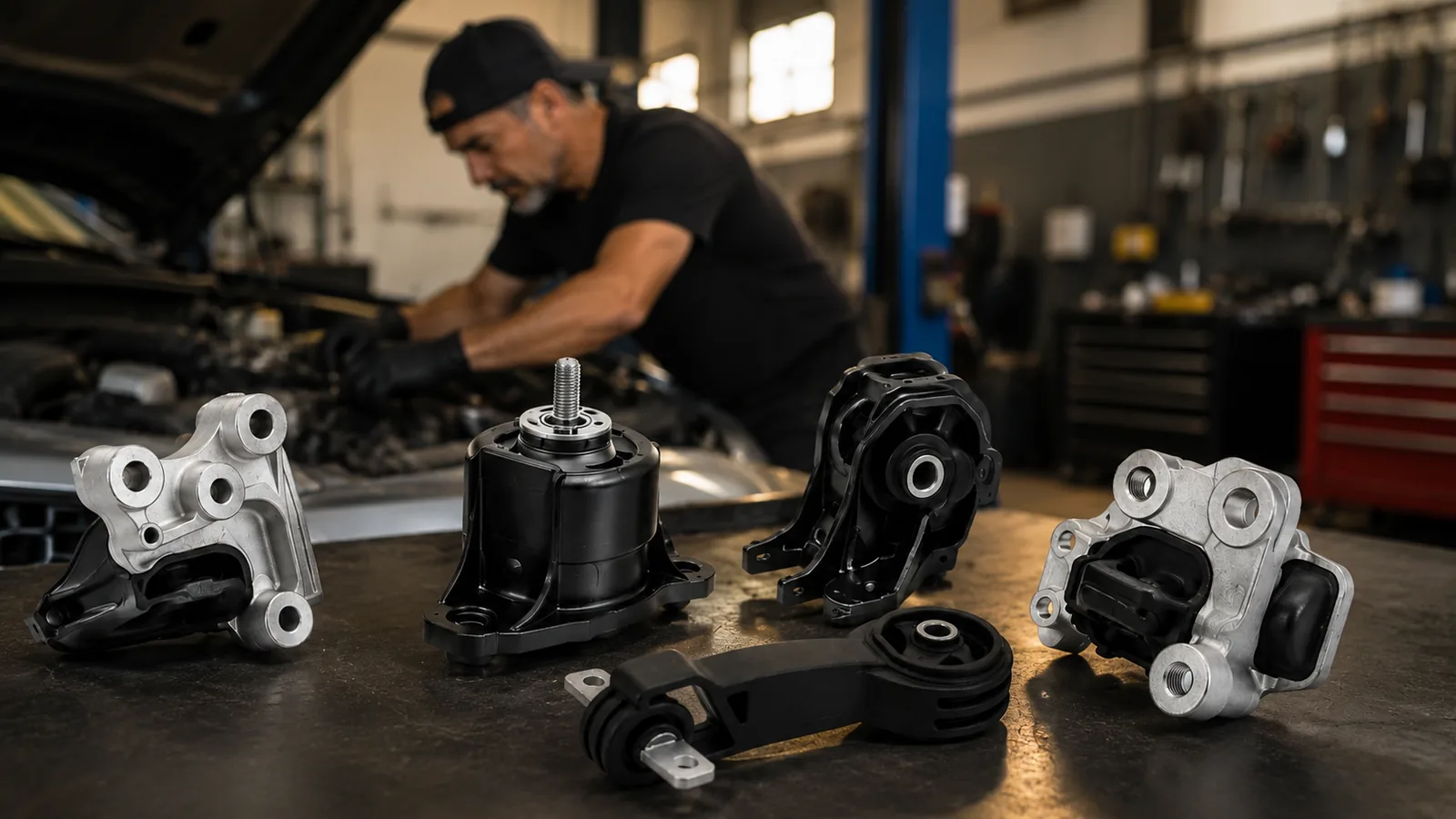
A motor mount (also called an engine mount) is a bracket that bolts your engine to the car's frame. Most are engineered rubber bonded between two steel plates. One part, three jobs. It holds the engine's weight. It absorbs the vibration of thousands of combustion events a minute, so that shake never reaches your seat. And it controls how far the engine moves when you accelerate or brake. Most cars run 3 to 4 mounts. When one wears out, you feel it: shaking, clunking, or a jolt when you shift.
Find the Right Motor Mount for Your Vehicle
Enter your year, make, and model — we'll show only the mounts that fit
What Does a Motor Mount Do?
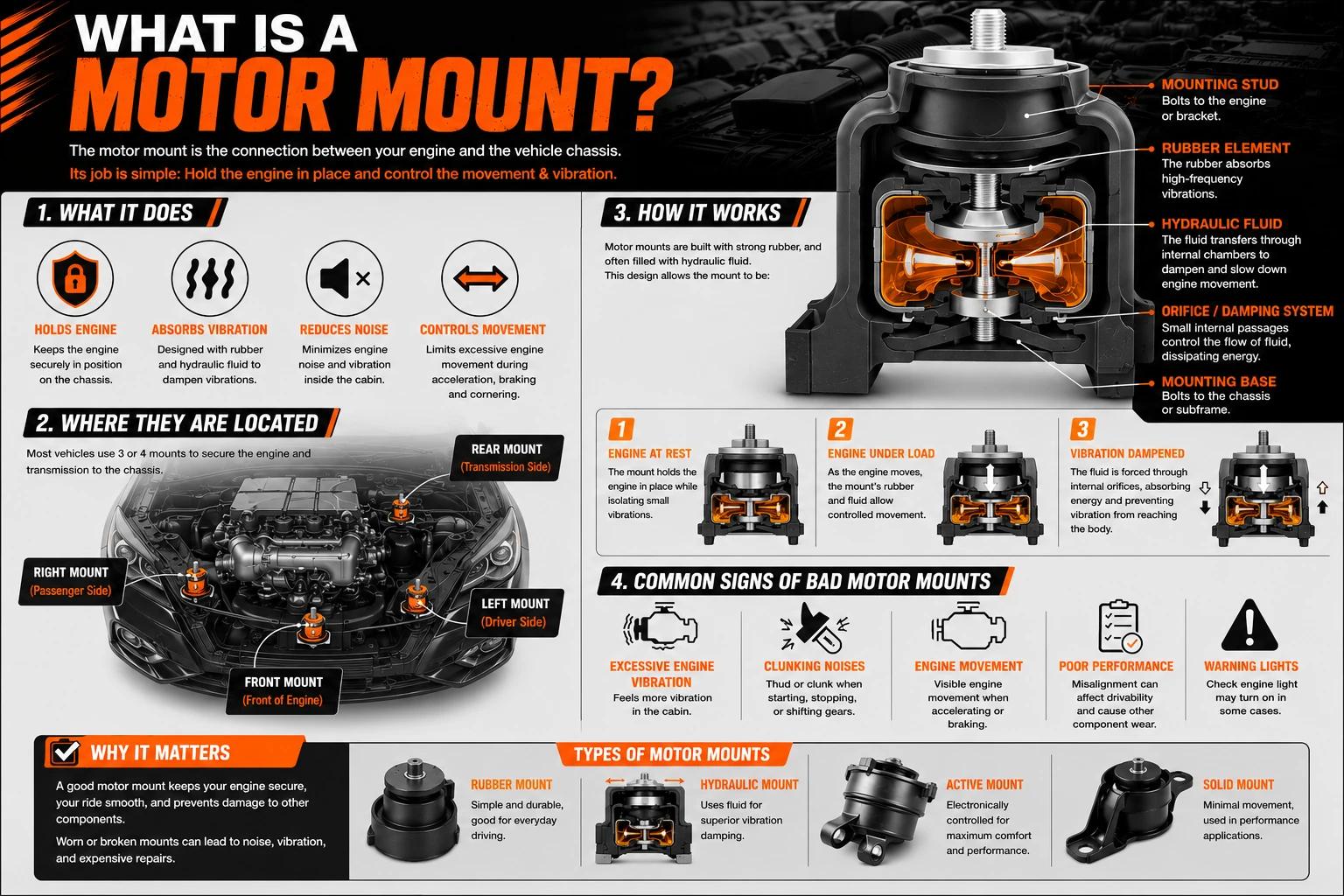
Your engine is a heavy chunk of metal, and it shakes constantly as it runs. Bolt it rigidly to the chassis and that shake rattles every panel and buzzes up through the steering wheel. Motor mounts sit between the engine and everything you touch. Three things:
- Hold the weight and position. The mounts carry the engine and keep it aligned with the transmission, axles, and driveshafts. If the engine sags or shifts, everything bolted to it is thrown off.
- Absorb vibration. The rubber (or fluid, on hydraulic mounts) flexes to soak up combustion shake before it reaches the cabin. That's why a car with fresh mounts feels smooth and one with dead mounts feels like it's idling on gravel.
- Control movement under load. When you launch hard or brake, the engine wants to rock and twist. Good mounts let it move a controlled amount, then snap it back. A failed mount lets it slam around. That slam is the clunk you feel.
Engine Mount vs. Motor Mount — Are They the Same Thing?
Yes. "Engine mount" and "motor mount" are two names for the exact same part. "Engine mount" is the more technical term, the one you'll see in service manuals and outside North America. "Motor mount" is what the shop and most drivers here actually say. There's no mechanical difference. If a parts listing calls it one thing and your mechanic calls it the other, they mean the identical component.
The one related-but-separate part is the transmission mount, which holds the gearbox instead of the engine. It works alongside the engine mounts and fails the same way, but it's its own piece. If the clunk comes through the shifter rather than the engine bay, Bad Motor Mount Symptoms helps you tell them apart.
How Many Motor Mounts Does a Car Have?
It depends on how the engine sits in the car. As a rule, count on three to four on a modern front-wheel-drive vehicle.
| Layout | Typical Mount Count | What's There |
|---|---|---|
| FWD (transverse / sideways engine) | 3–4 | 2 main load-bearing mounts + 1–2 torque (dogbone) mounts |
| RWD (longitudinal / front-to-back engine) | 3 | 2 engine mounts (driver + passenger side) + 1 transmission mount |
| AWD / 4WD | 3–4 | RWD base plus extra bracing depending on layout |
| Transverse V6 (many Hondas) | 4 | Often includes a hydraulic mount to kill idle vibration |
On a sideways-mounted FWD engine, two big mounts hold the weight while one or two smaller torque mounts (also called a dogbone or torque strut) stop the engine from rocking under throttle. A rear-drive car mounts the engine front-to-back, so two side mounts plus a transmission mount do the job. If you're diagnosing a problem, assume four and inspect them all. A car that's been running on one bad mount has been overworking the rest.
The Types of Motor Mounts
Not all mounts are built the same, and the type matters when you replace one:
- Solid rubber. The classic. Rubber bonded between two steel plates, simple and cheap, standard on most vehicles.
- Hydraulic (fluid-filled). A rubber chamber filled with fluid for better vibration damping, common on modern comfort cars, especially four-cylinders. It fails when the fluid leaks and leaves an oily residue.
- Polyurethane. A firmer aftermarket performance bushing. It cuts engine movement but adds cabin vibration, so it's an enthusiast choice, not a comfort one.
- Electronic / active. A hydraulic mount that stiffens on command, found on luxury cars and cylinder-deactivation engines.
The rule when replacing: match the type your car came with. A full breakdown with durometer specs is in Engine Mount Types: Rubber vs Hydraulic vs Polyurethane.
How Do You Know a Motor Mount Is Bad?
A worn mount announces itself. The classic signs: vibration at idle (worst when you're stopped in gear), a clunk or thud when you shift into Drive or Reverse, a knock on acceleration and braking, and the engine visibly jumping when you blip the throttle. Here's the quirk that fools people. A bad motor mount never triggers a check-engine light. There's no sensor on it, so the computer can't see the problem. You diagnose it by feel, sound, and a couple of simple tests.
The full symptom list is in Bad Motor Mount Symptoms, and if you've got more than one mount and want to find the specific failed one, see How to Tell Which Motor Mount Is Bad.
How Long Do They Last, and What Do They Cost?
A healthy set of motor mounts typically lasts 5–7 years or roughly 60,000–100,000 miles, though oil leaks and cheap parts can cut that dramatically. When it's time to replace one, the part itself is usually cheap ($15–$200 depending on type). Most of the bill is the labor to reach it. Expect $250–$600 all-in at a shop for one mount, with real savings if you do it yourself.
The deep-dives: How Long Do Motor Mounts Last · Motor Mount Replacement Cost · How to Replace a Motor Mount.
Why the Quality of the Mount Matters
Here's what most parts-store shoppers miss: a motor mount is only as good as its rubber compound and its steel. Get the rubber durometer wrong and the mount either transmits too much vibration (too hard) or fails early (too soft). Get the steel gauge wrong and the bracket flexes or cracks. That's the case for buying from a mount specialist rather than a generic catalog brand.
Westar is a good example. It's a U.S. manufacturer that's built engine and transmission mounts since 1986, in ISO-certified plants, focused on this one category with 3,200+ SKUs. When a company does mounts all day, the rubber hardness and steel gauge get dialed in per application. You end up with a quiet, long-lasting, drop-in fit. Exactly what you want in a part you'd rather never touch again.
Get the Exact Mount for Your Car
Add your vehicle — we'll show the engine and transmission mounts that fit, backed by our fitment guarantee
Bottom Line
A motor mount (same thing as an engine mount) bolts your engine to the frame, soaks up its vibration, and keeps it from slamming around under load. Most cars have three or four. They last 5–7 years, and when one goes you'll feel the shake and clunk long before anything else warns you. Match the right type and a quality rubber compound when you replace one, and you fix the problem once.
Shop: Motor Mounts · Westar Mounts · Transmission Mounts
FAQ / People Also Ask
Yes. Motor mount and engine mount are two names for the exact same part. 'Engine mount' is the technical term used in service manuals and outside North America; 'motor mount' is the common North American term. There's no mechanical difference. The only related-but-different part is the transmission mount, which holds the gearbox.

Comments
Loading comments...
Comments are moderated by the AutoBuffy team.